The Day Four-Legged Robots Join the Border Watch
"Hey robot, first watch's done — fancy a round of WD-40?"
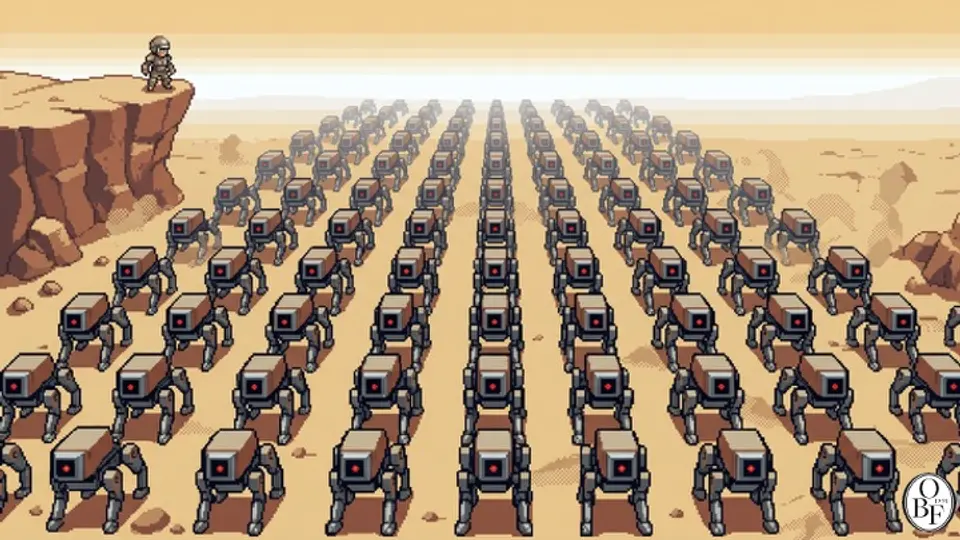
Opening
Dear reader, Bloomberg and Korea Economic Daily both broke the same story today: Hyundai Motor Group is teaming up with the Army to deploy robots to the front lines. Boston Dynamics’ four-legged robot Spot, Hyundai’s mobility platform MobED, and the wearable robot X-ble Shoulder will take on surveillance, search, and supply missions along the GOP1 fence line.
When you hear “military robot,” it’s easy to picture the android soldiers of sci-fi films — but reality looks a bit different. Right now, on the Ukrainian front, robots are capturing Russian positions, and Israel is calling the fighting in Gaza the “first robotics war.” In 2026, humanity is already fighting robot wars.
Let me get straight to the point: Korea’s decision here isn’t a technology experiment. It’s a structural shift in national security, forced by the unavoidable reality of the demographic cliff.
🤖 What’s Actually Happening on the Battlefield Right Now
Long before Korea started discussing military robots, robots on the battlefield were already seeing real combat.
In April 2026, Ukrainian forces captured a Russian position using only ground robots and drones — a battle with not a single human soldier involved. A Ukrainian unit commander told CNN: “We will never outnumber the enemy. So we have to build our advantage through technology.”
The numbers make the pace of change even clearer. Ukraine’s Ministry of Defense signed $2.5 million worth of ground robot contracts in the second half of 2024. By Q1 2025, that figure had jumped 60-fold to $150 million. The target for the first half of 2026 is contracts for 25,000 unmanned ground vehicles (UGVs)2. President Zelensky announced that drones and robots carried out more than 22,000 missions in just the past three months. The goal is to replace a third of the infantry with drones and robots within the year.
A RAND Corporation analysis nails the core point: “For Ukraine, fighting a numerically superior enemy for four years straight, replacing irreplaceable humans with cheap, expendable robots is a necessary condition for continuing the war.”
Yaron Sarig, director of Israel’s Ministry of Defense DDR&D3, said at Tel Aviv Defense Tech Week in December 2025: “In this conflict, we mobilized the entire defense ecosystem to deploy tens of thousands of autonomous systems on the battlefield, from drone swarms to nimble ground robots.” He dubbed the Gaza fighting the “first robotics war.”
The Israeli military converted retired armored vehicles (M113s, D-9s) into unmanned robots, and used Roboteam’s compact tactical robot, the MTGR, for tunnel searches. Brigadier General Oren Giber of the IDF’s Armored and Combat Vehicle Command described the future of ground warfare as “manned vehicles and robotic UGVs operating as a team” — a lead vehicle advances, a robot wingman enters the combat zone first, and the UGV launches small drones.
Here’s the core point: whether robots are useful on the battlefield is a question that’s already been answered. What remains is “how far, and in what way.”
📉 Why Korea? What the Numbers Reveal About a Crisis
What lies behind Korea’s move to consider military robots is a reality far more urgent than technological ambition.
In 2018, Korea’s standing military had 620,000 troops. As of 2026, that figure is 450,000. In six years, it dropped by 170,000. The Ministry of National Defense projects it will fall further, to 350,000, by 2040. According to the Korea Institute for Defense Analyses (KIDA), if current systems remain unchanged, the number will fall below the 400,000 mark by 2040, settling around 360,000.
Musk: “Korea? If North Korea just walks in, it’s over” — Watching the Interview Clip [This News]Tesla CEO Elon Musk brought up Korea again while discussing population decline. On the 8th, local time, in the U.S. …There’s an even scarier number: the population of 20-year-old men entering military service. This figure, 370,000 in 2015, dropped to 230,000 in 2025 and will plunge to 142,000 by 2040. Maintaining a force of 500,000 requires recruiting 220,000 people every year — and the point where that becomes physically impossible is fast approaching. (This is exactly the point Elon Musk was making when he said North Korea could just walk into the South.)
Jung Jun-oh, a research fellow at the Institute for National Security Strategy (INSS), warned: “Available military manpower is projected to fall sharply — from around 300,000 in 2020, to 200,000 in 2030, to 100,000 by 2040.”
This isn’t some distant future scenario. The fact that the Ministry of National Defense has already deleted the “500,000 standing troops” target once written into the Defense Reform Act shows just how serious the situation is. The target wasn’t achieved — population decline “achieved” it on its own.
What’s interesting is how strangely this echoes Ukraine’s situation. Ukraine’s population is about a third of Russia’s. The need to compensate for absolute manpower inferiority with technology was the key driver accelerating robot adoption there. The same holds for Korea. The gap between North Korea’s 1.28 million standing troops and Korea’s projected 350,000 by 2040 is a scale that a traditional, manpower-centered defense system simply cannot handle. The proposition that technology must substitute when population declines isn’t a theory — it’s been proven on the battlefield.
🔧 What Will Hyundai’s Robots Actually Do on the Battlefield?
The roles under discussion for these robots are clearly limited to non-combat functions.
- Spot: Boston Dynamics’ four-legged walking robot. Its main expected mission is minefield reconnaissance. In the U.S., it’s already been deployed for security and patrol duty at Tyndall Air Force Base, and it has also been used to guard former President Trump’s Mar-a-Lago estate.
- MobED: Hyundai Motor Group’s four-wheeled mobility platform. Expected to handle supply transport across rough terrain and serve as a communications relay hub.
- X-ble Shoulder: A wearable exoskeleton robot. It assists soldiers’ shoulder and arm strength, reducing the burden of carrying heavy equipment.
The goal is a manned-unmanned teaming system — building a structure where a single robot covers the patrol range of two or more soldiers. Esther Yim, an analyst at Samsung Securities, noted that “robotics is a field with no legacy constraints,” adding that “because it can leverage electric and electronic technology already established in autonomous driving, the pace of adoption could be very fast.”
One thing worth noting: in October 2022, Boston Dynamics signed an open letter opposing the weaponization of robots, stating that “attaching weapons to robots that are remotely or autonomously operated raises new risks and serious ethical issues.” The fact that this Korean military deployment is limited to “non-combat” roles isn’t unrelated to that pledge. But the cases of Ukraine and Israel already show that the line between “non-combat” and “combat” on the battlefield keeps blurring.
The context of the global arms race matters too. The U.S. is deploying thousands of autonomous unmanned systems under its “Replicator” initiative, and the EU is pursuing up to €150 billion in defense investment through the SAFE framework, which explicitly includes small drones and ground combat support systems. Israel’s IDF has made robot integration a core pillar of its 2026–2030 five-year plan. Korea joining this lineup is less a choice than a sign of the times.
Oz’s Lens
Honestly, I read this news through two lenses.
First, the security lens. The demographic cliff cannot be reversed. Even if the birth rate rebounded tomorrow, it would take 20 years before that child could enlist. 2040 is already a determined future. Filling the non-combat gap with robots isn’t a choice — it’s a necessity.
Second, the GTM lens. After 20 years of building go-to-market strategies, I’ve seen a pattern. When technology enters a market, the strongest early customer is often government procurement. Just as GPS spread from military tech into civilian life, and the internet spread from DARPA out into the world, defense procurement is the most powerful launch pad for validating a technology’s reliability and building economies of scale. If Hyundai Motor Group accumulates operational data in extreme cold, mountains, and unpaved terrain, that becomes a stronger proof point than any factory pilot.
Still, there’s something to watch for. The line drawn by “non-combat” is only clear on paper. In Ukraine, it didn’t take long before transport robots were fitted with flamethrowers. How long the “boundary of use” holds isn’t a matter of technology — it’s a matter of institutions.
Closing
- Robot warfare is already a reality. Ukraine is contracting 25,000 ground robots this year, and Israel calls the Gaza fighting the “first robotics war.”
- Korea’s adoption isn’t a technology trend — it’s a structural response to a demographic crisis. The figure of 142,000 20-year-old men projected for 2040 explains everything.
- It starts with non-combat roles, but that boundary has always blurred over time. More important than the technology is society reaching consensus on the scope of what robots should do.
References & Further Reading
Primary sources
- Hyonhee Shin, “South Korea Exploring Using Hyundai Robots as Army Numbers Fall”, Bloomberg, 2026.05.11. : Bloomberg’s report covering Hyundai and Boston Dynamics’ defense strategy.
- Yang Gil-seong and Kim Woo-seob, “[Exclusive] Hyundai Motor Group’s Robots to Be Deployed to the Military’s Front Lines”, Korea Economic Daily (Hankyung), 2026.05.10. : An exclusive domestic report detailing the specific robot models and deployment plans.
- “‘Robots don’t bleed’: Ukraine sends machines into the fight”, CNN, 2026.04.20. : An on-the-ground report on Ukraine’s ground robots in combat. The case of Russian forces surrendering to robots alone is striking.
- “Robots Just Captured a Russian Position in Ukraine—but Don’t Worry About Real-Life Terminators Just Yet”, RAND Corporation, 2026.04.17. : RAND’s analysis offers a balanced look at both the potential and the limits of robot warfare.
- “Israeli official says Gaza conflict was ‘first robotics war’”, Breaking Defense, 2025.12.08. : The article capturing the Israeli defense official’s declaration of the “first robotics war.”
Background
- Shin Dae-won, “‘360,000 Troops by 2040’ — 30% of Korea’s Military Manpower Set to Vanish”, Herald Business, 2023.02.17. : The most systematic overview of Korea’s troop-decline projections; the KIDA analysis charts are especially useful.
- Jung Jun-oh, “Minority Report for National Future Strategy Vol. 2: Declining Birth Rates and National Defense”, Institute for National Security Strategy (INSS) Issue Brief No. 617, 2024.10.31. : An academic report examining the security implications of declining military manpower.
- Boston Dynamics, “Open Letter Opposing Weaponization of General Purpose Robots”, 2022.10.06. : The original text of Boston Dynamics’ pledge against robot weaponization; essential for understanding the tension with this military deployment.

The author, Kwangseob Ahn, is a professor of business administration at Sejong University and lead consultant at OBF (Oswarld Boutique Consulting Firm). He teaches statistics and data analysis — business data management and business analytics — while leading GTM and AI strategy consulting in the field, designing the seam between technology and business. He has published academic research on a memory architecture for AI dialogue systems (HEMA) and runs Daily Arxiv, a daily curation of global AI papers. He holds a master’s from Korea University’s Graduate School of Technology Management and a KMBA. He is the author of Homo Brainless: The People Who Outsource Their Thinking.
Footnotes
-
GOP (General Outpost, ilban jeoncho): A frontline guard post that the Korean military operates near the DMZ (Demilitarized Zone). It’s one of the most dangerous and isolated duty stations, where small units maintain 24-hour watch. ↩
-
UGV (Unmanned Ground Vehicle): A ground robot that moves via remote control or autonomous driving without a human on board. If a drone is an unmanned aircraft in the sky, think of a UGV as its counterpart on the ground. ↩
-
DDR&D (Directorate of Defense Research & Development): Israel’s Ministry of Defense research and development directorate. It’s the core institution behind Israeli defense technology, from missile defense systems like Iron Dome to AI and robotics. ↩
Related issues
 Issue #102AI & Tech
Google Chrome Secretly Installed a 4GB AI Model on Your PC
An AI installed to protect your privacy never asked for your consent—here's what that paradox reveals.
 Issue #101AI & Tech
Rosedale's AI Camera Fence: Who's Inside, Who's Out
If safety can be purchased, who ends up paying the price?
 Issue #99AI & Tech
Everyone Can Code Now: Who Are We Building For?
As AI drives coding costs toward zero, the real question becomes who software should serve.
Your take shapes the next issue
What resonated most in this issue, or where has your experience been different?