

Optimistic About AI, Yet Afraid of Falling Behind
AI optimism, fear of falling behind, and organizational readiness are separate issues—here's what Korean surveys actually show.
BusinessOpening
I keep coming across the claim that Korea is an AI-optimistic country. Adoption rates are climbing fast, and some surveys show Koreans worry about AI less than people in other countries do.
But at work, I hear a different tune. People acknowledge AI is useful, but worry they personally won’t use it well enough and will fall behind.
I think both reactions can coexist. Expecting a technology to be useful and worrying about your own place amid that change are two separate questions. Still, we shouldn’t merge different survey results into a single, tidy story about what motivates Koreans to adopt AI.
61% of Korean respondents said their hope and worry were about equal
In 2025, the Pew Research Center asked people in 25 countries how they felt about the growing everyday use of AI. In Korea, only 16% said their concern outweighed their excitement — the lowest share among all countries surveyed. 22% said excitement outweighed concern, and 61% said the two were about equally matched.
That last group — hope and worry roughly balanced — was actually the largest response. If you read the low “more concerned than excited” number as proof that Koreans barely worry about AI at all, you miss that 61%.
In the United States, 50% said concern outweighed excitement, versus just 10% who said excitement outweighed concern. Countries clearly differ here, but note what the question actually asks: which feeling is stronger, not whether concern exists at all.
The gap between the US and China doesn’t prove why it exists
Stanford’s AI Index 2026 compiles and compares polling from multiple institutions. The Ipsos survey cited in that report finds relatively high expectations for AI products and services in China, while North America and Europe skew toward low expectations and high concern.
The same report also includes trust levels in whether one’s own government will regulate AI responsibly: 31% in the US versus 81% in Singapore. That gap alone shows how much government trust varies by country.
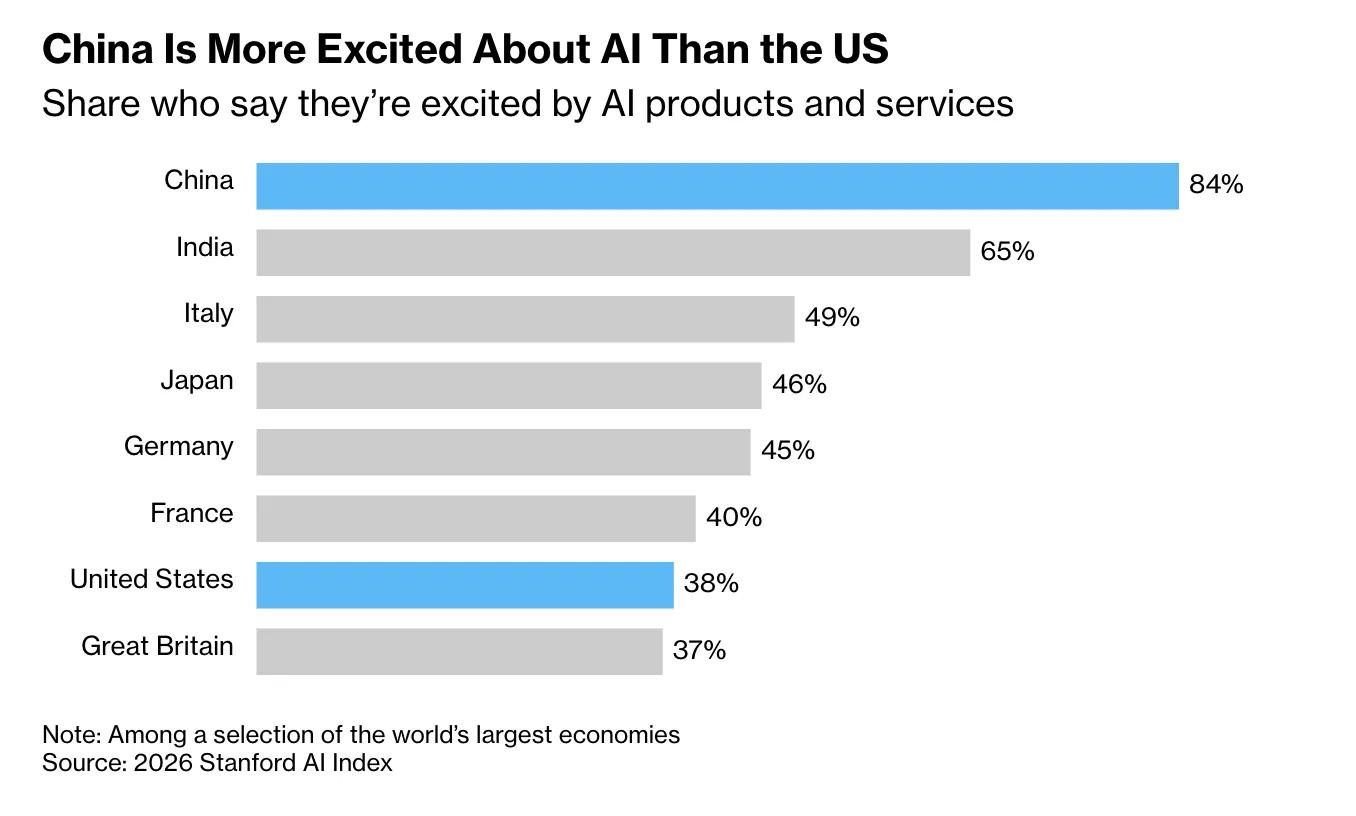
When I think about how people adopt new technology, I do weight trust in government and business heavily. Lived experience of tech making life more convenient, outlook on jobs, and confidence that you’ll be protected if something goes wrong can all feed into that trust.
But simply lining up national numbers side by side doesn’t let us conclude that American anxiety stems from distrust of regulation, or that Chinese optimism stems from trust in government. Each survey asked different questions of different people.
There are surely people in China who worry about falling behind in the race, and people in Korea who use AI precisely because they trust the technology and the institutions around it. Pin a single motive on an entire country, and you miss the different experiences within it.

What a survey of Korean office workers reveals about anxiety and organizational gaps
Microsoft’s Korea Work Trend Index, released in June 2026, found that 78% of respondents felt a sense of crisis — that failing to adapt quickly could leave them behind.
This survey covers knowledge workers who use AI at work. The global core study surveyed 20,000 people across 10 countries; the Korea figures were released separately afterward as market-specific data. Both the sample and the questions differ from Pew’s public-opinion survey of the general population.
A few items from the Korean results stand out:
- Only 16% agreed that leadership and AI strategy were clearly aligned.
- Only 7% believed that attempts to redesign their work would be rewarded even if results weren’t immediate.
- 54% said they were now producing higher-quality output than before.
That 7% figure is worth flagging specifically — it’s not asking whether all AI use gets rewarded. It’s asking whether attempts at redesigning work get credit even when they don’t pay off right away.
These results suggest a gap between how fast individuals feel change happening and how much organizational support exists. But without analyzing whether the same respondents answered both items a certain way, we can’t confirm that unclear direction actually causes the anxiety.
Even so, this raises questions that adoption-rate numbers alone would miss: are employees given the time and criteria to test new methods? Can they fail and try again along the way?
Usage rate is not a proxy for readiness
Microsoft’s AI diffusion report estimated Korea’s generative AI usage rate at 37.1% in Q1 2026 — up 6.4 percentage points from the comparison period in the second half of 2025.
This metric covers the working-age population (15–64) and is a model-based estimate: aggregated usage signals adjusted for OS/device market share and internet penetration, among other factors. It isn’t calculated the same way as the employee-survey response rates discussed above.
Rapid diffusion is real and visible in the data. But how well people are actually using the tools, and whether companies have set clear standards for work and evaluation — a single usage number can’t tell us that.
Oswarld’s Lens
Looking at all this data, I kept thinking of a scene I ran into over and over during GTM strategy consulting.
Adoption projects would often start by handing me internal AI tool usage rates. High usage tended to reassure everyone that the organization was “ready.” But when I asked about outcomes a few months later, the answers were often murky.
In some cases I saw, usage didn’t rise because the organization had designed the work around AI — it rose because individuals started using it on their own, out of personal need or anxiety. Adoption outpaced any company decision about evaluation or reward.
So when I see a high usage number, I’ve learned to ask the next question: What is it being used for? Who checks the output? Does what one team learns actually get shared with anyone else?
Trust in AI and fear of falling behind can coexist. And motives differ person to person. Even someone who uses a tool simply because it’s useful still needs clear work standards; and someone who started out of anxiety still needs tools and training that genuinely help.
I don’t think an organization’s job is to label which motive an employee has. It’s to build concrete conditions: which tasks can be handed to AI, what criteria judge the results, and how new methods get tested and evaluated — decided together.
Hearing that usage rates are climbing is genuinely good news. But that number alone shouldn’t be read as “readiness achieved.” The gap I kept seeing on the ground wasn’t between people who use the tool and people who don’t — it was between the number of people using a tool, and the organization’s readiness to turn that use into actual performance.
Keep the perspective, not the noise.
We choose one consequential shift and trace what sits beneath it, every other day.
Confirm once to finish subscribing.
Already a subscriber? Sign in to join the conversation


References & Further Reading
- Pew Research Center, Concern and Excitement About AI and the country-by-question topline results — see exactly which questions produced Korea’s 16%, 22%, and 61%.
- Stanford AI Index 2026, Public Opinion chapter — a compilation of separate surveys, so read each source’s questions and sample carefully.
- Microsoft, 2026 Work Trend Index — Korea release — explains the questions behind the 78%, 16%, and 7% figures and the scope of Korea’s released data.
- Microsoft, State of Global AI Diffusion in Q1 2026 — details how the usage rate is calculated and the comparison periods used.
From past issues
- China’s review of AI export controls and domestic-chip data centers
- Why freelance developers moonlight as delivery riders

Related issues
Hiring Freezes: The Overlooked Side of AI and Jobs
Beyond layoffs, quiet cuts to hiring plans deserve the same scrutiny when we talk about AI's effect on jobs.
BusinessASML's AI Diagnostics Raise New Data Control Questions
Beyond benchmarks: why ASML's AI rollout puts data storage, training rights, and access control on the negotiating table.
BusinessZurich Tested 100 Students on Vibe Coding, No Code Shown
In a Zurich study, students who said they used LLMs more often actually built worse apps.
Business
Your take shapes the next issue
What resonated most in this issue, or where has your experience been different?