The Costco Cashier Who Turned Down a Promotion
Costco has kept him for 40 years — even though he's already a millionaire.
Opening
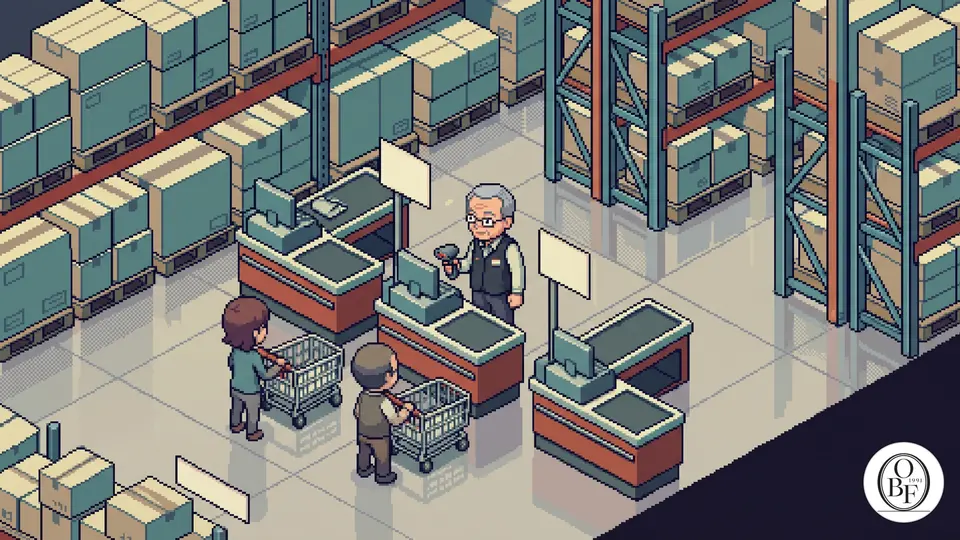
It’s 9:02 a.m. at the self-checkout lanes of a Costco in Tucson, Arizona. Sixty-year-old Tony Bazar picks up a scanner and starts making his rounds between six registers. He started in this same building in 1986, gathering carts in the parking lot for $5.85 an hour. Forty years later, he’s still doing the job.
Here’s the thing, though — this man is already a millionaire. His 401(k)1 holds more than $1 million. The company has offered him a manager’s position multiple times. He’s turned it down every time.
The strange party here is actually the company. Most businesses find long-tenured employees a burden — they’re expensive, and doubly so if they have no interest in moving up. Costco does the opposite. It works hard to keep him exactly where he is.
Let me give you the conclusion up front: the reason isn’t warmth. It’s accounting. Open Costco’s income statement, and the numbers explain exactly why holding onto Bazar is a profitable bet.
The Man Who Turned Down a Promotion, and the Company That Won’t Let Him Go
Tracing Bazar’s career shows how Costco treats its people.
In 1986, he started collecting carts in the parking lot of a Price Club store in Tucson, earning $5.85 an hour — nearly double what he’d made at his previous job, a neighborhood grocery store. Price Club merged with Costco in 1993. A few years later, to escape the heat, he moved inside to handle overnight stocking. When his first child was born, he wanted regular hours, so he switched to greeting members at the entrance. Eventually he landed at the register, and it fit. He liked handling money and talking to people.
Today his hourly wage is $32.90. Costco’s health insurance covered his wife’s three brain surgeries in full, and he took nearly a year of paid leave to care for her. A regular doctor’s visit costs him a $15 copay. As he puts it, you don’t realize how deep this insurance goes until something actually happens.
The company has offered him a management position several times. He’s declined every time. He likes meeting members face-to-face at the register, and he believes that not being a boss actually makes him a better mentor to younger employees.
Here’s where it gets interesting: the company doesn’t treat this as a problem.
Costco has recently created a role called “culture coach” at several stores — not a management position, but an official mentorship role for long-tenured hourly employees. It’s a mechanism for keeping the experience of people who don’t want to be promoted inside the organization. The top hourly wage rose from $31.90 to $32.90, and employees with 30+ years of tenure now get an extra week of vacation.
The general manager who has run the Tucson store for eight years put the strategy into words precisely. When a veteran employee leaves, the average wage across the store’s 380 employees goes down — which helps the bottom line — but the company pays for it in experience. As new hires accumulate, he adds, the core culture gets diluted.
Pay attention to that word: diluted. In standard accounting, senior employees are a cost. But this manager calls their departure dilution — a word you use when an asset is being watered down.
Costco Doesn’t Make Money Selling Stuff
So how much is that “asset” actually worth? I opened Costco’s fiscal 2025 annual report (10-K)2 and ran the numbers myself.
Revenue is $269.9 billion. Subtract the cost of goods, and gross profit comes to $30 billion. But selling, general, and administrative expenses total $25 billion. Net those against each other, and operating income from selling merchandise alone comes to just $5.1 billion — 1.87% of revenue.
Yet Costco’s actual operating income is $10.4 billion. Where did the other $5.3 billion come from?
Membership fees.
The $5.3 billion in annual membership fee revenue flows straight into operating income with essentially no cost attached. Do the math, and membership fees account for 51.3% of Costco’s operating income. Money made from merchandise and money made from membership fees are nearly split down the middle. Put a bit provocatively: Costco isn’t a company that recruits members to sell them stuff — it’s a company that sells stuff cheap in order to keep its members.
And membership fees renew every year. That’s where everything changes.
This isn’t one-time revenue from a single sale — it’s subscription revenue, where every member re-decides, once a year, whether to pay again or not. In fiscal 2025, the renewal rate was 92.3% in the U.S. and Canada, and 89.8% worldwide.
Add in the scale, and the picture shifts. Costco has 81 million paying members worldwide. A one-percentage-point swing in the renewal rate moves 810,000 people. And the fees those 81 million people pay prop up half the company’s operating income.
Now let’s go back to Bazar at the register.
When a member decides whether to hit “renew” or not, where does that judgment actually get made? Product selection and prices matter, but for most members, the only moment they interact with Costco as a company, human to human, is at the checkout. Does the line move fast? When something goes wrong, who fixes it? According to Costco’s internal data, the fastest cashiers process 70 customers an hour; the average is 57. That gap accumulates, every day, in every store, as every member’s last impression on the way out.
Bazar stands on the front line defending the renewal rate. And that renewal rate generates half the company’s profit. Retention builds the customer experience, the customer experience protects the renewal rate, and the renewal rate is responsible for half the profit. This isn’t a feel-good story — it’s an income statement.
Costco doesn’t hide this logic, either. Its annual report states plainly that the company’s compensation philosophy is not to minimize wages and benefits. To keep turnover low and productivity and satisfaction high, it says, the company must maintain better-than-industry-average compensation — so costs that other employers would pass on to workers, Costco absorbs itself.
The order of its code of ethics tells the same story. First, comply with the law. Second, take care of members. Third, take care of employees. Fourth, respect suppliers. And then, at the very end: if the organization delivers on all four, the ultimate goal — rewarding shareholders — will follow. Shareholders come last, and notably, they’re written in as an output, not an input.
So Is It Just About Raising Wages?
Read this far, and the conclusion looks simple: raise wages, turnover drops, profit follows. But carrying that conclusion forward as-is is risky. Three things need scrutiny.
First, the turnover figure itself.
Various outlets currently place Costco’s 7% turnover rate side by side with the retail industry average of 60% and call it a tenfold difference. But Costco’s own annual report defines this number: it’s the retention rate among employees who have been there over a year, at 94%. In other words, the 6-7% turnover figure applies to people who’ve already cleared their first year.
McKinsey’s 60% frontline retail turnover figure, by contrast, includes first-year departures. Given that a large share of retail turnover happens in employees’ first year, these two numbers aren’t measuring the same thing. Costco doesn’t separately disclose its first-year turnover rate. Costco’s retention really is excellent — that part is true. But the “tenfold” framing circulating right now stacks numbers measured on different bases on top of each other. When you work with data, you run into this kind of quiet unit mismatch more often than you’d think.
Second, the context behind this particular wage increase.
The original article describes the raise to $32.90 and the 30-year vacation bump as if Costco offered them voluntarily. Lay out the timeline, and a slightly different picture emerges. In January 2025, 18,000 Costco Teamsters3 union members voted 85% in favor of authorizing a strike. Had it gone through, it would have been the largest retail strike in U.S. history. Just days before the strike deadline, Costco announced a three-year wage increase plan covering all non-union hourly employees: a top hourly wage of $31.90, with an additional $1 raise in both 2026 and 2027. The 30-year vacation benefit was announced at the same time. The strike was averted with a tentative agreement reached right at the deadline.
$32.90 is the second-year step of that three-year package. The union represents just over 8% of U.S. employees, and the high-wage strategy itself is a genuine 40-year-old policy — but the timing of this particular increase was set at the bargaining table. Reading it as a pure gift doesn’t match the facts.
Third, and most important: wage investment alone doesn’t make this system run.
MIT Sloan’s Zeynep Ton has tracked Costco, Trader Joe’s, Spain’s Mercadona, and QuikTrip for over 15 years. What she found early in her research was that this virtuous cycle doesn’t spin on its own. Ton lays it out this way: investing in people is the first element of a good-jobs system, but the real secret is four operational choices — focus and simplify, standardize while empowering, cross-train, and operate with slack.
Map Costco onto this framework, and the picture completes itself.
- Focus and simplify: A single warehouse carries fewer than 4,000 SKUs4 — a fraction of what a general retailer stocks. Products are stacked on pallets, there’s no advertising, and store hours are short. This is why SG&A comes to just 9.25% of revenue.
- Standardize and empower: Pay raises happen automatically every 1,040 hours worked. There’s no room for managerial discretion to intervene.
- Cross-train: Bazar’s own career is the proof — carts, overnight stocking, the entrance, the register, he’s done them all.
- Slack: Costco stations a 40-year veteran at self-checkout.
Read that last point again. Self-checkout was designed to remove people from the equation. Yet Costco knows, from its own data, that self-checkout is slower than staffed registers — and it deliberately keeps its most skilled employee there anyway. Instead of using technology to cut labor costs, it chose to put a person right next to the technology.
This is the crux of it. High wages are the output of this system, not the starting point. If you don’t cut your product count to 4,000, don’t build a second profit engine like membership fees, and don’t hold SG&A down to 9%, and you just raise wages the way Costco does — that’s just a cost increase.
Oswald’s Lens
Over nearly 20 years of building go-to-market strategy, there’s one misunderstanding I run into more than any other: the failure to distinguish between “copying” a good case study and “understanding” it.
Conversations with executives who bring up the Costco case almost always start with wages. “Should we be raising frontline pay too?” But the question I always throw back is different: do you know how much what that person is protecting is actually worth?
Costco knows. It knows, in hard numbers, that the 40-year cashier at the register is protecting the renewal rate, and that the renewal rate is half of operating income. So the money spent keeping him isn’t labor cost — it’s profit-defense spending. Most companies, by contrast, have no idea exactly how much their frontline employees are protecting, and file that position under cost, period. Not knowing, they have no choice but to cut.
So the real lesson of this case, as I see it, isn’t “be nice to your employees.” It’s this: calculate, first, exactly where your company’s profit actually comes from, and who is protecting that point. Only once that calculation is done can you start talking about compensation. Raise pay first, without doing the math, and you don’t become Costco — you just become a company with thinner margins.
I don’t read shareholders being placed last in Costco’s code of ethics as an act of humility. I read it as a statement of causal order.
Closing
To sum up:
Costco keeps a cashier who turned down a promotion on the payroll for 40 years not out of kindness, but out of calculation. Half its profit comes from membership renewals, and the person protecting those renewals is standing at the register.
But this model can’t be copied by lifting out the wages alone. The product count, the membership-fee structure, and the sub-10% SG&A all have to exist together to make that wage sustainable.
So the question isn’t “should we pay more too” — it’s “where does our profit actually come from, and who is protecting that spot?”
Who, in your organization, is protecting the point where profit is actually generated? Is that position treated as a cost, or as an asset? Tell me in the comments — I’ll feature the most compelling examples in the next issue.
💬 Share your thoughts or experiences on this topic in the comments — I may feature them in the next issue. 📨 If you know someone who’d find this useful, please share it with them.
References & Further Reading
Primary sources
-
“He Earns $33 an Hour as a Costco Cashier. Now He’s a Millionaire.”, The Wall Street Journal, July 9, 2026. Read it here ··· This is the article that sparked today’s issue. Worth reading as a straightforward day-in-the-life piece on Bazar.
-
Costco Wholesale Corporation, Form 10-K, Fiscal Year 2025, SEC, 2025. Read it here ··· The primary source for all of today’s math. The $5.3 billion in membership fees, the $10.4 billion in operating income, the 92.3% renewal rate — it’s all here. I especially recommend the “Human Capital” section. Seeing, in an actual public company filing, the plain statement that the company won’t minimize wages hits differently than hearing it secondhand.
-
Zeynep Ton, “The 4 essential choices in a good jobs system”, MIT Sloan, 2023. Read it here ··· Ton’s own summary of the four operational choices. This is the backbone of section three today.
-
McKinsey & Company, “Frontline retail workers and the Great Attrition”, 2022. Read it here ··· The source for the 60% frontline retail turnover figure. You can check for yourself how differently it’s measured compared to Costco’s numbers.
Background
-
Zeynep Ton, The Case for Good Jobs, Harvard Business Review Press, 2023. ··· A book built on 15 years of field research, arguing that good jobs are a competitive advantage, not a cost. Covers Mercadona and QuikTrip alongside Costco.
-
Costco Wholesale, “Mission & Ethics”. Read it here ··· A five-line code of ethics. Worth counting for yourself exactly where shareholders land in the order.
-
“Costco union representing 18,000 workers authorizes nationwide strike”, CNBC, January 20, 2025. Read it here ··· Confirms the timeline behind this round of wage increases — context missing from the original article.
Related past issues
- (To confirm: add 1-2 links here to past issues covering organizational/talent strategy or retail business models.)
📝 Glossary

Footnotes
-
401(k): The primary retirement savings vehicle in the U.S. Employees set aside a portion of their salary, the company matches a percentage, and the funds are invested in stocks and bonds. Because it compounds the longer it’s held, someone like Bazar who’s contributed for 40 years ends up with the company’s stock appreciation baked in as well. ↩
-
10-K (Annual Report): A disclosure document U.S. public companies are legally required to file with the Securities and Exchange Commission (SEC) every year. Unlike marketing materials, it carries legal liability, making it the most candid window into a company’s own stated strategy and risks. ↩
-
Teamsters: One of the largest labor unions in the United States. Originally centered on transportation and logistics workers, it has since expanded to organize warehouse and retail workers as well. About 18,000 Costco employees are union members. ↩
-
SKU (Stock Keeping Unit): The unit used to count how many distinct products a store carries. Even the same product counts as a different SKU if the size or color differs. Fewer SKUs mean simpler inventory management and employee training. ↩
Related issues
 Issue #202Business
Magnificent Seven Name Fades, Its Market Weight Doesn't
The new label Wall Street is drafting already includes Anthropic, OpenAI, and SpaceX.
 Issue #201Business
Pay-Per-Post Turns Communities Into Content Mills
A 570,000-person experiment found that the deciding factor is cashability, not size.
 Issue #199Business
My Book Sold for $656 in AI Royalties
The next contract might not even offer that royalty at all.
Your take shapes the next issue
What resonated most in this issue, or where has your experience been different?