AI Swallowed Our Content, and Clicks Went to Zero
Korean publishers still have no legal shield against AI search's traffic squeeze.
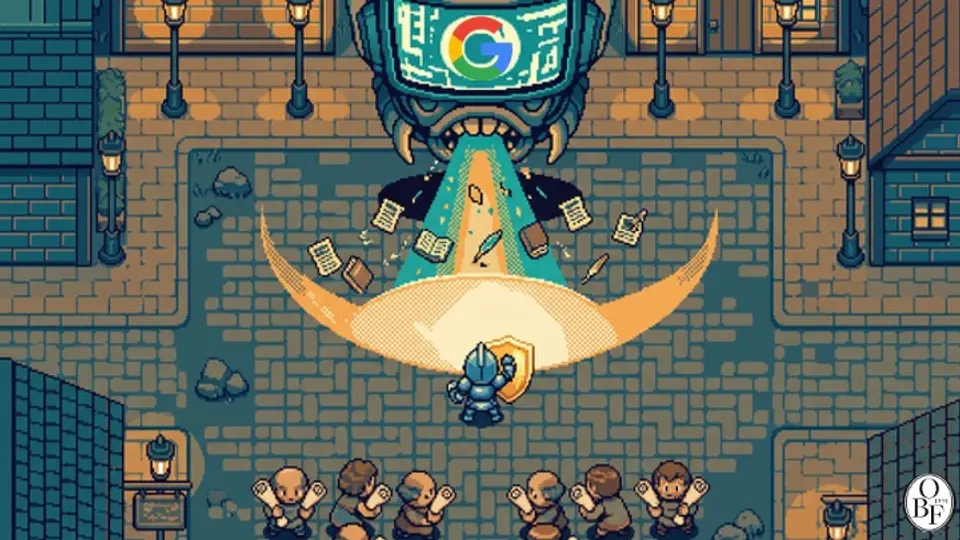
Opening
Hello, subscribers. This is OZ Talking. On June 3rd, the UK’s Competition and Markets Authority (CMA)1 handed Google an unprecedented order: legally guarantee publishers the right to refuse having their content used in AI search features. It’s a binding measure the CMA itself calls a “world first.”
“Why cover UK regulation in a Korean newsletter?”
Because the problem this regulation targets — AI summarizing content while clicks to the original source disappear — is exactly what Korean news outlets, bloggers, and content creators are experiencing right now. To cut to the conclusion: the UK has built a legal shield. Korea doesn’t have one yet.
I recently covered, in this newsletter, the search updates announced at Google I/E 2026 — and the UK was the fastest to respond to the changes those updates brought, which is what I wanted to dig into today. For reference, Korea has a separate traffic source in Naver, so in some ways it’s been partly shielded from this shock.
A Single Search Box Is Rewriting the Food ChainThe ecosystem’s ruler is reshaping its own ecosystem🔍 The UK’s ‘World First’ Order to Google
The conduct requirements the UK CMA announced boil down to three core points.
First, the right to opt out2** of AI search is guaranteed. Publishers can refuse to have their content used in Google’s AI search features, including AI Overviews**3, AI Mode, and more. What matters here is that opting out carries no penalty in regular search rankings. Previously, refusing the AI feature meant pulling out of Google Search entirely — there was effectively no real choice at all.
Second, the right to refuse AI training use. Publishers can also block Google from using their content to fine-tune4 its AI models — a rule covering Google’s entire AI product line, including Gemini and Vertex AI.
Third, a mandatory clear-attribution requirement. AI-generated search results must display a clear link to the source of the original content, so users can immediately see where the information came from.
The legal basis for this regulation is the Digital Markets, Competition and Consumers Act (DMCCA)5, enacted in May 2024. The starting point is Google’s market dominance — it accounts for more than 90% of UK search. The UK opened its investigation into Google in January 2025, designated the company as having “Strategic Market Status (SMS)” that October, and issued binding conduct requirements in June 2026 — completing the world’s first AI-search regulatory framework in just 18 months. Google must meet all requirements within 9 months, though the CMA said it expects the core items to be completed well before that.
Google has already begun rolling out a new toggle in Search Console to some UK website owners, and plans to expand it globally after testing. In other words, this regulation starts in the UK but is likely to affect content creators worldwide.
📊 The Numbers Behind the Content Crisis
Why did the UK move so fast? One look at the numbers makes it obvious.
Chartbeat tracked more than 2,500 news sites worldwide and found that Google search traffic to publishers fell 33% over the course of 2025. The US dropped 38%, Europe 17%. CNN lost 27–38%, Business Insider lost 55%, and Forbes and HuffPost each lost roughly 50% of their traffic.
The cause is clear. As Google places AI-generated summaries (AI Overviews) at the very top of search results, users no longer have a reason to click through to the original article. Ahrefs analyzed 300,000 keywords in February 2026 and found that for keywords showing AI Overviews, the click-through rate (CTR)6** for the No. 1-ranked page fell 58%. That’s nearly double the 34.5% decline measured back in April 2025 — a worsening that took just 10 months. Pew Research’s findings are even more direct: only 8% of users clicked a link when an AI Overview appeared, compared to 15% when it didn’t — nearly half**.
This isn’t just a news-industry problem. The education platform Chegg saw non-subscriber traffic fall 49% between January 2024 and January 2025 as AI Overviews began answering study questions directly. One UK lifestyle publisher reported that CTR for the popular search term “how to get rid of bugs” dropped from 5.1% to 0.6%. Rankings stayed the same — only the clicks vanished. This is why it was hard to expect Google to fix this problem voluntarily. In fact, Google had previously rejected a publisher opt-out feature, arguing that AI search was “evolving into a space for monetization.”
Here’s the dilemma publishers face: opt in, and their content becomes free raw material for AI summaries while clicks decline. Opt out, and they disappear from AI search entirely, with exposure dropping to zero. Either way, they lose. This is what’s called “Hobson’s choice”7 — a situation where there’s effectively only one option.
What the UK CMA did was create a third option that breaks this double bind: “opt out of AI search, but keep your regular search ranking.” That single line gave publishers real negotiating leverage for the first time.
But there’s a deeper structural irony here. Google’s search-ad revenue topped $50 billion in the first quarter of 2026 alone. That revenue depends on a cycle: users search, visit websites, and see ads. Yet AI Overviews are systematically shrinking the “website visit” step at the heart of that cycle. Google is depleting the very fuel its own business runs on.
🇰🇷 Where Does Korea Stand Right Now?
So where does Korea stand?
Korea is caught in the same structural shock. According to Opensurvey (a Korean market research firm)‘s “AI Search Trend Report 2026,” Naver’s usage rate fell from 85.3% to 81.6%, while ChatGPT usage crossed 50% for the first time, at 54.5%. Google Gemini usage roughly tripled, from 9.5% to 28.9%. The Reuters Institute for the Study of Journalism projected that AI-summary-driven traffic losses for news publishers could reach as high as 40%. In Korea’s search market too, the shift from “search” to “answer” has already begun.
The Korean government isn’t just standing by, either. Korea’s AI Basic Act took effect in January 2026, and in February the Ministry of Culture, Sports and Tourism and the Korea Copyright Commission published a “Fair Use Guide for Generative AI Training on Copyrighted Works.” Its interpretation: “In principle, it is not fair use for AI to train on an entire news article and then offer a summary service based on it.” The Korea Newspaper Association has also filed a complaint with the Korea Fair Trade Commission, alleging that Naver used news content without authorization to train HyperCLOVA, Naver’s in-house AI model. There’s movement — the problem is speed and enforceability.
But compared with the UK’s action, a decisive difference stands out.
The UK CMA’s regulation is a binding legal obligation. If Google doesn’t comply, sanctions follow. By contrast, Korea’s fair-use guide is just a reference document. It carries no authoritative legal interpretation and no legal force. The AI Basic Act, too, focuses on AI transparency and managing high-impact AI systems — it contains no regulation at all of the structure by which AI search summarizes and consumes content in real time.
Here’s a sense of scale. According to research presented at a National Assembly seminar in October 2025, the copyright value that generative AI should pay for training on news content from Korea’s three terrestrial broadcasters was estimated at ₩87.7 billion per year — and that’s counting only the three broadcasters. Add general dailies, business papers, trade publications, and individual creators, and the number grows far larger.
And this isn’t a story limited to major media companies. Blog operators, YouTube creators, newsletter publishers — every content creator who depends on search traffic is exposed. The UK included all of them under its protection. It’s disappointing that in Korea, this is still being framed only as a dispute between big media companies and platforms.
To sum up the picture: the UK has legally guaranteed content providers’ “right to decide whether their content is used in AI search.” In Korea, that right doesn’t yet exist in law. The guide and the complaint are a start, but a binding mechanism that actually protects the people who create content remains missing.
Oz’s Lens
To be honest, I think the real essence of this regulation isn’t “protection” — it’s building a structure that puts a price tag on content. There’s a pattern I’ve observed again and again while building go-to-market strategies: once a structure in which a platform consumes a supplier’s content for free becomes locked in, the supplier’s negotiating power converges toward zero. Switching to a paid structure later is many times harder than building that paid structure in from the start.
The opt-out button the CMA created isn’t, by itself, a shield — opting out just drops AI search traffic to zero. But the button’s real function is to create a negotiating table. The moment the option to “opt out” exists, publishers can say, “If you want to use our content, let’s talk terms.” The CMA itself explicitly stated the purpose of this regulation as putting publishers “in a stronger position to negotiate deals for the use of their content.”
What Korean content creators need right now isn’t a guide — it’s exactly this kind of structural negotiating power. Given the speed at which the UK completed a binding framework in just 18 months, the longer Korea’s government response lags behind that pace, the longer Korean content creators will have to accept platform terms as-is, with no cards to negotiate with.
In Korea, Naver has preemptively rolled out its own homegrown solution called Naver Mate — a program that pays creators the more their content gets cited in AI search results. Viewed globally, this is a remarkably fast and innovative move in its own right. It’s almost puzzling that it hasn’t gotten more attention.
Naver Mate — Naver Premium ContentOf course, the opt-out right alone won’t solve everything. When AI paraphrases content before using it, tracing the original source becomes difficult, and the effectiveness of any regulation depends on a robust monitoring system. Even the CMA described this move as just “the start.” But the gap between a country that has at least started and one that hasn’t started at all can only widen over time.
Closing
Let me wrap up.
One: the UK CMA’s legal mandate requiring Google to let publishers opt out of AI search use of their content is the world’s first binding measure of its kind. Two: the 33% drop in global publisher traffic caused by AI Overviews isn’t a copyright dispute — it’s a survival-structure problem for the entire content ecosystem. Three: Korea has taken its first step, but a binding protection mechanism is still missing.
Do you actually use AI’s search-summary feature much? Do you tend to just skim the summary and move on, or do you click through to the original source? Let me know in the comments.
References & Further Reading
Primary sources
- UK Competition and Markets Authority, “CMA secures fairer deal for publishers and improves Google Search services in UK”, 2026.6.3. : Today’s newsletter’s core evidence — you can see the regulation’s three pillars firsthand here.
- Google, “New controls for website owners”, 2026.6.3. : Covers the specifics of the opt-out toggle Google introduced in Search Console.
- Ahrefs, “AI Overviews CTR Impact Study”, 2026.2. : The 300,000-keyword study showing AI Overviews cut CTR for the No. 1-ranked page by 58%. Check here if you want the original source of the figures.
- Press Gazette & Chartbeat, “Global publisher Google traffic dropped by a third in 2025”, 2026.1. : The original source for the 33% drop in Google search traffic across 2,500 news sites.
Background
- Kluwer Competition Law Blog, “AI Overviews Are Harming Competition, Letting Publishers Opt-out Won’t Help”, 2026.4.
- Ministry of Culture, Sports and Tourism & Korea Copyright Commission, “Fair Use Guide under Copyright Law for Generative AI Training on Copyrighted Works”, 2026.2. : Shows the Korean government’s current stance. It carries no legal force but could influence future case law.
- Opensurvey, “AI Search Trend Report 2026”, 2026.1. : Data on Korea’s AI-driven search-market shift, showing Naver’s decline and ChatGPT’s rise in numbers.

The author, Kwangseob Ahn, is a professor of business administration at Sejong University and lead consultant at OBF (Oswarld Boutique Consulting Firm). He teaches statistics and data analysis — business data management and business analytics — while leading GTM and AI strategy consulting in the field, designing the seam between technology and business. He has published academic research on a memory architecture for AI dialogue systems (HEMA) and runs Daily Arxiv, a daily curation of global AI papers. He holds a master’s from Korea University’s Graduate School of Technology Management and a KMBA. He is the author of Homo Brainless: The People Who Outsource Their Thinking.
Footnotes
-
CMA (Competition and Markets Authority): The UK’s Competition and Markets Authority, playing a role similar to Korea’s Fair Trade Commission. Since 2025 it has held new powers to directly regulate Big Tech companies in digital markets. ↩
-
Opt-out: The act of requesting that your content or data be excluded from a specific service or feature. The reverse — choosing to participate — is called opt-in. ↩
-
AI Overviews: AI-generated summaries Google has displayed at the top of search results since 2024. The feature has AI synthesize multiple web sources to answer a user’s question directly. ↩
-
Fine-tuning: The process of further training an already-trained AI model on data from a specific domain — think of it as precision-adjusting a general-purpose model for a specific use. ↩
-
DMCCA (Digital Markets, Competition and Consumers Act 2024): The UK’s Digital Markets, Competition and Consumers Act. It provides the legal basis for designating Big Tech companies with “Strategic Market Status (SMS)” and imposing tailored conduct regulations on them — the UK’s counterpart to the EU’s Digital Markets Act (DMA). ↩
-
CTR (Click-Through Rate): The ratio of actual clicks to the number of times a search result was shown. A low CTR means the result is being seen but people aren’t actually clicking it. ↩
-
Hobson’s Choice: An expression for a situation with effectively only one real option — “take this, or take nothing.” It comes from Thomas Hobson, a 17th-century English stable owner who would only rent customers the horse nearest the door. ↩
Related issues
 Issue #112Business
Same Company, 100x Bonus Gap: Korea's New Problem
Citizen dividends, a sovereign fund, solidarity wages—three rival fixes emerged in just three weeks.
 Issue #111Business
Founders Banned, $2 Billion Meta-Manus Deal Unwound
The chip war's next battlefield: AI agents.
 Issue #109Business
Why Anthropic Is Hiring a $320K Copywriter
AI can write, but only humans can figure out what to say.
Your take shapes the next issue
What resonated most in this issue, or where has your experience been different?