

Why AI Agents Still Need CPUs, Not Just GPUs
A once-overlooked chip market is set to grow sixfold to $210 billion by 2030.

Opening
Reader, if you’ve ever handed a task off to an AI agent, think back to what was actually happening on screen while it worked. It was opening browsers, running code, organizing files, reading through search results. The moments when the model is actually “thinking” are brief — everything else is that kind of housekeeping. And that housekeeping doesn’t run on GPUs. It runs on CPUs.
On the 13th, Bank of America (BofA) turned this observation into numbers, forecasting that the server CPU market will grow sixfold by 2030. Here’s the bottom line — the computing demand of the agent era isn’t just inflating GPUs. It’s pulling the CPU, long treated as a supporting player in the GPU era, back to the table for a leading role.
BofA Rewrites the Invoice
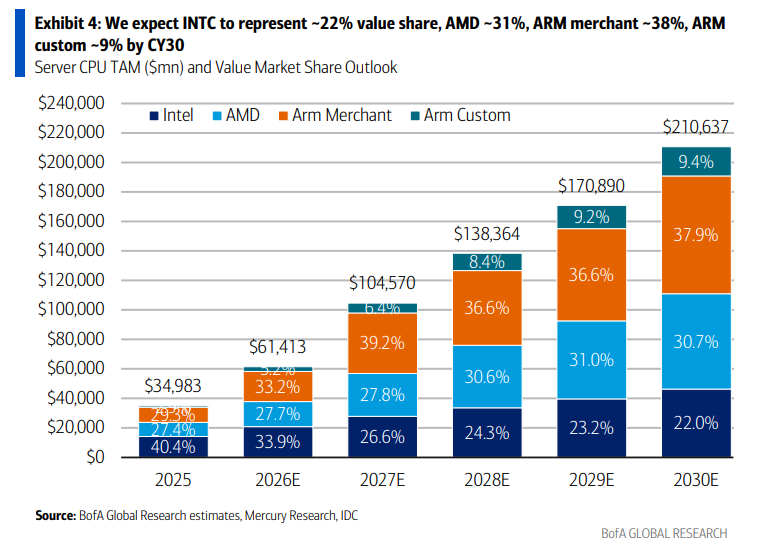
Let’s start with the numbers. BofA’s team of analysts led by Vivek Arya put the 2030 server CPU market size (TAM1) at over $210 billion. Given that this market was worth about $35 billion in 2025, that’s a 6x jump in five years — a 36% compound annual growth rate.
What’s interesting is that this isn’t the first time BofA has floated a number like this. Their 2030 forecast has climbed in stages: from $125 billion to $170 billion, and now to $210 billion. They’ve effectively rewritten the invoice twice in a matter of months, and the reason has been the same each time: agentic AI.
 The core argument is about ratios. In the training-heavy era, the standard AI server configuration paired four GPUs with one CPU — a 4:1 ratio — because the CPU’s job was just to feed data to the GPUs. But BofA argues that in the age of agentic inference, this ratio approaches 1:1. The CPU becomes the control plane2 that directs the entire agentic system — what BofA calls the data center’s “control hub.”
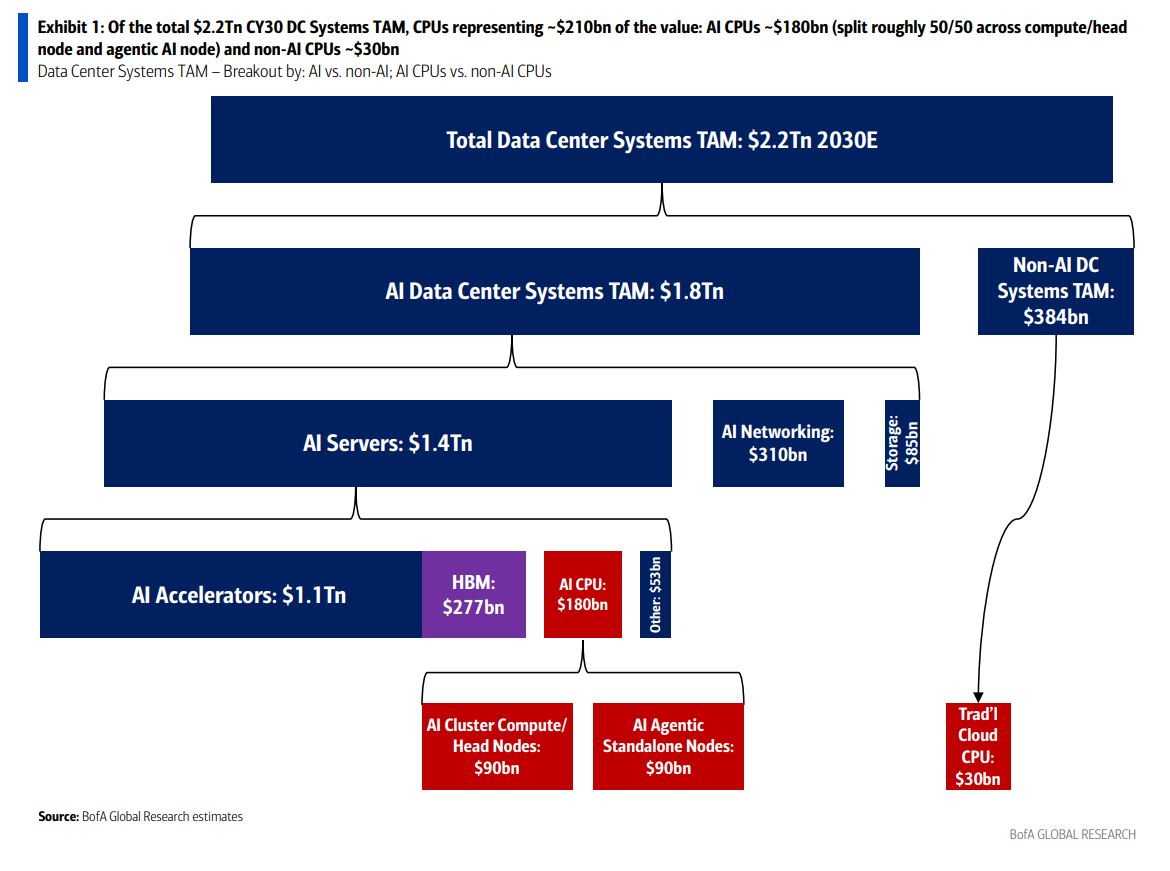
Breaking down the dollar figures makes the picture even clearer. Of the $2.2 trillion BofA projects for the total 2030 data center systems market, AI CPUs account for $180 billion — and that figure splits exactly in half. One half, $90 billion, goes to head nodes3 that direct GPU clusters. The other half, another $90 billion, goes to agent-only nodes that run entirely on CPUs, with no GPUs at all. That second category is the star of today’s story.
Looking at the draft against the Korean source, everything checks out well — headings, numbers ($1.1 trillion, 6x/six times), image line, and structure all match. No Hangul remains, and the terminology aligns with the glossary.
A Day in the Life of an Agent-as-Worker
Why agent-specific nodes are necessary becomes obvious the moment you look at what an agent actually does all day.
AI in the chatbot era was simple: receive a question, spit out an answer, done. 100% of the work was model inference — GPU work. Agents are different. They plan (inference), open a browser to look things up (execution), write and run code (execution), review the results (inference), and organize everything into files (execution). Just like a human employee uses software to get work done, an agent uses software too. And browsers, code-execution environments, file systems, and databases all belong to the realm of general-purpose computing — the CPU’s domain.
 So if you break an agent’s day down by time, the GPU-powered “thinking” happens in brief bursts, while CPU-powered “hands and feet” fill in the rest. Hiring one agent is, in effect, like handing that agent its own computer — the same way you’d issue a new hire a laptop on day one.
This connects back to the workload data I discussed in last week’s scissors piece. The fact that tokens per task keep climbing means agents are working longer, in more steps. And as the number of steps grows, so does the execution work sitting between each step. It’s a structure where bigger inference drags bigger execution along with it.
That said, let’s strip away the hype. A 1-to-1 ratio is a ratio of counts, not of dollars. Even in 2030, the AI accelerator market will be worth $1.1 trillion — six times the size of the AI CPU market. This isn’t a story about the CPU reclaiming its throne; it’s more accurate to read it as the supporting actor everyone wrote off suddenly getting a 6x raise.
A Growing Market, a Changing Throne
Who takes this growing market — that’s the second twist.
Server CPUs have been Intel’s kingdom for nearly 30 years. But look at BofA’s share forecasts: Intel’s revenue-based share, at 40.4% in 2025, gets cut roughly in half to 22.0% by 2030. AMD climbs from 27.4% to 30.7%, and on that trajectory it overtakes Intel for the first time as soon as next year (2027). AMD is also BofA’s top pick among CPU stocks.
But the real winner sits outside x864 altogether — the ARM camp. Merchant ARM chips sold as finished products, like Nvidia Grace, account for 37.9%; custom silicon5 designed in-house by big tech firms, like Amazon Graviton or Google Axion, adds another 9.4%. Combined, that’s 47% of the 2030 server CPU market — nearly half.
 And this isn’t some distant future scenario. According to IDC, non-x86 servers — ARM-based systems chief among them — already accounted for 47.9% of server market revenue in Q1 of this year, up 107.6% year over year. That figure needs a careful reading, though: it’s tallied by attributing an entire server’s price to whichever CPU architecture it uses, so an Nvidia NVL72 rack costing up to $6.5 million per unit gets counted entirely as ARM revenue simply because it runs Grace CPUs. Still, the direction is unmistakable. Nvidia plans to ship 4,000,000 Grace and Vera CPUs this year alone, while x86 server revenue slipped 2.9% over the same period.
Let’s do the math fairly for Intel, too. Even with its share cut in half, the market itself is growing sixfold, so Intel’s actual server CPU revenue still more than triples, from the $14 billion range to the $46 billion range. This isn’t a losing game — it’s a game of winning far less than everyone else. But capital markets don’t price absolute dollars; they price direction. A company ceding half its throne while the market grows sixfold simply cannot command the same valuation as the company eating into that market from scratch.
Oswarld’s Lens
In my work doing AI-adoption consulting, I often review infrastructure quotes, and there’s one blank that shows up in almost every single one. The GPU and token costs are itemized down to the last decimal, but there’s no line item at all for the environment where the agent actually does its work — the sandbox, the browser instances, the orchestration servers. People are budgeting for agents using a chatbot budget template. I read BofA’s $90 billion “agent-dedicated node” line as a number that shows, at industry scale, exactly how expensive that blank really is.
That said, there’s something I always tell my students in data class: when you see a market-share number, ask about the denominator first. Today’s numbers are a perfect exercise in that. IDC’s claim that “ARM is half of servers” uses server revenue — GPU value included — as its denominator, while BofA’s 47% uses only CPU chip value as its denominator. These are two numbers of a different kind that just happen to look similar, and if you lump them together, you end up overstating ARM’s current position by roughly double. And the fact that sell-side forecasts have been revised upward twice in just a few months is a signal both that demand is strong and that the estimates are still catching up to reality. The real information isn’t the $210 billion figure itself — it’s the fact that it’s already been rewritten twice.
So here’s how I’d summarize the real signal in this report: AI isn’t replacing existing computing — it’s amplifying it. As agents multiply, demand for the most mundane forms of computing — browsers, databases, operating systems — rises right alongside them. If last issue’s “scissors” story was about margin shifting from models to infrastructure, today’s scene is about the spotlight widening within that infrastructure itself — from a one-actor show starring accelerators to the whole stage. And the fact that the HBM market is projected to reach $277 billion by 2030, larger even than the AI CPU market, is a nice bonus for our readers in Korea.
Looking at the fragment against the source, I checked headings, footnotes, links, images, numbers, and glossary terms. Everything matches well. One small fix: “BofA Global Research (Vivek Arya’s team)” should reflect “team” more naturally, but this is a minor style point, not an error. I found no Hangul, missing numbers, or structural drift. The draft is accurate and complete.
Closing
Three things, in summary.
First, BofA thinks the server CPU market will grow sixfold to $210 billion by 2030. That’s because agents spend more time working on CPUs than they do thinking on GPUs. Second, the ARM camp will take half of that market, while Intel’s share shrinks from 40% to 22%. The market grows, but the throne changes hands. Third, that “1:1” figure is a unit ratio, not a dollar ratio — and IDC’s 47.9% is a number whose denominator already includes GPU spend. Trust the direction, but scrutinize the magnitude.
If you’re evaluating agent adoption, here’s one thing to try this week: add a line called “execution infrastructure” next to the “GPU/tokens” line item in your pilot budget. That means sandboxes, browsers, orchestration, and log storage. If that line is still blank, you’re planning your agent on a chatbot template.
For the record, this piece is an industry-structure analysis, not investment advice on any specific company or asset. I’d encourage you to verify the Intel, AMD, and ARM figures directly against the primary sources below. And for what it’s worth, I’ve been enjoying the skill Cloudflare built, linked below. If you have a favorite skill of your own, let me know.
GitHub - cloudflare/computer: Give your agent a computer 👾Give your agent a computer 👾. Contribute to cloudflare/computer development by creating an account on GitHub.Reader, where is your organization running its agents? Whether your cloud CPU instance bill came in way higher than expected, or you haven’t even thought about the execution environment yet — share your experience in the comments. I’ll gather the stories and pick this up again in an issue on agent infrastructure.
💬 Tell me in the comments where and how you’re running your agent execution environment. I’ll fold it into the next issue. 📨 If you have a colleague who deals with AI infrastructure budgets, please share this piece with them.
📎 References & Further Reading
Primary sources
- BofA Global Research (Vivek Arya’s team), server CPU TAM outlook report, 2026.8.13. ··· This is the backbone of today’s piece. Both the $2.2 trillion TAM tree (Exhibit 1) and the share forecast (Exhibit 4) come from here.
- Yahoo Finance UK, “BofA lifts server CPU TAM to $210bn+ on the rise of AI agents”, 2026.8. ··· Lays out the report’s core thesis and explains the shift from a 1:4 ratio to 1:1.
- Tom’s Hardware, “Arm servers capture over 45% of data center market revenue”, 2026. ··· The original article covering IDC’s Q1 tally. Here you can check exactly what’s in the denominator behind that 47.9% figure.
Background
- Forbes, “Vera CPU Is Strategic For Nvidia, Not A Side Show”, 2026.7.21. ··· An analysis of why Nvidia is building out CPUs as a strategic business, not a sideline.
- Benzinga, “BofA Sees $210B CPU Boom: AMD, Intel, ARM”, 2026.8. ··· A summary piece focused on ticker-by-ticker implications.
Related past issues
- The Four-Year Pledge SanDisk Secured ··· Another scene of power shifting toward infrastructure — the storage version of this repricing story.

📝 Glossary
Footnotes
-
TAM (Total Addressable Market): The theoretical ceiling of a market a product could reach — not actual revenue, but a measure of the market’s upper bound. Because of that, the definition and size can vary between forecasting firms. ↩
-
Control Plane: The management layer that directs what happens, when, and how — separate from the part of a system that actually does the work. Think of a factory: this is the control room, not the production line. ↩
-
Head Node: The CPU server in a GPU cluster responsible for task allocation, scheduling, and data preparation. For thousands of GPUs to move as one, this command server is indispensable. ↩
-
x86: The traditional CPU architecture used by Intel and AMD. It has been the server market standard for the past 30 years; its rival, ARM, started in smartphones and entered servers on the strength of power efficiency. ↩
-
Custom Silicon: Chips that big tech companies design in-house for their own workloads instead of buying off-the-shelf. Amazon’s Graviton, Google’s Axion, and Microsoft’s Cobalt are prime examples. ↩
Related issues
Why Lawyers Beat Coders to AI Agents
Codex usage among legal teams grew 108x—more than any other department, including engineering.
 Issue #216Business
Same Person, Different Name: How Truth Became Falsehood
Substitution breaks not at the person, but at the sentence
 Issue #215Business
The URL Berners-Lee Called 'Cool' Died in 4 Months
Yet his own essay about it has lived at the same address for 28 years.
Your take shapes the next issue
What resonated most in this issue, or where has your experience been different?