

Why Lawyers Beat Coders to AI Agents
Codex usage among legal teams grew 108x—more than any other department, including engineering.
Opening
Reader, last Thursday’s issue told you the story of Harvey, the legal AI company that built its own model in just two months. There was one question I left unanswered at the time. Why legal, of all fields?
Half the answer was already sitting there three days earlier. On August 25th, Google Cloud unveiled its first industry-specific Gemini Enterprise offerings, and there were only two: finance and law.
The other half is in the enterprise usage data OpenAI updated on August 12th. It’s a table showing, by job function, how many times weekly active Codex users among enterprise customers multiplied between February and June 2026. The top of that list wasn’t engineering.
It was legal. 108x. Engineering came in at 5x.
Codex is a coding tool. Lawyers presumably aren’t writing code. So today I want to start from that mismatch. The short answer: this isn’t a story about legal suddenly falling in love with AI. Agents take root first not in the profession that likes AI the most, but in the profession where “what counts as a good result” is already written down on paper.
Before you take that 108x at face value
Let’s look at this number properly first. It’s a multiple indexed to February 1, 2026 as 1, tracked through June.
| Function | Multiple vs. February |
|---|---|
| Legal | 108x |
| Sales | 41x |
| Recruiting | 41x |
| Marketing | 26x |
| Healthcare | 24x |
| Finance & Accounting | 20x |
| Engineering | 5x |
Even a16z, which introduced this chart, added its own caveat: “how much of this shift is simply due to Codex’s broader general availability rollout is worth interrogating.” I’d add one more line to that. This is a multiple, not an absolute figure.
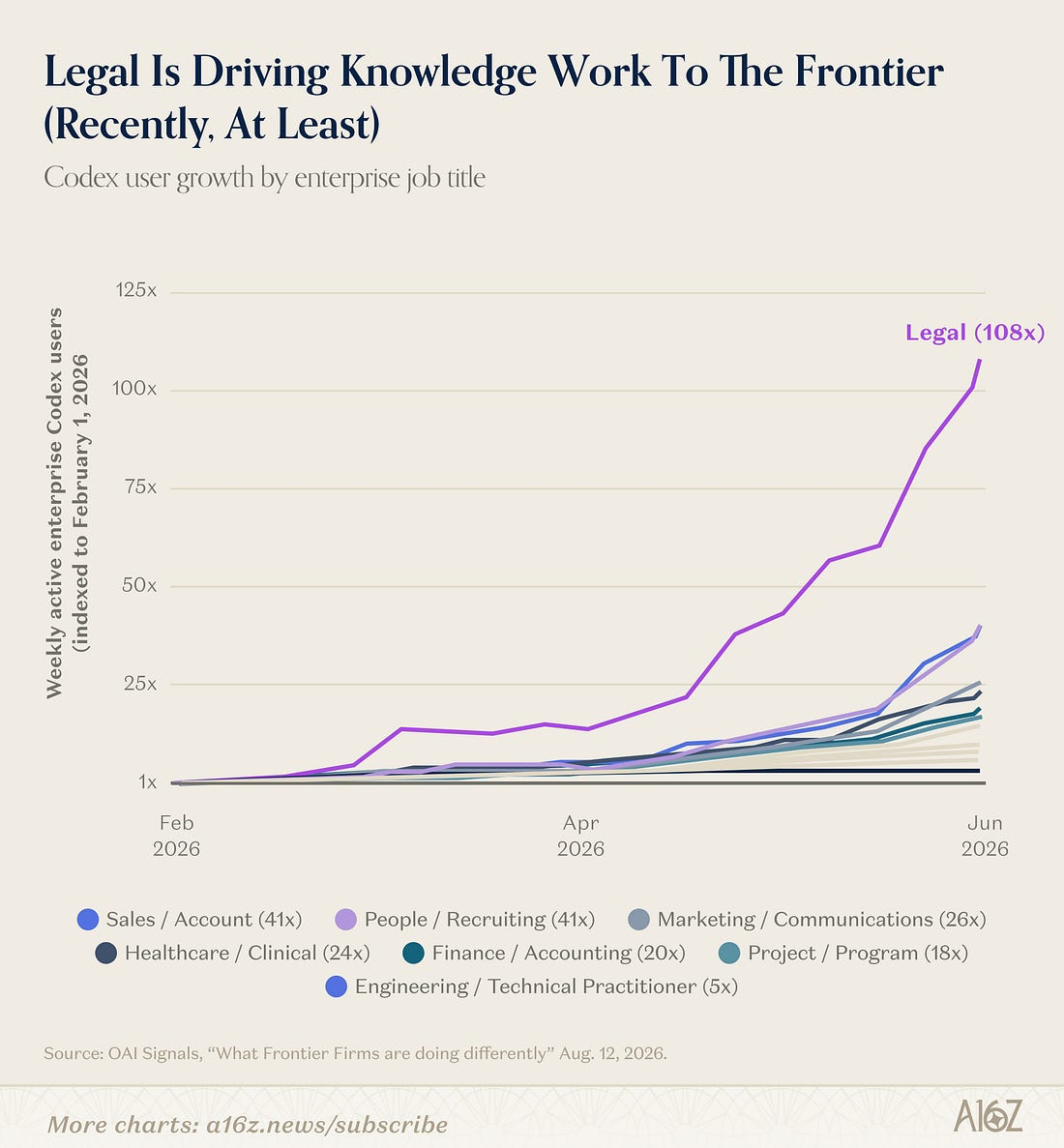
So what’s actually left standing in this table? I’d argue it’s relative ranking.
Codex’s broader rollout wasn’t opened to legal alone. It opened to sales, to marketing, to finance, all at the same time. If everyone started from the same floor and legal still hit 108x while marketing only hit 26x, that 4x gap can’t be explained by “the door opened.” The door opened for everyone — the real question is who walked through it first. That’s the one question today’s piece is trying to answer.
One more thing worth noting. In the same report, as of June, Codex accounted for 64% of combined Codex-plus-ChatGPT output tokens among enterprise customers. That means the center of gravity has shifted — from typing questions into a chat window to handing off entire tasks. What legal switched on wasn’t a coding tool. It was an agent.
The Two Doors Google Opened Last Week
On August 25, Google Cloud released Gemini Enterprise for Financial Services and Gemini Enterprise for Legal simultaneously, in preview. They’re the first two industry-specific versions. Healthcare and life sciences are listed only as “coming soon.”
The two products share the same structure — four layers: domain-specific skills for each industry, MCP1 connectors, agents that actually carry out the work, and a partner ecosystem.
The flagship on the financial side is the Financial Research agent. It ships with more than 50 built-in skills and handles tasks like credit risk assessment, portfolio monitoring, KYC, and bond issuance. Google says it can cut risk-exposure analysis on a complex bond portfolio down to under 5 minutes. The data sources it connects to include FactSet, Moody’s, MSCI, PitchBook, Guidepoint, Dun & Bradstreet, and SEC EDGAR.
On the legal side, it covers contract review and redlining, playbook2 drafting, regulatory monitoring, legal research, and DSAR3 response. It connects to iManage, NetDocuments, DocuSign, Everlaw, RelativityOne, Thomson Reuters HighQ, and even the free case-law database CourtListener. Cleary Gottlieb, Freshfields, Weil, and Williams & Connolly took part in development, while Deutsche Bank and CME Group joined on the financial side.
Up to this point, it’s a fairly ordinary enterprise product announcement. What held my attention was a different sentence.
When the financial agent produces a result, it delivers a confidence score, an explicit methodology, an auditable data snapshot, and precise source citations alongside it. And under data governance, there’s this line: “Licensed data remains licensed. Permissioned data remains permissioned.”
The key point is that this isn’t a newly invented product spec — it’s professional norms transcribed verbatim.
Agents settle first where a scorecard already exists
Overlay two signals and the picture snaps into focus.
Law and finance aren’t fields known for embracing AI. If anything, they’ve long had a reputation for being conservative. But these two professions have three things that other fields lack.
First, their output is text. Contracts, memos, opinions, research notes — exactly the form an agent can produce.
Second, what counts as a passing grade is already written down. Law firms have clause-by-clause playbooks; banks have KYC checklists and underwriting criteria tables. Decades of regulations and precedent have piled up. That’s the exact material you need to train and grade an agent. Last issue I told you that Harvey built 1,750 task environments and 75,000 grading items by hand to train its model. Law is the profession that already had the master copy of that scorecard from the start.
Third, showing your work is already a professional norm. Lawyers never argued a point without citing a source to begin with. Analysts always disclosed their methodology. So “cite your sources, state your methodology explicitly, keep an audit trail” isn’t a safety feature bolted onto an AI product after the fact — it’s the output spec this profession always demanded.

So when Google picked finance and law as its first targets, it wasn’t just about market size. It was staking a claim in the industries whose agent output could actually be graded. In industries where you can’t grade the output, nobody can tell whether the agent did a good job or not.
So the moat isn’t the model — it’s access
The most interesting list in this announcement is the roster of legal connectors. Harvey and Legora are both on it.
The two companies are the leading rivals in the legal AI market. Harvey was valued at $11 billion last March, and Legora at $5.6 billion this April. But instead of pushing them out, Google pulled them in as connectors. In Legora’s case, once both customers approve, some of Legora’s functionality becomes usable inside Gemini Enterprise, while Legora’s source citations and grounding4 remain intact. The trade outlet Artificial Lawyer read this as “not competition, but ecosystem.”
I see it a little differently. The moment you become a connector, the window users open every day belongs to Google. The legal AI company becomes a component supplying features from behind that window. Platforms don’t kill their competitors. They turn them into partners and take the point of contact.
And Harvey has already answered this. As I covered in the last issue, Harvey rolled out its own model, Tenet, within two months, staking its mission on letting “law firms own their own intelligence.” The timing makes it even clearer. Harvey’s announcement came on August 18; Google’s came on August 25. A week before its name showed up on the connector list, Harvey had already answered that it would not become a component.
So the front line in legal and financial AI now runs three layers deep.
| Layer | Who holds it | What’s being sold |
|---|---|---|
| Model | Google, OpenAI, Anthropic | Intelligence itself — a commodity reshaped every two months |
| Grading environment | Harvey, Legora | The ability to know what counts as a pass |
| Access | FactSet, Moody’s, iManage, Thomson Reuters | The original data and the permissions attached to it |
What Google sold here is the wiring that binds all three into a single permission system. In the last issue, I laid out that “the model is the commodity, the environment is the capital asset.” This announcement adds one more line to that: the thing more expensive than the environment is access. No matter how good an agent is, if it can’t read the documents inside iManage under the same permissions the firm already has, no law firm will use it.
Korea Already Runs a 3-Track System
There’s a reason this doesn’t feel like a story from some distant market.
Taepyeongyang, a major Korean law firm, became the first domestic firm to roll out Harvey company-wide in July, then in August became the first large Korean firm to deploy ChatGPT Enterprise company-wide. Domestic case law runs separately on LBox and SuperLawyer, two Korean legal-tech platforms. International contracts go through Harvey, domestic case law goes through homegrown legal tech, and document drafting and translation run on general-purpose AI. That’s already a 3-track system.
What Google is selling sits exactly on top of those three tracks — a governance layer. It’s not adding a fourth tool; it’s making the tools you already have run under the same permission rules.
So the question Korean organizations need to ask right now isn’t “which AI should we buy.” It’s two questions.
One. Does your organization’s repetitive work have a scoring rubric?
A contract-review playbook, screening criteria, a QA checklist. Without one, you can’t judge whether any tool’s output is actually good. And if you can’t judge it, you can’t delegate it — someone ends up re-reading everything anyway. That’s why law and finance moved first. Building this rubric isn’t an AI project; it’s a job-definition project, and it costs you working hours from the business side, not IT budget.
Two. Does the system you’d attach an agent to actually hold permissions?
Google’s announcement line — “permissioned data stays permissioned” — will make immediate sense to anyone whose company documents are scattered across personal PCs and messenger apps. The connector to iManage works precisely because the law firm already uses iManage. If your documents were never permission-gated in the first place, there’s nothing to plug into. For most Korean organizations, the bottleneck isn’t model performance. It’s this.
Closing
Let me sum it up in three points.
First, the 108x figure for Codex users in the legal profession is heavily mixed with base-rate effects. Still, the relative ranking—4x ahead of other professions under the same conditions—is a real signal.
Second, Google chose finance and law as its first industry-specific targets because these two industries already have criteria for grading an agent’s output.
Third, the competitive landscape has shifted from model performance to data access rights and permission systems. The proof is that Google folded Harvey and Legora in as connectors, after Harvey had answered that very question with its own model a week earlier.
Here’s something to try this week: pick the three tasks that repeat most often in your organization, and for each one, write down in five lines what result counts as a “pass.” Once you have those five lines, delegation begins; without them, you just accumulate more tools. Law got there first because it already had those five lines.
📎 References & Further Reading
Primary sources
- OpenAI, “Enterprise signals: What frontier firms are doing differently”, updated 2026.8.12. ··· This is the primary source for the 108x figure. I’d recommend reading not just the per-occupation multipliers, but also OpenAI’s own definition of “frontier firms” (the top 10% of companies by monthly AI usage) and its own caveat that tokens are an imperfect proxy for business value.
- a16z, “Charts of the Week: Winds of Thematic Change”. ··· This is the piece that introduced the chart. What matters is that the authors themselves flag “how much of this is just the Codex rollout” as an open question.
- Google Cloud, “Introducing Gemini Enterprise for Legal”, 2026.8.25. ··· Check the connector list yourself and see Harvey and Legora sitting on it. Chapter 4 of today’s piece came straight out of that list.
- Google Cloud, “Introducing Gemini Enterprise for Financial Services”, 2026.8.25. ··· This is where the 50+ built-in skills, the confidence scores and audit snapshots, and the line “licensed data stays licensed” all live.
- Artificial Lawyer, “Google Launches Gemini Enterprise for Legal”, 2026.8.25. ··· This is evidence that the industry read this announcement as “ecosystem,” not “competition” — the opposite of my own read, so it’s worth reading side by side to form your own judgment.
Background
- ZDNet Korea, “OpenAI’s first foray into the law-firm market — a signal for broader general-AI adoption?”, 2026.8.5. ··· This lays out Bae, Kim & Lee’s firm-wide ChatGPT Enterprise rollout and the “specialized AI + general AI” side-by-side structure. Start here for the Korean context.
- Korea Law Times (Lawtimes), “Bae, Kim & Lee adopts legal AI ‘Harvey’ firm-wide”, 2026.7. ··· This is the first case of a Korean law firm adopting Harvey firm-wide.
- TechCrunch, “Legal AI startup Legora hits $5.6B valuation”, 2026.4.30. ··· This gives the backstory on the rivalry between the two companies Google just absorbed as connectors.

📝 Glossary
Footnotes
-
MCP (Model Context Protocol): A standard that governs how AI connects to external systems’ data and functions. Instead of wiring up a custom connection for every service, it’s closer to using a standardized plug that fits a standardized outlet. ↩
-
Playbook: An internal reference table that law firms or corporate legal teams keep for each contract clause, spelling out “this is acceptable as-is, this must always be revised.” For a human, it’s a manual; for an AI, it becomes an answer key. ↩
-
DSAR (Data Subject Access Request): An individual’s right to ask a company “tell me what personal data you hold on me.” Because there’s a response deadline and it requires combing through a company’s entire document store, it’s a textbook example of work that’s expensive when done by hand. ↩
-
Grounding: A method that ties an AI’s answers to actual source documents — so it doesn’t fabricate — and requires it to cite those sources alongside its response. If no supporting document can be found, the safer choice is not to answer at all. ↩
Related issues
 Issue #216Business
Same Person, Different Name: How Truth Became Falsehood
Substitution breaks not at the person, but at the sentence
 Issue #215Business
The URL Berners-Lee Called 'Cool' Died in 4 Months
Yet his own essay about it has lived at the same address for 28 years.
 Issue #214Business
Why JD.com Is Giving Away Free Helmets
In India, they paid $2.60 an hour for this exact footage.
Your take shapes the next issue
What resonated most in this issue, or where has your experience been different?