The Wuxia Cult That Traces Back to Middle East Oil
A 3rd-century Persian faith became wuxia fiction's Cult of Light — and that same flame ignited the 20th-century oil industry

Opening
Subscriber, do you enjoy wuxia novels? I’m the type who devours everything — classic wuxia, time-loop reincarnation stories, fusion wuxia, wuxia webtoons, all of it. Read enough of them, and one faction keeps showing up without fail: the “Cult of Evil” (魔教, mojiao). They call themselves the “Cult of Light” (明教, mingjiao), but the martial world and the Central Plains brand them mojiao — a sinister group said to worship evil. Of course, now that the picaresque format is trending, plenty of protagonists hail from the cult these days, often portrayed along the lines of “even the cult of evil is just people trying to get by.”

I’m getting a little ahead of myself, but trace the roots of this Cult of Light and you find an astonishing chain of connections — through an ancient Persian religion, all the way to the birth of the 20th-century oil industry. Today’s story is about how religion, fiction, and geopolitics twist together into a single thread.
🔥 The Real Identity of Mingjiao — Manichaeism and Zoroastrianism
If you’re a wuxia fan, you probably picture the Mingjiao from Jin Yong (Louis Cha)‘s The Heaven Sword and Dragon Saber. Based at Guangming Peak (“Bright Summit”), this Mingjiao wields fire- and light-based martial arts like the “Sacred Flame Order” techniques and the “Great Shift of the Universe,” and is depicted as a religion transmitted from Persia.
This setting is grounded in real history. The historical prototype for Mingjiao is Manichaeism (摩尼教)1 — a religion founded in 3rd-century Persia by the prophet Mani. Here’s an important nuance: many people assume the archetype of the “cult of evil” is Zoroastrianism, the “fire-worshipping religion,” but strictly speaking, Manichaeism and Zoroastrianism are two distinct religions.
That said, Manichaeism borrowed Zoroastrianism’s core worldview — the dualistic2 struggle between light (good) and darkness (evil). The reverence for fire and the pursuit of light’s ultimate victory were also lifted from Zoroastrianism. When Manichaeism reached China during the Tang dynasty, it took on the name Mingjiao (明教), meaning “Religion of Light.” By the Song dynasty, it had merged with folk rebel movements like the White Lotus Society3 and drawn suppression from the imperial court. The “Religion of Light” ended up branded the “Demonic Religion” (魔教) — essentially a smear the ruling class stuck on a subversive movement.
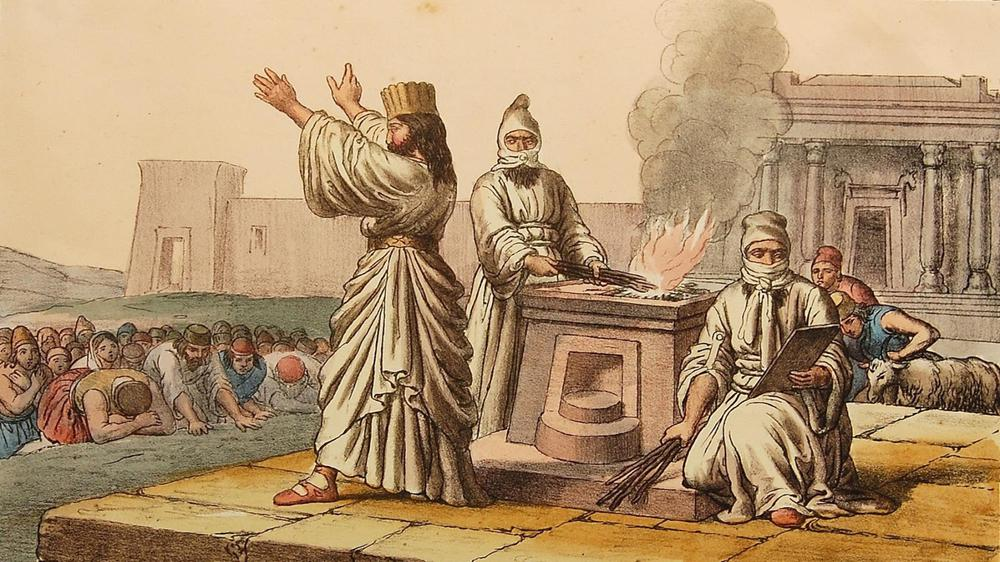
So here’s the through-line: Zoroastrianism (fire worship) built a worldview centered on fire and light; Manichaeism borrowed it and completed the narrative of light struggling against darkness; Manichaeism traveled the Silk Road4 into Tang-dynasty China and became Mingjiao; and the Chinese novelist Jin Yong wove it into wuxia fiction. This lineage is exactly why wuxia novels depict the cult’s martial arts as wielding an unquenchable flame.
Interestingly, there’s even a theory that the name of the Ming dynasty (明朝) itself derives from Mingjiao. The historian Wu Han first raised this connection academically in his 1941 paper “Mingjiao and the Great Ming Empire,” noting that Zhu Yuanzhang — founder of the Ming dynasty, posthumously known as the Hongwu Emperor — rose from the ranks of White Lotus/Mingjiao-affiliated rebels. Once he became emperor, though, he banned Mingjiao outright in 1370. A dynasty named after the very religion its founder later suppressed — that’s one of history’s ironies.
⛽ The Secret of the “Unquenchable Flame” — From Zoroastrianism to Oil
Now the story takes a turn. Let’s go back to Zoroastrianism, the parent religion of Manichaeism.
Zoroastrianism began in Persia around 1000 BCE (estimates vary widely among scholars) and is considered one of the world’s first monotheistic-leaning religions. At its core is a dualism in which the god of good, Ahura Mazda, wages a cosmic struggle against the god of evil, Ahriman — a worldview many scholars believe later influenced Judaism, Christianity, and Islam. Some even argue that concepts like heaven, hell, the Last Judgment, and the messiah first appeared in Zoroastrianism.
The religion’s most iconic feature is its reverence for fire. To be precise, Zoroastrians don’t worship fire itself; they treat it as a symbol of Ahura Mazda’s purity and truth — similar to how Catholicism venerates holy water without worshipping the water itself. A Zoroastrian temple (called an “atashkadeh”) always keeps a sacred fire burning, and once a flame is consecrated, it is never allowed to go out. One temple in Yazd, Iran reportedly has kept a fire burning for more than 1,500 years.
But this “unquenchable flame” hid a geological secret. Across ancient Persia and Azerbaijan, oil seeps5 — spots where natural gas and petroleum leak naturally up through the earth’s surface — dotted the landscape. When gas rising from the ground catches fire, neither rain nor wind can put it out. Ancient people took this as a sign of the divine and built temples on top of it. The “Pillars of Fire” near Baku, the Azerbaijani capital, was a major Zoroastrian pilgrimage site — and by modern geology, it’s simply a natural gas vent.
One man looked at this same connection from a completely different angle. A British businessman.
How could a religion have kept the concept of an “unquenchable flame” alive from before the common era all the way to the present?
🛢️ A British Businessman Sees Oil in Persian Fire
In the early 1900s, there was a man named William Knox D’Arcy — a London millionaire who’d made a fortune investing in Australian gold mines. His attention turned to Persia’s oil potential thanks to geological reports circulating in Europe at the time and the advice of his consultants.
Here’s a fascinating narrative thread: Zoroastrianism had kept an unquenchable flame burning for millennia since before the common era, and the very region where that flame burned — the Zagros Mountains — happened to be rich in oil and natural gas. Ancient religious phenomena and underground resources sprang from the same root.
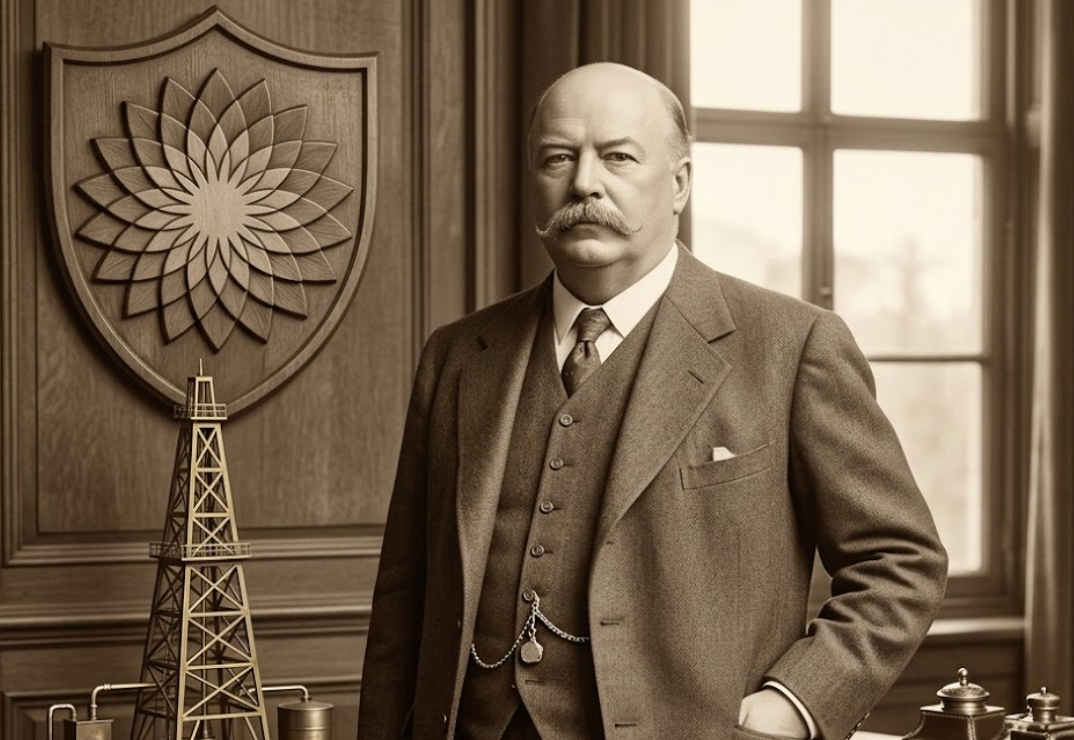
In 1901, D’Arcy began negotiating with Mozaffar al-Din Shah of Persia. On May 28 of that year, he secured a 60-year exclusive concession to extract oil. Known as the “D’Arcy Concession”6, the terms of this deal required a cash payment of £20,000 (roughly £2.1 million today, or ₩3.5 billion), an equal value in company shares, and 16% of annual net profits paid to the Persian government. The concession covered roughly 1.2 million square kilometers — three-quarters of Persia’s entire territory.
But oil didn’t come easily. D’Arcy never once set foot on Persian soil himself; he entrusted the fieldwork to a geologist named George Bernard Reynolds. Exploring hostile terrain, dealing with tribes that didn’t recognize the central government’s authority, in near-roadless wilderness, was hell. After seven years of prospecting, D’Arcy had poured in £160,000, even taking out bank loans, and was effectively on the brink of bankruptcy. In early May 1908, investors cabled Reynolds: “Stop work, discharge the staff, dismantle the equipment, and come home.”
Just days before that telegram arrived, however, a massive oil field was finally discovered at Masjed Soleyman. The timing was almost cinematic. It became the first commercial oil development in the Middle East.
For reference, the world’s first commercial oil well was drilled by Edwin Drake in 1859 in Pennsylvania, USA. D’Arcy’s find wasn’t a “world first,” but it carries a different kind of historical weight: it opened the curtain on the age of Middle Eastern oil. This field became the foundation for the Anglo-Persian Oil Company, founded in 1909 — the company that would later become BP (British Petroleum), a petrochemical giant with a market cap of roughly ₩170 trillion.
🌍 The Geopolitics Oil Built — Coups, Revolution, and the Present
What follows only grows more complicated. In 1914, when the British Navy switched its warship fuel from coal to oil, the British government acquired a 51% stake in the company. Persian oil had become a core resource for British naval power.
The problem was profit-sharing. Under the contract, Persia was to receive 16% of net profits, but in practice the British side never opened its books, and the amounts Persia actually received through the 1920s fell far short of what was promised. In 1932, Reza Shah — the first monarch of the Pahlavi dynasty — unilaterally canceled the D’Arcy Concession, but under British pressure, the two sides renegotiated in 1933. The terms improved slightly, but the concession’s term was actually extended, to 1993.
The decisive turning point came in 1951. Iran’s democratically elected prime minister, Mohammad Mosaddegh, nationalized7 the oil industry — a law passed unanimously by the Iranian parliament. (Put simply: Iran’s government was forcibly reclaiming what had effectively been an unequal treaty of the time… though from the British/American perspective, this broke the agreement — so they engineered an internal coup to take it back.) But in 1953, the American CIA and British MI6 jointly staged a coup (Operation Ajax) that ousted Mosaddegh and reinstated Mohammad Reza Pahlavi (Pahlavi II). The oil concession was then reorganized into a consortium8 structure, with BP holding 40% and American oil companies splitting a substantial share.
The Pahlavi dynasty remained a steadfast American ally, but public anger over corruption and dictatorship kept building. Then in 1979, the Islamic Revolution toppled the Pahlavi dynasty and gave birth to today’s Islamic Republic of Iran. And… that Iran is the same country now run by a clerical leadership.
Oz’s Lens
What struck me most when I first came across this story was how the same phenomenon can carry a completely different value depending on the frame through which you view it.
Ancient people saw flames rising from the earth and took them as a manifestation of the divine. For thousands of years, they built temples on top of them, wrote scripture, performed rituals. But a modern businessman looked at the same phenomenon and instinctively sensed the presence of underground resources. Once the “interpretive frame” shifted, an object of religious wonder was completely transformed into a source of economic value.
I think this kind of frame-shift keeps repeating itself in today’s AI era. What we see as a “simple text generator,” someone else might be reading as “the end of the search paradigm.” What we dismiss as a “fun chatbot,” someone else might be interpreting as “a signal of structural change in the labor market.” In the end, what determines the value of a phenomenon isn’t the phenomenon itself — it’s the frame of the person reading it.
What made D’Arcy remarkable wasn’t that he discovered oil. It’s that he held a frame that let him reinterpret something everyone else had seen for thousands of years only as “sacred fire,” as “evidence of underground resources.” That’s the whole point.
Closing
How does this story land for you? Isn’t it fascinating? I personally love stories like this — where a piece of lore or legend that most people would just let pass by, someone else leans in, listens closely, and snowballs it into an enormous outcome. The Cult of Evil (Mingjiao) from wuxia fiction is Manichaeism, born in 3rd-century Persia and transmitted to China — and Manichaeism itself borrowed Zoroastrianism’s dualism of light and darkness. Plenty of people could have heard this and simply thought, “huh, interesting,” and moved on.
The “unquenchable sacred fire” that Zoroastrianism maintained for millennia was built atop spots where oil and natural gas vented from the earth, and this very connection became the prelude to the 20th-century Middle Eastern oil industry. The journey from a single drop of oil to imperialism, coups, and revolution demonstrates geopolitics’ basic formula: resources are power.
And one bonus note: the founder of Zoroastrianism was named Zarathustra — the very same figure from Nietzsche’s Also sprach Zarathustra (Thus Spoke Zarathustra). Nietzsche believed Zarathustra was the first person to establish a moral system of good and evil, and that’s precisely why he chose Zarathustra as the name of the figure who would go on to dismantle that very moral system. There’s an irony of history here too.
References & Further Reading
Primary sources
- “D’Arcy Concession”, Wikipedia / Encyclopaedia Iranica. : A detailed account of the D’Arcy Concession’s original terms and historical context.
- “Chinese Manichaeism”, Wikipedia. : An academic overview of how Manichaeism transformed into Mingjiao in China.
- “1953 Iranian coup d’état”, Britannica. : A balanced account of Mosaddegh’s ouster and the CIA/MI6 involvement before and after.
Background
- Giuseppe Etiope, “‘Eternal flames’ of ancient times could spark interest of modern geologists”, ScienceDaily, 2015. : Explains the geological link between ancient “eternal flames” and natural gas seeps.
- “Ming Cult”, Wikipedia / WuxiaSociety. : Analyzes the relationship between Jin Yong’s fictional Mingjiao and the historical Manichaeism.
- Friedrich Nietzsche, Also sprach Zarathustra, 1883–1885. : Nietzsche’s landmark work, borrowing the name of Zoroastrianism’s founder, that attempts to dismantle the dualism of good and evil. Personally, I’d recommend the Minumsa translation.

The author, Kwangseob Ahn, is a professor of business administration at Sejong University and lead consultant at OBF (Oswarld Boutique Consulting Firm). He teaches statistics and data analysis — business data management and business analytics — while leading GTM and AI strategy consulting in the field, designing the seam between technology and business. He has published academic research on a memory architecture for AI dialogue systems (HEMA) and runs Daily Arxiv, a daily curation of global AI papers. He holds a master’s from Korea University’s Graduate School of Technology Management and a KMBA. He is the author of Homo Brainless: The People Who Outsource Their Thinking.
Footnotes
-
Manichaeism: A religion founded in 3rd-century Persia by the prophet Mani. It blended elements of Zoroastrianism, Christianity, and Buddhism, with the cosmic struggle between light (good) and darkness (evil) as its core doctrine. It once spread from the Roman Empire to China, but has since died out in most regions. ↩
-
Dualism: A worldview that explains the universe through two opposing principles, such as good and evil, or light and darkness. Zoroastrianism is the classic example, holding that Ahura Mazda (good) and Ahriman (evil) wage a cosmic struggle. Think of it like how every Marvel movie needs both a hero and a villain — same basic structure. ↩
-
White Lotus Society: A folk religious movement active during China’s Song, Yuan, and Ming dynasties. It blended the Buddhist belief in the coming of Maitreya Buddha with Manichaeism’s doctrine of light and darkness, and became the ideological basis for numerous rebellions. ↩
-
Silk Road: The general term for the ancient trade routes connecting China to Rome. Far more than silk traveled along it — religions, technologies, and diseases moved along it too, and both Manichaeism and Zoroastrianism reached China this way. Think of it as the internet of its day — a superhighway for information and cultural exchange. ↩
-
Oil seep: A phenomenon in which underground oil or natural gas naturally leaks up to the surface through cracks in rock. Observed since ancient times, oil seeps are used in modern oil exploration as a geological clue suggesting the presence of a large underground oil field. ↩
-
Concession: A contract in which a country’s government grants a foreign individual or company exclusive rights, for a set period, to explore, extract, and sell its natural resources. Common between resource-rich nations and great powers during the 19th–20th century age of imperialism, these deals often came with unequal terms. ↩
-
Nationalization: A policy that converts industries or assets owned by private or foreign companies into state ownership. Iran’s oil nationalization was a declaration that the country would directly manage resource revenues that had been going to foreign companies — and it became the direct cause of the 1953 coup. ↩
-
Consortium: An alliance formed by multiple companies to jointly carry out a specific business venture. The 1954 Iranian oil consortium included major Western oil companies such as BP (UK), Exxon and Mobil (US), and Shell (UK-Netherlands). ↩
Related issues
 Issue #66Business
Meta's $6M Verdict Just Gave PMs a New Job
It's not the $6 million verdict that matters — it's the 30-year-old legal shield that just cracked.
 Issue #65Business
Your Book Taste Reveals Your Personality
Your book preferences quietly map your personality — the same logic that powers Netflix's recommendation engine.
 Issue #64Business
The Compliance Startup That Broke Compliance
YC's expulsion of Delve exposes cracks in open-source ethics and startup trust networks.
Your take shapes the next issue
What resonated most in this issue, or where has your experience been different?