Your Book Taste Reveals Your Personality
Your book preferences quietly map your personality — the same logic that powers Netflix's recommendation engine.

Opening
Dear reader, picture your bookshelf for a moment. Some of you probably have shelves packed with fantasy novels; others have rows of self-help books. But what if that bookshelf were actually a fingerprint of your personality?
There’s real research that scientifically proves this, drawing on data from more than 60,000 people. It found that your favorite book genres and tags can predict your personality with up to 47% accuracy. And this is the exact same principle behind the algorithm Netflix uses to recommend content to you right now.
Today, let’s unpack the structure hiding behind the word “taste.”
Two Languages for Measuring Personality: MBTI and the Big Five
To understand this story, we first need to understand how personality is measured.
In Korea, MBTI functions almost like a shared language. You’ve probably heard people say things like “I’m an INFP, so I love fantasy” all the time. But in academia, researchers mainly use a model called the Big Five (OCEAN)1 instead of MBTI.
Here’s an easy way to picture the difference. If MBTI is 16 rooms, the Big Five is 5 volume dials. MBTI cuts you cleanly in two — “you’re either extroverted or introverted” — while the Big Five sees things as a continuous spectrum: “your extraversion scores 72 out of 100.” That’s why it’s the model that’s been repeatedly validated over decades for predicting things like job performance, health, and relationships.
That’s not to say MBTI is bad. In everyday conversation, “I’m an ENFP” is far more intuitive than “I’m 72 on extraversion, 85 on openness.” It’s just worth keeping in mind that these are tools with different levels of academic precision. You might think, “Isn’t 5 fewer than 16?” — but if you count the Big Five’s opposite poles and midpoints, you actually land at least 10 to 15 categories, so it’s comparable, not smaller. Anyway, read on with an open mind!
What 60,000 People’s Data Reveals
Now let’s get to the main point. A research team led by Ng Annalyn published a paper in IEEE Transactions on Affective Computing. This study gathered data from 61,662 users through Facebook’s myPersonality app, and pulled 24,091 tags and data on 479 books from Goodreads, the world’s largest reading community. Those tags were used a combined total of more than 193,000,000 times.
Existing research had analyzed things at the level of at most 81 genres. Inside a broad category like “fantasy,” there are dozens of distinct flavors — dark fantasy, urban fantasy, high fantasy — but earlier studies lumped them all together. This study, by contrast, used 24,000 user-generated tags to capture a far more granular texture of taste.
Personality × Reading Taste: Five Findings
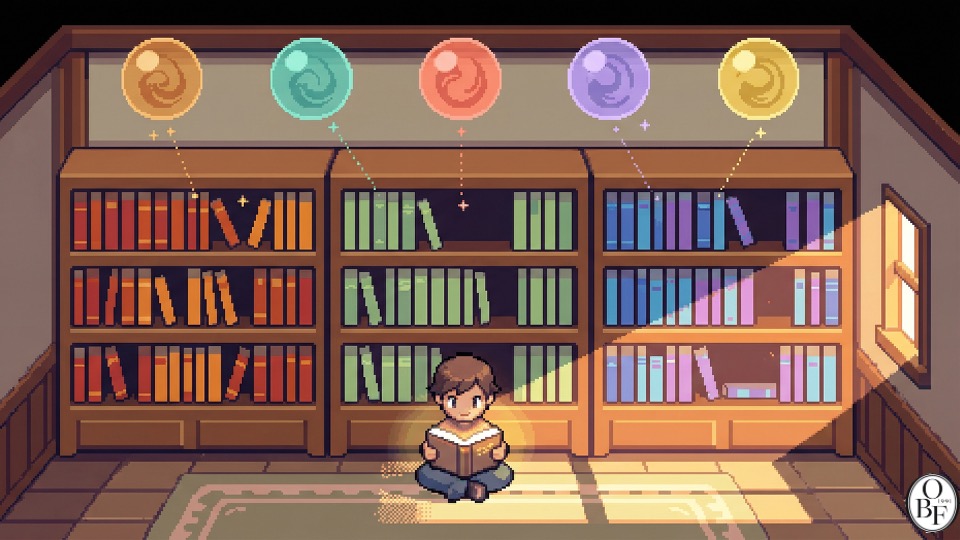
Here’s how the results break down by personality dimension.
Extraversion: Extraverted people liked “people stories” — relationships, chick lit2, memoirs. Introverted people preferred genres that let them escape into imagined worlds — fantasy, sci-fi, comics.
Agreeableness: People high in agreeableness liked Christian classics, family stories, and children’s books. Conversely, people low in agreeableness enjoyed works with a twisted perspective, like psychological drama or cult classics.
Openness: This dimension showed the strongest predictive power in the study. An R² of 0.473 — meaning reading taste alone can explain 47% of the variation in a person’s openness. In social science, that’s remarkably high explanatory power. People high in openness preferred philosophical novels and university liberal-arts books, while people low in openness preferred lighter genres like light fantasy.
Neuroticism: People who tended toward emotional instability liked books with sad endings or books about mental health. Interestingly, there was also a correlation with the “pretty cover” tag, though this needs careful interpretation since gender is a confounding variable here. Conversely, emotionally stable people preferred self-help books or science and technology books.
Conscientiousness: Conscientious people liked professional reading, business, and history books, while less conscientious people liked humor or YA novels.
The Behavioral Tag: “Books to Read Later”
There’s one finding in this study that deserves special attention. The “back-burner” tag — meaning “books to read later” — showed the strongest correlation with openness, at a correlation coefficient of 0.28. People high in openness tend to stockpile a huge number of books they want to read.
This is the first finding to show that personality is reflected not just in genre preference, but in reading “behavior” itself. Earlier research only looked at “what” people read, not “how” they read.
Why This Finding Matters: How AI Recommendations Actually Work
Let’s take this one step further. Do you know how Netflix classifies its content? It’s not as simple as sorting things into “romance” or “action.” According to a 2014 investigation by The Atlantic, Netflix was operating with 76,897 micro-genres (altgenre). That’s granular enough to produce categories like “Romantic British Period Dramas Good for a Rainy Day.”
This is essentially the same approach as the study above using 24,000 tags. Fine-grained tags capture the texture of taste that gets lost when you lump things into broad genres. And more than 80% of what gets watched on Netflix reportedly comes from this recommendation algorithm.
Netflix doesn’t officially say “we’re figuring out your personality.” But classifying taste across more than 70,000 micro-genres is, structurally, the same thing as building a personality profile.
There’s another study that supports this point. In 2015, a research team at Cambridge University led by Wu Youyou published a paper in PNAS analyzing Facebook Likes data from 86,220 people. They found that a computer could predict a person’s personality more accurately than that person’s friend using just 70 Likes, more accurately than family using 150 Likes, and approaching the accuracy of a spouse using 300 Likes.
There’s a reason this matters even more in Korea’s context. According to the Ministry of Culture, Sports and Tourism’s 2025 National Reading Survey, the overall adult comprehensive reading rate stands at 38.5%, an all-time low. Yet people in their 20s were the only group to see a slight rise, up to 75.3%. Even more notable: among people in their 20s, the e-book reading rate of 59.4% significantly outpaced print books (45.1%).
On e-book platforms, everything accumulates as data — what you read, where you stopped, how fast you read. None of that’s possible with print books. The more digital reading accelerates, the more precisely these algorithms will inevitably be able to read our taste — and, ultimately, our personality.
Oz’s Lens
Honestly, two thoughts crossed my mind looking at these findings. One is genuine admiration. The fact that even a behavioral tag like “books to read later” reflects personality means that the way we consume content is itself a kind of personality signature. From my own experience working with data analysis, an R² of 0.47 is a fairly impressive figure for a single-variable model.
The other is a structural concern. There’s a pattern I’ve seen repeatedly while working on business strategy. When a company says it “understands” its users, the purpose of that understanding is almost always conversion. Netflix’s 76,897 micro-genres are a tool for improving user experience, but they’re also engineered to reduce churn. Netflix’s own estimate that its recommendation engine prevents over $1 billion a year in subscription cancellations speaks to this.
The problem is that, within this structure, users have no way of knowing they’re being profiled. Behind the friendly label of “taste recommendations,” what’s actually happening is the collection of personality data. As more people in their 20s in Korea move to e-book platforms, this asymmetry will only grow.
And personally, I think this might be exactly the direction Korean reading-club services like Trevari and Hitch should head in. Think about it — these aren’t platforms where people show up to one or two meetings and leave; they’ve accumulated countless books and tags tied to individual users. Building on that to recommend personality types and tastes — and beyond that, ads, content, and products — feels like it could be an enormous business opportunity.
Closing
What this research tells us is that reading taste is a mirror of personality. Especially on the dimension of openness, an R² of 0.47 means that just by looking at what books you’re drawn to, you can read nearly half of that person’s personality. And tags carry far richer information than genres do — even a behavioral tag like “books to read later” reflects personality. AI recommendation algorithms are already operating on this exact principle. Netflix’s 70,000 micro-genres are the proof.
One more thing before I go. If reading taste reflects personality, could the reverse also be true — could reading genres you don’t usually read shift your personality, even a little? In fact, a study by Djikic et al. (2009) found that reading fiction produced significant changes in self-reported personality traits. Causation isn’t fully established, but it’s a fairly fascinating possibility.
Next time you pick up a book, why not consciously reach for a different shelf than usual? That might just be the first step outside the algorithm’s recommendations.
References & Further Reading
- Ng Annalyn, Maarten W. Bos, Leonid Sigal, Boyang Li, “Predicting Personality from Book Preferences with User-Generated Content Labels”, IEEE Transactions on Affective Computing, Vol.11, 2020, pp.482-492. : This is the core evidence behind today’s newsletter. The visualization of top tags by personality dimension in Fig. 2 is especially intuitive.
- Wu Youyou, Michal Kosinski, David Stillwell, “Computer-based personality judgments are more accurate than those made by humans”, PNAS, Vol.112(4), 2015, pp.1036-1040. : A study on personality prediction based on Facebook Likes. It found that AI judges personality more accurately than a friend can.
- Ministry of Culture, Sports and Tourism, “2025 National Reading Survey”, 2025. : The key figures are the adult reading rate of 38.5% (an all-time low) and the rebound among people in their 20s (75.3%).
- Alexis C. Madrigal, “How Netflix Reverse Engineered Hollywood”, The Atlantic, 2014. : An article dissecting the structure of Netflix’s 76,897 micro-genres. Essential reading for understanding how recommendation algorithms work.
- Maja Djikic, Keith Oatley, Sara Zoeterman, Jordan B. Peterson, “On Being Moved by Art: How Reading Fiction Transforms the Self”, Creativity Research Journal, Vol.21, 2009, pp.24-29. : An experimental study on how reading fiction affects personality traits.

The author, Kwangseob Ahn, is a professor of business administration at Sejong University and lead consultant at OBF (Oswarld Boutique Consulting Firm). He teaches statistics and data analysis — business data management and business analytics — while leading GTM and AI strategy consulting in the field, designing the seam between technology and business. He has published academic research on a memory architecture for AI dialogue systems (HEMA) and runs Daily Arxiv, a daily curation of global AI papers. He holds a master’s from Korea University’s Graduate School of Technology Management and a KMBA. He is the author of Homo Brainless: The People Who Outsource Their Thinking.
Footnotes
-
Big Five (OCEAN): Five axes psychology uses to measure personality. The letters stand for Openness, Conscientiousness, Extraversion, Agreeableness, and Neuroticism — hence the name “OCEAN.” Rather than sorting people into types the way MBTI does, it’s a continuous model that expresses each axis as a score between 0 and 100. ↩
-
Chick Lit: A fiction genre dealing with the daily life, romance, and careers of women in their 20s and 30s in a light, humorous way. Bridget Jones’s Diary is the classic example. ↩
-
R² (coefficient of determination): A value showing how much of the variation in data a model explains. 0 means no explanatory power at all; 1 means perfect explanation. In social science, an R² of 0.47 is considered “remarkably high explanatory power.” For reference, in social science research, even an R² of just 0.1 to 0.2 is often considered a meaningful result. ↩
Related issues
 Issue #64Business
The Compliance Startup That Broke Compliance
YC's expulsion of Delve exposes cracks in open-source ethics and startup trust networks.
 Issue #61Business
BYD's 5-Minute Charging Is About Structure, Not Speed
It's not about who can build the same technology — it's about who shares the same industrial structure
 Issue #59Business
From a Garage to $3.8 Trillion: Apple at 50
Three growth curves — economic, ecosystem, and creative — explain why the company's flywheel is so hard to break.
Your take shapes the next issue
What resonated most in this issue, or where has your experience been different?