TikTok's $10 Billion 'Fee' Isn't Really About a Fee
The US government is testing how to turn regulatory power into a revenue-generating asset
Opening
Hello, subscriber. This is Oswarld’s Knowledge Talking. Last week, The Wall Street Journal and The New York Times reported the same figure on the same day: $10 billion (about ₩14 trillion). That’s the amount the investor consortium1** that acquired TikTok’s US business has agreed to pay to the US Treasury.**
In deals like this, the investment bank handling advisory work typically earns a fee of 0.5–2% of the deal value. Bank of America’s fee for advising on the Norfolk Southern acquisition — one of the largest single advisory fees in history — was about $130 million, which comes out to just 0.18% of a $71.5 billion deal.
But in the TikTok deal, the $10 billion the US government is collecting is roughly 70% of the $14 billion valuation Vice President JD Vance disclosed for the business. This isn’t a fee. What this number actually signals lies somewhere else entirely.
What Happened — The Anatomy of $10 Billion
A bill passed with bipartisan support in 2024 required ByteDance to either sell TikTok’s US business or shut it down. President Trump repeatedly extended the deadline through executive orders after taking office, and the White House itself became the central broker of the sale negotiations.
Vice President JD Vance ran point on the deal, and a structure emerged in which Oracle, Silver Lake, and the Abu Dhabi investment firm MGX each acquired roughly 15% stakes. ByteDance’s stake was reduced to below 20%, and a new entity, “TikTok USDS Joint Venture LLC,” was created to handle US user data protection and content moderation.
Up to this point, it’s a story about restructuring for national security reasons. But this deal has one line item you don’t see in a typical M&A transaction: a $10 billion “transaction fee” that the investors must pay to the Treasury. About $2.5 billion was already paid when the deal closed this past January, with the remainder due in installments.
President Trump explained the figure this way last September: “The United States is going to be receiving a tremendous fee. I call this a ‘fee-plus.’ It’s the price of making the deal happen.”
Background — The Portfolio of a “Dealmaker State”
If you view the TikTok fee purely as a US–China conflict, or as an isolated incident involving one Chinese company, you miss something important. It’s one of a series of deals the US government has struck with private companies since 2025. Laid out, the pattern looks like this.
Equity-stake type: In August 2025, in exchange for disbursing CHIPS Act2 funds to Intel, President Trump secured roughly a 10% stake in Intel (worth about $8.9 billion). Similar structures followed at rare-earth mining companies MP Materials (15% stake), Lithium Americas (10%), and Trilogy Metals (10%).
Veto-power type: In approving the merger between US Steel and Japan’s Nippon Steel, the US government secured a “golden share.”3 It carries no economic return but grants veto power over the company’s strategic decisions. That power was actually exercised in September 2025, in connection with a decision to close a steel plant in Illinois.
Revenue-share type: In August 2025, Nvidia and AMD received export licenses for AI chips sold to China on the condition that they pay 15% of that China revenue to the US government. President Trump initially demanded 20%, and said the figure was negotiated down to 15% after talks with Nvidia CEO Jensen Huang. CFRA Research estimated this could generate roughly $5 billion a year for the US government.
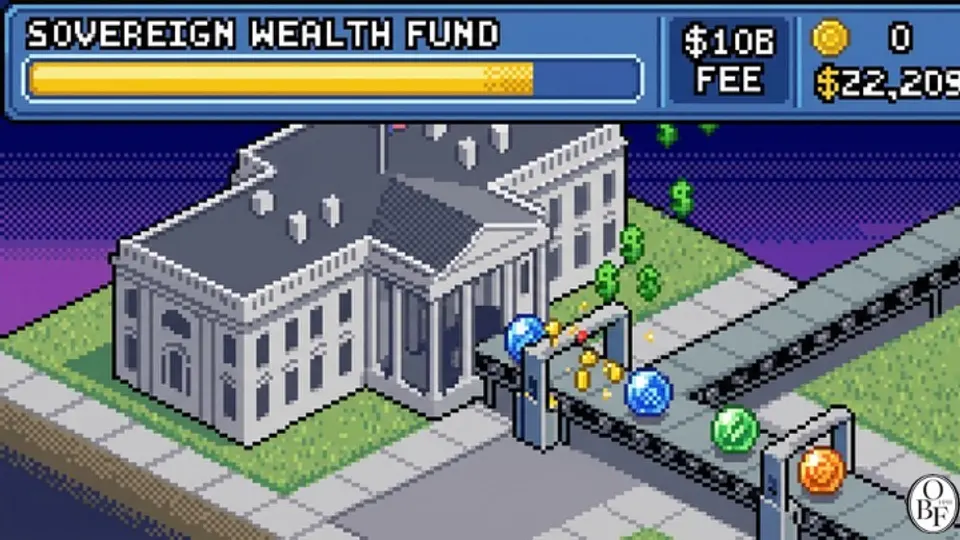
Fee type: And now, TikTok’s $10 billion. Kevin Hassett, Chair of the White House National Economic Council (NEC), summed up this whole trend in one phrase during a CNBC interview: “a down payment on a sovereign wealth fund4.” He said “the president has believed since his campaign days that the US should have its own sovereign wealth fund” and that similar deals would follow across more industries.
Where This Goes — Three Points to Watch
If this pattern expands, several structural questions arise.
First: is this a tax, a fee, or a negotiation? Nvidia’s revenue-share arrangement is officially described as “voluntary.” Whether a “voluntary” agreement reached while an export license hangs in the balance is truly voluntary is a question constitutional scholars are still debating. Gary Hufbauer, a senior fellow at the Peterson Institute for International Economics, has pointed out that this structure may effectively bypass Congress’s taxing authority. TikTok’s $10 billion can be read the same way.
Second, there’s the risk that government equity stakes distort markets. According to an analysis by the Cato Institute, the stock prices of companies in which the US government took a stake jumped sharply after the announcements. Intel’s stock more than doubled after its stake announcement, Trilogy Metals rose 171%, and MP Materials rose 122%. Once the government effectively becomes “insurance” for a specific company, investors may start basing decisions on political relationships rather than fundamentals.
Third, this model could be replicated by other countries. If the US successfully collects a “market access fee” from digital platforms, other governments may start demanding similar arrangements from Big Tech companies trying to enter their own markets. In effect, a prototype for a “digital tariff” is being built right now.
Oz’s Lens
I want to call this phenomenon “Regulation as Revenue.” Normally, when a company enters a new market, its biggest cost isn’t product development or marketing. Good domestic examples are Socar (a Korean car-sharing service) and Toss (a Korean fintech app). The real cost is “the cost of getting permission” — licensing, regulatory approval, standards certification. The time and resources these processes consume often determine whether a business succeeds or fails.
What the US government is doing is experimenting with turning that “permission cost” into an official revenue model. Export licenses are traded for a cut of revenue. Merger approval comes with a golden share attached. Permission to keep operating in the market is exchanged for a $10 billion fee.
What deserves attention here is who actually bears this cost. TikTok’s investors are the ones formally paying the $10 billion, but that cost will inevitably show up in how the platform is run. Nobody has yet answered what it means, long-term, for a $14 billion business to start out carrying $10 billion in obligations before it’s even off the ground — for the platform’s competitiveness, or for its creator ecosystem.
As someone who looks at data for a living, there’s one more thing worth flagging: the $14 billion valuation itself is questionable. TikTok’s annual US revenue is estimated at over $10 billion, on a platform with more than 170 million active US users. Around the same period, Snapchat’s market cap was about $14 billion — and that figure covers Snapchat’s entire global business. In other words, the $14 billion valuation placed on TikTok’s US business alone is quite conservative, and it’s on top of this already-low valuation that a 70% fee has been layered.
Closing
To sum up:
- TikTok’s $10 billion fee isn’t an isolated episode of US–China conflict or a one-off targeting a single Chinese company. It’s the latest instance of a new pattern in which the US government intervenes in private companies that own digital services, using four tools: equity stakes, golden shares, revenue sharing, and transaction fees.
- The White House sees this as the seed of a sovereign wealth fund, and has officially signaled that similar deals will multiply.
- If this model succeeds, other countries may replicate it. Watch closely whether a new cost category — a “market access fee” on digital platforms — becomes a standard feature of the global tech industry.
References & Further Reading
- “TikTok Investors Set to Pay $10 Billion Fee to Trump Administration”, The New York Times, 2026.03.14. : The article that sparked this issue. It covers the structure and background of the $10 billion fee in the most detail.
- “US to Receive $10 Billion Fee for TikTok Deal”, The Wall Street Journal, 2026.03.13. : Reported this alongside the NYT. Contains more specific comments from administration officials.
- “Trump administration set to receive $10 billion ‘fee’ for brokering TikTok deal”, Investing.com, 2026.03.14. : A clear comparison against typical M&A advisory fees.
- “Tracking the Unseen Costs of ‘State Corporatism’”, Cato Institute, 2026.01.31. : A full accounting of the Trump administration’s equity-stake portfolio, including a critical risk assessment.
- “Did Trump effectively nationalize US Steel with his ‘golden share’?”, Atlantic Council, 2025.06.16. : Useful for understanding the legal nature and limits of golden shares.
- “‘Bizarre’ Nvidia, AMD chip export deal with Trump raises legal questions”, The Hill, 2025.08.12. : Covers the constitutional debate around the revenue-share structure.
- “Government will take stakes in more firms, top Trump adviser says”, Axios, 2025.08.25. : The original context behind Kevin Hassett’s “down payment on a sovereign wealth fund” remark.

The author, Kwangseob Ahn, is a professor of business administration at Sejong University and lead consultant at OBF (Oswarld Boutique Consulting Firm). He teaches statistics and data analysis — business data management and business analytics — while leading GTM and AI strategy consulting in the field, designing the seam between technology and business. He has published academic research on a memory architecture for AI dialogue systems (HEMA) and runs Daily Arxiv, a daily curation of global AI papers. He holds a master’s from Korea University’s Graduate School of Technology Management and a KMBA. He is the author of Homo Brainless: The People Who Outsource Their Thinking.
Footnotes
-
Consortium: a temporary alliance of companies or institutions formed for a specific business or investment purpose. It lets multiple parties jointly take on large projects that would be hard for any single entity to handle alone. In the TikTok deal, Oracle, Silver Lake, and MGX formed one such consortium. ↩
-
CHIPS Act (CHIPS and Science Act): a law passed under the Biden administration in 2022 that provides about $52.7 billion in subsidies and tax incentives to expand semiconductor production in the US. It was designed to reduce US dependence on China in the chip supply chain. ↩
-
Golden Share: a special class of stock that gives a government veto power over certain strategic decisions without requiring an actual equity stake in the company. It carries no economic benefit (like dividends), but functions as a “brake” the government can apply to decisions touching national security. ↩
-
Sovereign Wealth Fund: a state-owned fund that invests a country’s assets to generate returns. Norway’s sovereign wealth fund (worth about $1.8 trillion) is the most famous example, alongside large funds run by Middle Eastern oil-producing nations, China, and Singapore. These funds are typically financed by natural resource revenue or trade surpluses — and until now, the US has never had an official sovereign wealth fund. ↩
Related issues
 Issue #48Business
China's 15th Five-Year Plan: Structure Over Speed
The era of speed is over — what Beijing is really trying to change is the fundamental makeup of its economy.
 Issue #47Business
Perplexity Profits on Every Sale — But Not Enough Yet
Perplexity says every revenue dollar has a positive gross margin, yet the company still loses money. Here is what its AI costs reveal.
 Issue #46Business
Your Sadness Is Someone Else's Ad Timing
When feelings become merchandise, protecting minors alone isn't enough to solve the problem.
Your take shapes the next issue
What resonated most in this issue, or where has your experience been different?