The SaaS Stock Crash Isn't Really About AI
Software is shifting from a divergence phase to convergence—survival favors those who deliver action, not summaries.
Opening
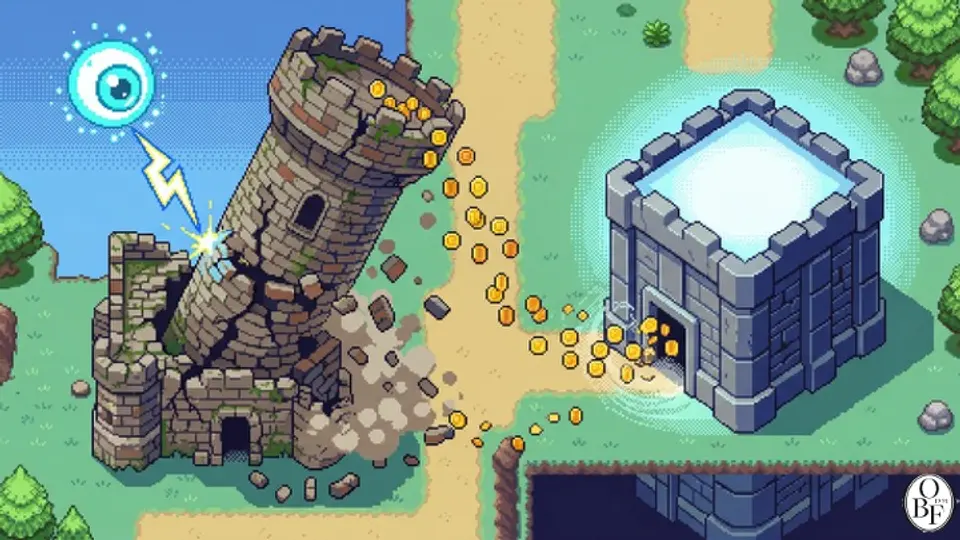
Dear subscriber, if you’ve checked your stock portfolio recently and happen to be holding software names, you’ve probably let out a sigh. The iShares Expanded Tech-Software Sector ETF (IGV) has fallen about 30% from its September 2025 peak. Over the same period, the Nasdaq 100 (QQQ) has stayed roughly flat, while the semiconductor ETF (SMH) has actually climbed 30%. Software is the one category taking the beating.
The headlines are unambiguous: “AI is killing SaaS.” Wall Street even coined a new term for it—“SaaSpocalypse” (SaaS + Apocalypse). But I think this narrative is only half right. AI pulled the trigger, sure, but the bullet was already loaded. Today I want to talk about what that pre-loaded bullet actually was.
The surface: what happened
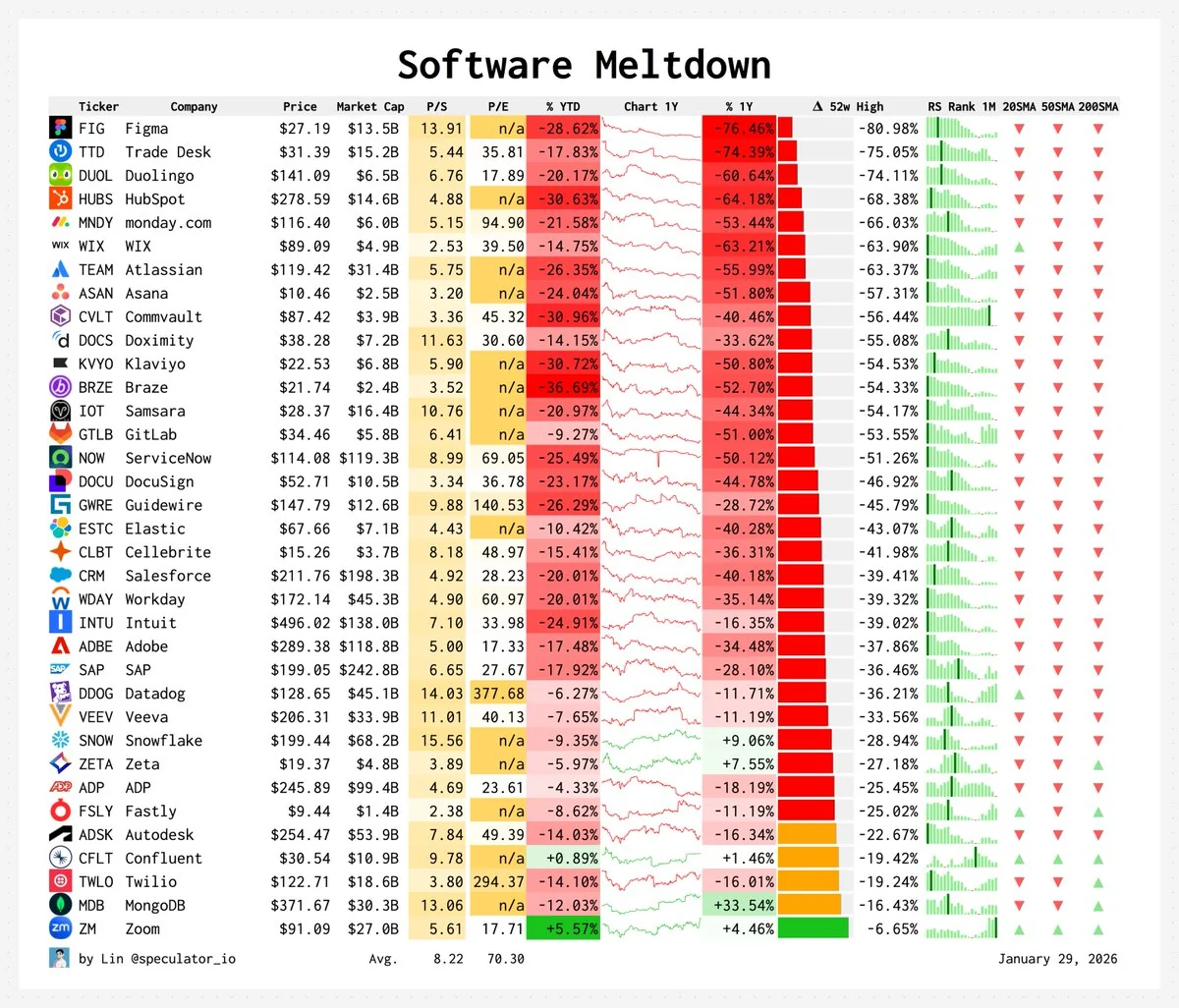
From mid-January through early February this year, roughly $1 trillion in market cap evaporated from software stocks. The S&P North American Software Index dropped 15% in January alone—its worst monthly decline since the 2008 financial crisis.
The immediate trigger was a wave of AI agent product launches. Anthropic released Claude Cowork as a research preview in January and shipped the full enterprise version in late February. It connects directly to Google Drive, Gmail, and DocuSign—reading files, drafting emails, even reviewing contract clauses. OpenAI showed off its own enterprise agent, Frontier, around the same time. The market’s read was simple: “If AI agents can directly do the work that enterprise software used to do, that software is finished.”
Legal software company CS Disco, data analytics firm Thomson Reuters, and even the London Stock Exchange Group (LSEG) all suffered double-digit declines. Among Wall Street traders, the phrase going around was reportedly, “Get me out—just sell everything.”
The undercurrent: the bullet was already loaded
Here’s where we need to take a step back. As SaaStr’s Jason Lemkin has pointed out—and this is the crux of it—the growth rates of publicly traded SaaS companies have declined every single quarter since peaking in 2021. Every quarter. This isn’t an AI story. It’s a deceleration that’s been unfolding for three years already.
If you dig into recent SaaS earnings, a lot of what looks like revenue growth is actually just price increases on existing customers. The metrics that represent real growth—new customer acquisition, expanded usage among existing customers—have been slowing. In Lemkin’s words, this isn’t growth, it’s harvesting. And a company that’s harvesting gets a completely different valuation1 than one that’s growing.
Bain & Company’s analysis points to the same conclusion. Net revenue retention (NRR)2 across software companies has stalled, and as the adoption curve for core features flattens out, seat-based growth is no longer a meaningful engine. Layer on top of that the fear that AI can replicate the core functions of existing software, and the market ended up doing three years’ worth of deferred repricing all at once.
Bank of America pointed out the logical contradiction in this selloff. The bearish case that “AI investment ROI is weak” and the bearish case that “AI will fully replace SaaS” can’t both be true at the same time. They can’t both be right. But markets don’t discount for logical consistency—they discount for uncertainty itself. So both fears got priced in simultaneously.
Divergence and convergence: the early iPhone all over again
I think what’s happening right now structurally resembles the early iPhone app ecosystem of the early 2010s.
If you remember when the iPhone first launched, there were dozens of bus-route apps, and countless messaging apps—KakaoTalk, MyPeople, TikTalk (as it was then called), NateOn. Every category was flooded with near-identical apps. And now? Most of them have converged down to one.
The AI software market is in that same divergent phase right now. Everyone is pumping out apps claiming “AI automates this” or “AI generates that.” But divergence is always followed by convergence—a period when the unnecessary gets cleared out and things settle around a handful of core platforms.
Gamma is a case that illustrates this well. In automated slide-deck generation, Gamma was once dominant—the revenue leader in its category. But recently, Claude got built directly into Microsoft Office as an extension. Build a good PPT template, and Claude fills in the content for you. Suddenly, the reason to use Gamma at all just disappeared. Gamma ended up abandoning its cloud-competition strategy and pivoting to a security-focused, on-premise3 approach instead.
This isn’t a Gamma-specific problem. It’s the structural question facing every SaaS startup that competes head-on with general-purpose AI platforms in the cloud: “If Claude or Gemini offers what I do as a default feature, why would anyone use me?”
Not summaries, but action: what it takes for software to survive
There’s another important shift happening here—AI’s role is moving from “generating text” to “taking action.”
Even just a year or two ago, AI’s core value proposition was “summarize this,” “organize this,” “write me a report.” Everyone now knows anyone can do that. The real value lies beyond it: AI directly sending emails, scheduling calendar events, editing documents, reviewing contracts—taking action.
Google’s Gemini is an interesting case. Starting in early 2025, Gemini began shipping by default across the entire Google Workspace suite, and by early 2026 it had completed full enterprise-grade integration. It summarizes and drafts emails in Gmail, writes up meeting notes after a Google Meet call ends, adds follow-up tasks to your calendar, and even answers questions about YouTube videos.
Here’s why that matters: users stop consciously thinking, “I’m using AI right now.” They’re just reading email, editing documents, watching videos like always—and then they realize they’ve been using AI the whole time. It’s the same as what happened with smartphones. Nobody decided, “I’m going to start using a smartphone now”—one day you just noticed you were already using one. I think this kind of natural, invisible penetration is what genuinely meaningful AI adoption looks like.
And the question this “action” trend poses to existing SaaS is stark: “Is your software pulling AI budget toward itself, or losing budget to AI?” This is the framing SaaStr’s Lemkin has laid out, and I think it’s going to determine which software companies live and which die.
Oz’s Lens
Honestly, when I saw the SaaS stock crash, my first reaction was “finally.”
From my own experience building go-to-market strategy, seat-based pricing is a model that only really works during a growth phase where user counts keep climbing. Once penetration approaches saturation, the only lever left is raising prices—and that’s not growth, that’s squeezing your existing customers. This structural limitation existed long before AI showed up.
AI was just the catalyst that made this limitation dramatically visible. Why pay for “software billed per seat” when one employee using an AI agent can do the work of three? Fewer seats are inevitable. Bain’s report actually confirms that seat growth among their client base has been slowing.
That said, I don’t buy the “SaaS is dead” narrative either. According to Gartner’s February 2026 forecast, global software spending is expected to grow 14.7% this year, surpassing $1.4 trillion. Forrester projects global SaaS spending will grow from $318 billion in 2025 to $576 billion by 2029. The pie itself is still growing. What’s happening is redistribution, not disappearance.
Here’s the core of it, in the end: software that’s deeply embedded as a system of record in an organization—enterprise CRM, ERP—doesn’t get replaced easily. Retraining staff, migrating data, re-obtaining security certifications—these switching costs are enormous. Simple productivity tools or workflow-automation-level SaaS, on the other hand, are far easier for AI agents to replace directly.
As I see it, the software companies that survive going forward will have at least one of three things: irreplaceable data (the organization’s core records), deep workflow embedding (pulling it out would destabilize the organization), or infrastructure that AI agents themselves depend on (observability, security, databases). If a company has none of these, today’s stock decline might not be the bottom.
Closing
To sum up: the SaaS stock crash can’t be explained by AI fear alone—it’s a compound phenomenon where AI pulled the trigger on three years of accumulated growth deceleration. The software industry is transitioning from a divergent phase to a convergent one, much like the early iPhone era, and in this process, companies that deliver “action” rather than “summaries” are more likely to survive. The shift from seat-based pricing to outcome- and consumption-based pricing is no longer optional—it’s a matter of survival.
If you want to dig deeper into this topic, I’d recommend starting with the NRR analysis section of the Bain & Company report linked below. It lays out the structural causes of SaaS growth deceleration with solid data.
References & Further Reading
- Bain & Company, “Why SaaS Stocks Have Dropped—and What It Signals for Software’s Next Chapter,” 2026.: The key report analyzing NRR stagnation and slowing seat-based growth with data.
- Jason Lemkin, “The 2026 SaaS Crash: It’s Not What You Think,” SaaStr, January 30, 2026. : A sharp “growth vs. harvesting” framing, from an insider’s view of the SaaS industry.
- Anthropic, “The Future of AI at Work: Introducing Cowork,” January 2026. : Helpful for understanding the Chat → Code → Cowork evolution.
- CNBC, “Anthropic updates Claude Cowork tool built to give the average office worker a productivity boost,” February 24, 2026. : Covers the details of the Claude Cowork enterprise launch and market reaction.
- Google Workspace Blog, “The future of AI-powered work for every business,” January 15, 2025.: Background on Gemini becoming a default feature across all Workspace products.
- Fortune, “The tech stock free fall doesn’t make any sense, BofA says,” February 4, 2026.: Bank of America’s analysis of the logical contradiction in the SaaS selloff.
- Calcalist Tech, “‘SaaS is dying as a business category’,” January 25, 2026. : Surveys global SaaS’s structural shift through the lens of Israeli software companies.

The author, Kwangseob Ahn, is a professor of business administration at Sejong University and lead consultant at OBF (Oswarld Boutique Consulting Firm). He teaches statistics and data analysis — business data management and business analytics — while leading GTM and AI strategy consulting in the field, designing the seam between technology and business. He has published academic research on a memory architecture for AI dialogue systems (HEMA) and runs Daily Arxiv, a daily curation of global AI papers. He holds a master’s from Korea University’s Graduate School of Technology Management and a KMBA. He is the author of Homo Brainless: The People Who Outsource Their Thinking.
Footnotes
-
Valuation: The assessment of a company’s market worth—typically expressed as a multiple of earnings or revenue. Growth companies command high multiples; stagnant companies get low ones. ↩
-
NRR (Net Revenue Retention): A metric showing how much revenue a company retained or expanded from existing customers year-over-year. Above 100% means existing customers are spending more; below 100% means churn is outpacing expansion. ↩
-
On-Premise: A deployment model where software runs on a customer’s own servers rather than in the cloud. Preferred by security-sensitive organizations, since data never leaves their infrastructure. ↩
Related issues
 Issue #22AI & Tech
Why Wrong Pundits Sell Memberships, Not Apologies
Failing to predict the market is human; refusing to admit it turns analysis into a cult.
 Issue #21AI & Tech
Silicon Valley Is Quietly Running on Chinese AI
Qwen, DeepSeek, Kimi and MiniMax are moving into production. The numbers behind Chinese open-source AI adoption in Silicon Valley.
 Issue #20AI & Tech
South Korea's R&D Spending Can't Win the Talent War
Why the world's No. 2 R&D spender by GDP share just fell outside the global top 25 in talent competitiveness.
Your take shapes the next issue
What resonated most in this issue, or where has your experience been different?