North Korea Cited GPT-4 in an Official University Journal
A Kim Il Sung University paper cites GPT-4 and Claude-2. What it reveals about North Korea's AI research capacity and the shrinking AI moat.

Opening
Dear reader, an unexpected piece of material has surfaced. It’s a paper titled “A Method for Building Training Data for Query Recommendation Models in Intelligent Search Systems,” published in Kim Il-sung University’s journal Information Science, Vol. 72, No. 1, 2026. What’s interesting isn’t the body of the paper — it’s the bibliography. There, OpenAI’s “GPT-4 Technical Report” (2023) and Google researchers’ “REALM” paper (2020) are cited side by side.
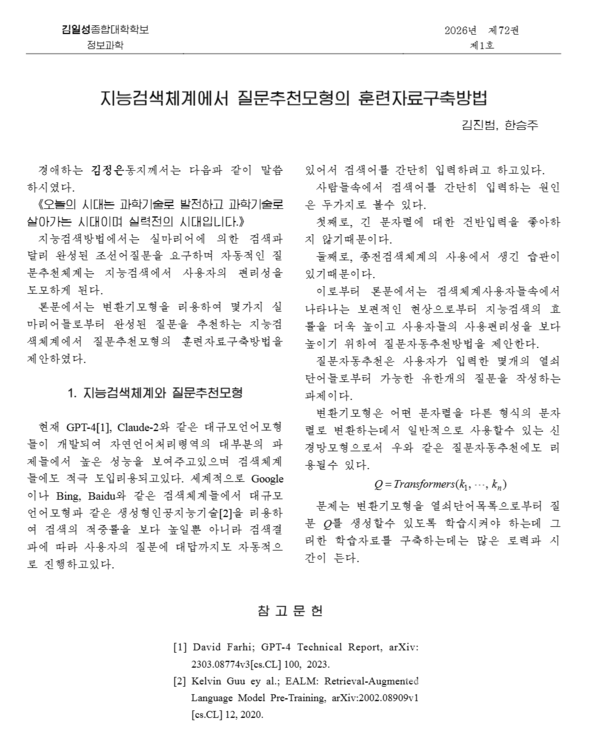
Reports that North Korea was studying ChatGPT had trickled out since February 2025. But this is a different kind of discovery. In an official university journal, with proper citation format, American and Google LLM research appears as the actual starting point of the research methodology.
Let me cut to the conclusion: this isn’t a question of “how did North Korea get its hands on this.” It’s a question of “where does the moat in AI research actually remain today.” Oh, and let me state clearly upfront: our principal enemy is North Korea, and I completed my mandatory service in the Republic of Korea Army as a sergeant, finished my reserve duty, and am now enrolled in civil defense.
What Happened
The paper’s authors are two researchers, Kim Jin-beom and Han Seung-ju. The problem they set out to solve is surprisingly mundane: how do you train a model that, given a few words typed into a search box, automatically recommends a complete Chosŏnŏ (North Korea’s term for the Korean language) query sentence? It’s the same autocomplete feature we see every day on Google or Naver.
The approach the researchers proposed was based on a Transformer model, and they evaluated performance using training data built from 50,000 documents and 7 million word pairs. Academically, this isn’t a particularly novel attempt. But one sentence in the introduction stands out.
“Large language models (LLMs) such as GPT-4 and Claude-2 have been developed and are now showing high performance across most tasks in the natural language processing domain, and are being actively adopted and used in search systems as well.”
It goes on to accurately note the changes in Google, Bing, and Baidu’s search engines as well. In other words, North Korean researchers clearly recognize the global LLM landscape, cite official sources, and have publicly disclosed — at the level of an official university journal — that they are applying this to their own systems.
Two facts are worth noting here.
First, both cited papers are freely accessible to anyone. The GPT-4 Technical Report is available on arXiv (arXiv:2303.08774). The REALM paper is a peer-reviewed paper published at ICML 2020 (arXiv:2002.08909).
Second, the time lag is about 2 years. Given that the paper was submitted in November 2025 and the GPT-4 Technical Report was published in March 2023, the gap works out to roughly 1 year and 8 months. Compared to North Korea’s historical lag in AI research since the late 1990s — anywhere from 5 years at best to over 10 years at worst — that’s a substantial narrowing.
Why Can an OpenAI Paper Be Read Even in Pyongyang?
Here it’s worth addressing a common assumption. There’s a perception that “OpenAI turned closed starting with GPT-4,” but that’s only half right.
The GPT-4 Technical Report clearly, deliberately withheld a great deal. Model size, the amount of compute used in training, dataset composition, training methodology — all of this was kept undisclosed. A 2024 academic review examining the “OpenAI: GPT-4” report concluded that “this report reads less like a rigorous technical evaluation and more like a demonstration of current performance.”
But just as much was disclosed as was hidden. The capability evaluation results, the System Card, the post-training alignment approach, and above all, the conceptual framework that lets you gauge the direction of the research — all of that remains intact. From a follower’s standpoint, this much information alone is enough to sketch a map of “which direction to try, and what to try.”
The REALM paper is even more clear-cut. Published at the main ICML conference in 2020, it was the first to formalize the core idea of the retrieval-augmented language model — the academic prototype of what we today call RAG1. The code is publicly available on GitHub.
This isn’t because OpenAI or Google were careless. Public publication is the price of academic legitimacy. If you don’t publish, you don’t get recognized at conferences, you don’t attract talent, and follow-on collaboration becomes difficult. But once you publish, anyone can read it. This tradeoff hasn’t changed once since academia was invented.
The problem is that this tradeoff has become asymmetric in the LLM era. In the past, engineering research required enormous follow-up work even after reading a paper before you could actually implement it. But the LLM field’s architecture is relatively standardized (Transformer + pretraining + alignment), so the direction alone, as laid out in a paper, is enough to serve as a starting point for catching up.
So Where Does the Real Moat Lie?
Analysts diverge here. One camp concludes, “this is a structural threat — the AI gap between the US and China is effectively narrowing.” The other camp emphasizes that “papers get published, but computing infrastructure does not.”
I think the latter is the more accurate diagnosis. North Korea’s own case illustrates why.
The same analysis of North Korean AI research shows that Pyongyang has managed to obtain some consumer-grade GPUs (around the level of a GeForce RTX 2070) through workaround channels, but access to data-center-grade GPUs like the H1002 and large-scale training infrastructure remains blocked. As a result, the center of gravity in North Korean AI research sits on lightweight models, efficiency optimization, and narrow-domain applications (speech recognition “Ryongnamsan,” the Go-playing “Eunbyul,” facial recognition, and so on). 38 North’s analysis reaches the same conclusion: “sanctions restrict access to advanced chips and training datasets, which constrains the scale and performance of AI deployment relative to leading economies.”
To sum up:
The conceptual moat has effectively disappeared. Information about who is researching in which direction now reaches even a sanctioned country’s academic journals within 2 years.
The computing infrastructure moat remains solid. Training a frontier-grade model requires tens of thousands of H100s, and this gate is locked firmly inside the US government’s export control framework.
The data-and-alignment moat is partial. The high-quality human feedback data used for instruction tuning, RLHF3, and safety alignment remains a corporate asset, but as synthetic data techniques advance, this gap is narrowing too.
The deployment moat is newly emerging. User count, distribution, real-time feedback loops — none of this can be transferred through a paper. ChatGPT’s real moat is likely not GPT-4’s architecture, but the alignment cycle that runs daily on top of its user data.
But Can North Korea Really Build an LLM?
We need to go one step further here. Just because a GPT-4 paper was cited in a university journal, does that mean Pyongyang will soon have its own LLM? Two realities stand in the way.
First, power. A 2026 analysis by The Diplomat, citing 38 North, is blunt about it: “North Korea’s power output is not enough to power the data centers.” Even Pyongyang experiences routine blackouts, and residents in poorer regions receive state electricity only once a year. In an era when a single AI data center consumes as much power as tens of thousands of households, this isn’t merely an infrastructure problem — it’s a physical ceiling. In fact, the 9th Party Congress in 2026 bundled AI together with new energy technology in its 5-year plan, explicitly stating that “solving the power shortage is the decisive factor determining the success or failure of the 5-year plan.” In other words, even North Korea’s leadership understands that power comes before AI.
Second, computing infrastructure. The same H100 gate discussed earlier applies here. Training an LLM with more than 70 billion parameters using dozens to hundreds of consumer-grade GPUs is effectively impossible. Even inference is a tight squeeze. In short, developing an in-house frontier model isn’t a realistic option.
So why does Pyongyang actually cite GPT-4 in a university journal? In my view, it’s not about in-house development — it’s about securing a path to use it. And there’s one strong candidate for that path: Chinese open-source LLMs.
Alibaba’s Qwen 2.5 explicitly supports 29 languages and includes Korean as a formal evaluation target (the KMMLU benchmark). The DeepSeek series was also trained on multilingual data. There are roughly 2 million ethnic Koreans (Chosŏnjok) in China, and a substantial Chosŏnŏ-language corpus produced by this community already exists online. In other words, Chinese open-source models are already being released with weights that can handle Chosŏnŏ to some degree. (In fact, if you look at the model cards for Chinese language models, they keep listing Chosŏnŏ as a minority language of the Chosŏnjok that they’re training on — at least nominally…)
The implication is clear. North Korea doesn’t need to train its own model. Simply obtaining Qwen or DeepSeek weights and fine-tuning4 them in Pyongyang is enough to fully achieve the journal’s stated goal of a “Chosŏnŏ autocomplete search engine.” Fine-tuning requires tens to hundreds of times less computing infrastructure than pretraining. It falls within reach of just a few dozen consumer-grade GPUs.
So Kim Il-sung University’s citation of GPT-4 isn’t a declaration of in-house development — it’s closer to a signal that “we understand the global LLM landscape, and we know what to build on top of which open-source model.” The nature of the threat itself is different.
Oz’s Lens
Watching this unfold, one GTM pattern came to mind: “when the technical moat collapses, an industry reverts to an operational moat.” It’s a pattern I’ve seen repeatedly while building various go-to-market strategies. Once semiconductor IP standardized, TSMC’s operational capability became the crux; once cloud infrastructure leveled out, AWS’s sales, account management, and release cadence became the differentiator.
AI is walking the same path. There used to be a saying that “OpenAI is 5 years ahead.” Where’s that 5-year gap now? In terms of model-capability gap, it’s narrowed to 6-12 months, and even Pyongyang has closed the lag to 2 years. And the fact that Pyongyang’s actual option isn’t in-house development but fine-tuning on top of Chinese open-source weights shows that the rules of the game have already changed.
In my view, OpenAI’s real asset has shifted to “operations.” User feedback generated from hundreds of millions of daily conversations, the pipeline that feeds that data back into alignment, the sales and delivery organization that rapidly absorbs B2B customer demands — none of this can be transferred by a paper or a weights download.
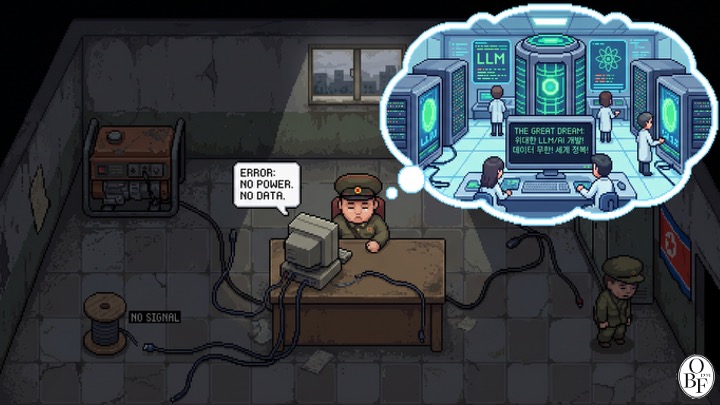
From this angle, the Kim Il-sung University journal episode is less a threat than a signal — a signal that the AI industry is shifting from a game of “smarter models” to a game of “deploying faster, wider, and more accurately.” Honestly, it doesn’t pose a threat to the software industry. It reminds me of Red Star OS, the operating system North Korea once built by mashing together Linux and Macintosh… I’ll wrap this up with the video below.
And since the operational moat favors whoever sits closer to the market and the data, there’s room for Korean companies to carve out an unexpected position in the Korean-language domain.
Closing
Let me sum up today’s issue in three lines.
- Kim Il-sung University’s 2026 Vol. 1 journal cited the GPT-4 Technical Report and the REALM paper. The catch-up lag is about 2 years.
- But given the physical constraints of power and computing infrastructure, it’s unlikely North Korea will build its own LLM. The more realistic scenario is fine-tuning on top of Chinese open-source model weights (Qwen, DeepSeek).
- The real signal this trend reveals is different: AI’s moat is shifting away from the model itself, toward compute and data, and above all, toward deployment and operations.
By the way, NK Economy — the outlet behind the reporting above — is holding a seminar to mark its 8th anniversary, so if you’re interested, go check it out. I can’t make it due to a scheduling conflict, but North Korea experts will reportedly cover the theme “The Current State of North Korea’s Digital Transformation in the Age of AI,” explaining how North Korea actually receives and uses IT technology.
Register for NK Economy’s 8th Anniversary Seminarㅇ NK Economy will hold its 8th anniversary seminar on the afternoon of June 17, 2026. If you’d like to attend, please apply using the form below.References & Further Reading
Primary sources
- Kang Jin-gyu, “North Korea Chasing Global LLMs…OpenAI, Google Papers Spotted Cited in Kim Il-sung University Journal”, NK Economy, 2026. This report lets you directly view the original journal images and the citation formatting.
- OpenAI, “GPT-4 Technical Report”, arXiv:2303.08774, 2023. This is the exact report cited by the North Korean journal — worth comparing directly to see what was disclosed and what was withheld.
- Kelvin Guu, Kenton Lee, Zora Tung, Panupong Pasupat, Ming-Wei Chang, “REALM: Retrieval-Augmented Language Model Pre-Training”, ICML 2020 (arXiv:2002.08909), 2020. This is the paper you could call today’s academic prototype of RAG. The North Korean journal misspelled it as ‘EALM.’ lol.
Background
- “Sanctions Built North Korea’s AI Playbook: How Pyongyang Boosts Performance Without Nvidia’s H100”, KMJ, 2026. An analysis of why, under computing infrastructure constraints, North Korean AI settled into an efficiency- and lightweight-oriented direction.
- “North Korea’s Risky Bet on Military AI”, The Diplomat, March 2026. Citing 38 North’s analysis, it notes that “power output is insufficient to run data centers” — the direct source behind this issue’s discussion of the power ceiling.
- Qwen Team, “Qwen2.5 Technical Report”, arXiv:2412.15115, 2025. A primary source for seeing exactly how a Chinese open-source LLM trains and evaluates Korean.
- “Emerging Applications and Implications of Artificial Intelligence in North Korea”, Asian Politics & Policy, 2025. If you need an academic analysis of North Korean AI policy, this paper is a good starting point.

The author, Kwangseob Ahn, is a professor of business administration at Sejong University and lead consultant at OBF (Oswarld Boutique Consulting Firm). He teaches statistics and data analysis — business data management and business analytics — while leading GTM and AI strategy consulting in the field, designing the seam between technology and business. He has published academic research on a memory architecture for AI dialogue systems (HEMA) and runs Daily Arxiv, a daily curation of global AI papers. He holds a master’s from Korea University’s Graduate School of Technology Management and a KMBA. He is the author of Homo Brainless: The People Who Outsource Their Thinking.
Footnotes
-
RAG (Retrieval-Augmented Generation): a method where, before answering, an AI first searches an external document database for relevant material, then generates its answer using those search results as reference. It’s more accurate than relying solely on the knowledge the model learned during training, and its sources can be traced. ↩
-
H100: a data-center-grade AI accelerator made by Nvidia. It’s a chip that’s effectively essential for training large-scale models like GPT-4, and one of the key items the United States has placed under export controls to China, Russia, North Korea, and others. ↩
-
RLHF (Reinforcement Learning from Human Feedback): a technique that uses feedback from human evaluators — ratings of “this answer is better/worse” — as a reward signal to align an AI model through reinforcement learning. It’s the key trick behind ChatGPT answering in the way we’ve grown used to. ↩
-
Fine-tuning: the process of further training an already-pretrained large model on data suited to a specific domain, language, or task, in order to specialize it. It requires tens to hundreds of times less computing infrastructure than pretraining, making it a common path for organizations that can’t afford to pretrain their own models to acquire LLM capabilities. ↩
Related issues
 Issue #97Business
Are the Growth Numbers in Press Releases Even Real?
We rarely know where or how a claimed "500% year-over-year growth" was actually measured.
 Issue #94Business
The Day Meta Passed Its Tax Down to Advertisers
Europe taxed Big Tech, but it's advertisers and consumers footing the bill.
 Issue #93Business
Musk in Court: 'Everyone Does It'
Musk admitted in court that xAI distilled OpenAI's models — the same practice Big Tech accused DeepSeek of stealing.
Your take shapes the next issue
What resonated most in this issue, or where has your experience been different?