The Red Crayfish Is Disappearing From Search
Where did all those crayfish go?

Opening
Dear reader, in the newsletter I sent back in March, I covered the ‘crayfish craze’ that was sweeping China. It was about how OpenClaw, an open-source AI agent, had people lining up outside Tencent’s headquarters and was shaking up both the cloud market and the messaging ecosystem at once.
But two months later, that crayfish is rapidly disappearing from Google search.
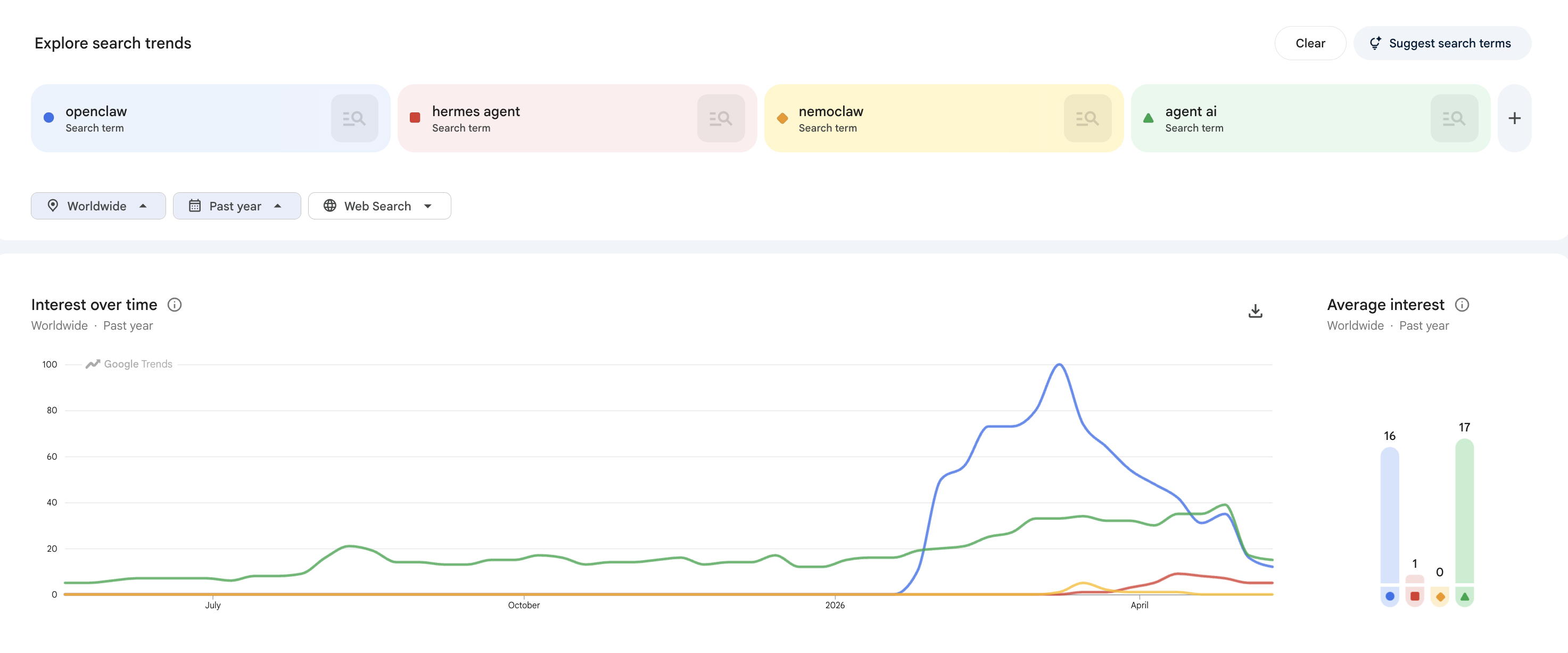
The Google Trends graph shows a dramatic shift. Search volume for “openclaw” peaked at 100 in April, then fell to 12 by May — a drop of roughly 88%. Hermes agent, the variant that got a lot of buzz in Korea, and nemoclaw, another clone, are both nearly invisible on the search graph too.
“Where did all those agents go?” Let me give you the answer up front: the agents haven’t disappeared. The word “agent” is disappearing. And this looks less like the death of a trend and more like the normalization of a category.
What the Search Graph Is Telling Us
Let’s start by reading the data carefully. There are four lines on the graph.
The blue line (openclaw) surged from mid-February, peaked at 100 in April, and has been dropping sharply since May, averaging 16 overall. The red line (hermes agent) ticked up slightly starting late April but averages just 1. The yellow line (nemoclaw) averages 0 — effectively no one is searching for it.
Then there’s the most important line: the green line (agent ai). It has held steady at an average of around 17 for the entire past year. It barely moved whether the crayfish craze was at its peak or on its way down. It briefly spiked to 36 in April before settling back to its normal level.
Two different stories are unfolding on the same graph at the same time.
One is the death of “tool names” (openclaw, hermes agent, nemoclaw). The proper nouns that were searched out of April’s curiosity are quickly fading. The other is the stability of the “category” (agent ai). The category those tool names once pointed to is holding at its usual baseline.
Words searched out of curiosity fade; the category survives. This simple pattern can explain the entire crayfish craze. Search is a function of curiosity. Once curiosity is satisfied, search disappears. But that doesn’t mean usage dies with it.
There’s data to prove this.
The Crayfish Isn’t Dead
A drop in search volume doesn’t mean a drop in usage. The actual data points in the opposite direction.
According to daily token1 throughput measured by OpenRouter2, the open-source LLM gateway, as of May 10, Hermes Agent is processing 224 billion tokens a day and OpenClaw 186 billion. Combined, that’s 410 billion tokens a day. Converted to Korean-language terms, that’s roughly the equivalent of 300,000 pages of A4 paper worth of work being processed by these two tools every single day.
OpenClaw’s cumulative token throughput has reached 9.17 trillion. Its GitHub stars have topped 370,000. Does that sound like a tool that has “disappeared”?
If anything, the OpenClaw camp went through upheaval after April. In February, founder Peter Steinberger left for OpenAI, and the project was handed off to an independent foundation. A security crisis soon followed. Between March 18 and 21 — just four days — nine CVEs3 were disclosed, one of them carrying an extreme severity score of CVSS 9.9. Of the 2,857 skills registered on the ClawHub skill marketplace, 341 were found to be malicious.
In Korea, Naver, Kakao, and Danggeun (Karrot, a local secondhand marketplace app) all banned in-house use on February 8. It was the first time in roughly a year — since DeepSeek — that a specific AI tool had been officially blocked.
When a security crisis like this hits, two things usually happen. First, new-user inflow stops. Second, people who were searching out of curiosity drop off. What’s interesting, though, is that users who had already built the tool into their workflows barely churned. The token throughput is the evidence.
Search volume counts people who’ve just gotten curious; token throughput is the trace left by people actually using it for work. These two numbers can trace completely different curves.
Why People Are Putting the Crayfish Down
While search is dropping, what’s actually happening among real users? I think four trends are at work simultaneously.

First, the natural decay of curiosity. When a new tool appears, search volume explodes. It’s the “what is this?” phase. And once curiosity is satisfied, search declines. Right after its January 30 rename, OpenClaw hit peak buzz, crossing 180,000 GitHub stars in a single month. April’s search volume of 100 was the aftershock of that; May’s 12 is the baseline left once the curious had moved on.
Second, the token economy is a heavy burden. I think this is the most decisive factor. Having an LLM read a PDF once and having an agent process that same PDF are worlds apart in token usage. An agent reads the PDF, summarizes it, reviews its own summary, and sends that review somewhere else. It’s not a single conversation — it’s a chain of tasks. Hermes Agent’s emphasis on “using tokens economically” is itself an attempt to solve this burden. But even with the most frugal tool, the absolute volume of tokens an LLM processes keeps rising. In the token-economy era, that translates directly into cost. On April 4, when Anthropic blocked Claude Pro/Max subscribers from spending their subscription tokens through external frameworks like OpenClaw, the cost burden became even more explicit. One user went public with a story about receiving an $800 bill in a single month because of an unmonitored OpenClaw instance.
Third, the frontier models absorbed it. In March, at the height of the crayfish craze, Anthropic shipped three things back to back within a single month: Claude Dispatch on March 17 (give an instruction from your phone, your desktop handles the rest), Claude Code Channels on March 20 (integration with Telegram, Discord, and iMessage), and Computer Use on March 23 (direct screen control). VentureBeat called Channels an “OpenClaw killer,” and AI commentator Matthew Berman summed it up as, “They’ve BUILT OpenClaw.” Around the same time, OpenAI Codex moved in a similar direction, and OpenAI went on to hire OpenClaw’s founder outright. If you need an agent that works autonomously inside a messaging app, you no longer need to install OpenClaw or Hermes separately — the tool you’re already subscribed to now does that.
Fourth, honestly, the crayfish isn’t a magic bullet. Early on, influencers and experts pitched OpenClaw as a “wand that does anything.” Use it for real and that’s not the case. Even with full permissions granted, there are clear limits to what it can actually pull off. Anthropic itself admitted, when unveiling Claude Dispatch, that the success rate for complex multi-app tasks sits at around 50% — and OpenClaw doesn’t stray far from that level either. On top of that, security issues never quite go away.
I was personally affected during the February–March security crisis too. I tried to cleanly remove OpenClaw, but the global NPM package, the ~/.openclaw directory, log files, and background processes wouldn’t come out neatly. So I built a small CLI utility called OpenShears and released it on GitHub myself. The concept: “just as kitchen shears are the tool for breaking down a crayfish, OpenShears is the tool for safely removing every trace of OpenClaw.” Building it, I realized something. If the crayfish had really been such a great tool, I never would have had to build a separate removal utility for it.
These four factors don’t operate in isolation — they operate together. Curiosity gets satisfied, cost becomes a burden, alternatives are already baked into Big Tech’s products, and it turns out not to be a magic bullet once you actually use it. The drop in search volume is the cumulative result of all four at once.
The Second Death Every New Technology Goes Through
It’s worth recalling Gartner’s Hype Cycle4 curve. In its 2026 report, Gartner explicitly stated that AI has entered the “Trough of Disillusionment.” It’s the stage where the dazzling expectations fade, failure cases pile up, and skepticism about ROI spreads.
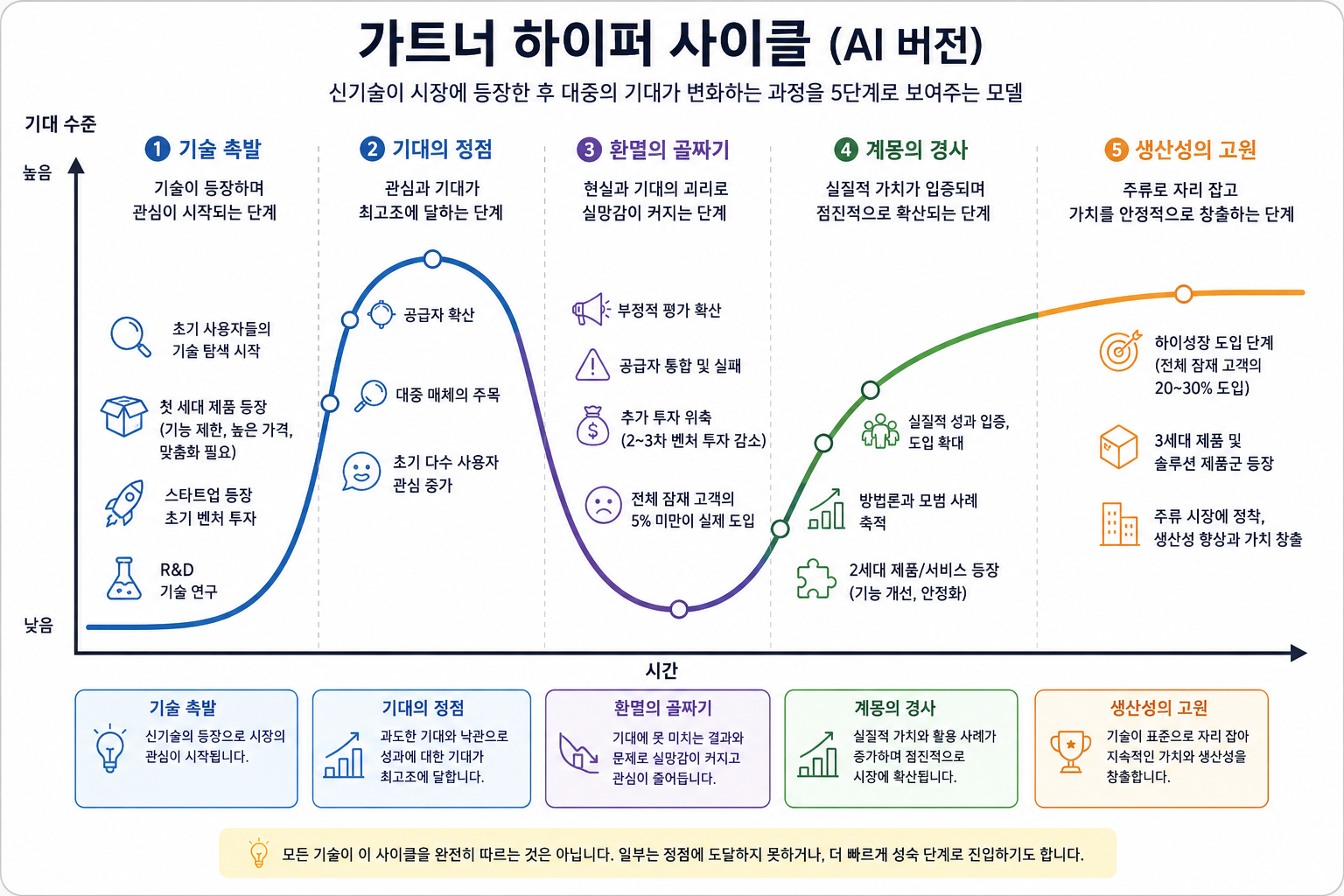
But the trough of disillusionment isn’t the end. Next comes the “Slope of Enlightenment,” followed by the “Plateau of Productivity.” Gartner made one point in particular: during this disillusionment phase, AI spreads not through fresh startups but through existing software vendors bundling it into their own products. Anthropic bundling Dispatch, Channels, and Computer Use into Claude, or Microsoft’s ClawPilot and Google’s Remy getting folded into the OS and the cloud — that’s exactly this pattern playing out.
The drop in OpenClaw’s search volume isn’t a sign that this category is failing. It’s a sign that it’s moving past the first death of a new tool — the fading of search curiosity — and into the second stage, being absorbed as a built-in feature of existing platforms.
This pattern isn’t new. When the dot-com bubble burst in the late 1990s, search volume for “internet” dropped for a while. Did the internet disappear? No — it just became so taken for granted that no one needed to search for it anymore. Search volume for “cloud computing” peaked around 2015 and then fell. Did the cloud die? It just became default infrastructure for every company.
The death of search is often a signal of absorption.
Oz’s Lens
There’s a pattern I’ve noticed from covering GTM strategy over the years: the tool that opens a new category almost always ends up ceding its place to the follower that standardizes that category. The category maker and the category owner are not the same thing. OpenClaw was the category maker. But the category-owner slot is quickly being claimed by followers like Anthropic’s Dispatch, OpenAI’s Codex, MiniMax’s MaxClaw, and Microsoft’s ClawPilot.
And this shift isn’t happening only at the software level. I’ve often noticed a signal from doing cloud consulting work: Intel’s Xeon CPUs are selling out as fast as they’re made, and Meta is snapping up ARM and Graviton chips wherever it can find them. Nvidia’s $20 billion acquisition of Groq’s LPU technology belongs to the same current. The center of gravity in AI infrastructure is shifting from “the GPUs that train LLMs” to “the CPUs and memory that run the harness.” While crayfish search volume falls, the infrastructure demand that crayfish created is reshaping entire data centers.
What’s striking is the speed. A cycle that took the internet 30 years and the cloud 10 years, AI agents are running through in 4 months. From a GTM strategy standpoint, that’s an alarming signal. By the time you look at a single search graph and conclude “the trend is over,” the category will have already moved on to its next stage.
Closing
Let’s return to the question we started with. Where did all those agents go?
- What disappeared is search, not usage. OpenClaw and Hermes Agent together process 410 billion tokens every day.
- Tool names decline, but the category stays alive. Search for “openclaw” dropped 88%, but search for “agent ai” has barely moved.
- The category is being absorbed by Big Tech. Microsoft’s ClawPilot, Google’s Remy, MiniMax’s MaxClaw, Nvidia’s NemoClaw, and OpenAI’s acquisition moves are all signs of it.
The real thing to watch over the next six months isn’t a search graph. It’s how far agents integrated at the operating-system level will go. By then, we won’t be searching for them — we’ll just be using them. That’s what the normalization of a category looks like, and the collapse of “openclaw” search volume is very likely its first signal.
References & Further Reading
Primary sources
- “Hermes Agent vs OpenClaw: Why Nous Research’s Self-Improving Agent Now Leads OpenRouter’s Global Rankings”, MarkTechPost, 2026.5.10. : This is the original source for the May 10 OpenRouter ranking shift and token data.
- “Anthropic just shipped an OpenClaw killer called Claude Code Channels”, VentureBeat, 2026.3.20. : The analysis that most clearly captures how frontier models are absorbing this category themselves.
- “Anthropic to OpenClaw users: Pay up”, The Media Copilot, 2026.4.6. : Covers the April 4 Claude subscription lockout and its implications for the cost structure.
- “OpenClaw Security Crisis 2026: What Happened and What To Do”, Get AI Perks, 2026.2.23. : The full timeline of the February–March security crisis.
Background
- “Gartner Hype Cycle for Agentic AI 2026”, Gartner, 2026. : You can check Gartner’s original definitions of each stage, including the “Trough of Disillusionment.”
- “Why does Gartner describe 2026 as a Trough of Disillusionment year for AI”, Christian & Timbers, 2026.1. : A clear summary of Gartner’s core diagnosis that, during the disillusionment phase, existing software vendors bundle AI into their products.
Oswarld’s Project
- oswarld/openshears : The CLI utility mentioned in this issue, for safely removing all traces of OpenClaw. You can run it with a single line: npx openshears.

The author, Kwangseob Ahn, is a professor of business administration at Sejong University and lead consultant at OBF (Oswarld Boutique Consulting Firm). He teaches statistics and data analysis — business data management and business analytics — while leading GTM and AI strategy consulting in the field, designing the seam between technology and business. He has published academic research on a memory architecture for AI dialogue systems (HEMA) and runs Daily Arxiv, a daily curation of global AI papers. He holds a master’s from Korea University’s Graduate School of Technology Management and a KMBA. He is the author of Homo Brainless: The People Who Outsource Their Thinking.
Footnotes
-
Token: The basic unit an AI model uses to process text. A word, part of a word, or a punctuation mark can each count as one token. In Korean, roughly 1 million tokens is equivalent to about 700 pages of A4 paper. ↩
-
OpenRouter: A unified gateway that lets you call different AI models (OpenAI, Anthropic, Google, Chinese models, and more) through a single API. Because it tallies which models are used and how much in real time, it’s the most widely cited benchmark in the industry for measuring “AI tool usage.” ↩
-
CVE (Common Vulnerabilities and Exposures): An officially assigned number given to a security vulnerability discovered in software. Severity is scored using CVSS, and a score in the 9-point range is “critical.” A CVSS of 9.9 is about as severe as it gets. ↩
-
Hype Cycle: A model Gartner uses to map how awareness of a new technology changes over five stages: “Innovation Trigger → Peak of Inflated Expectations → Trough of Disillusionment → Slope of Enlightenment → Plateau of Productivity.” The core idea is that expectations inflate and then deflate once, and only then does practical adoption begin. ↩
Related issues
 Issue #100Business
North Korea Cited GPT-4 in an Official University Journal
A Kim Il Sung University paper cites GPT-4 and Claude-2. What it reveals about North Korea's AI research capacity and the shrinking AI moat.
 Issue #97Business
Are the Growth Numbers in Press Releases Even Real?
We rarely know where or how a claimed "500% year-over-year growth" was actually measured.
 Issue #94Business
The Day Meta Passed Its Tax Down to Advertisers
Europe taxed Big Tech, but it's advertisers and consumers footing the bill.
Your take shapes the next issue
What resonated most in this issue, or where has your experience been different?