The CIA's 1944 Manual for Wrecking a Company
The playbook that sinks an organization, run in reverse, turns out to be exactly what saves one.
Opening
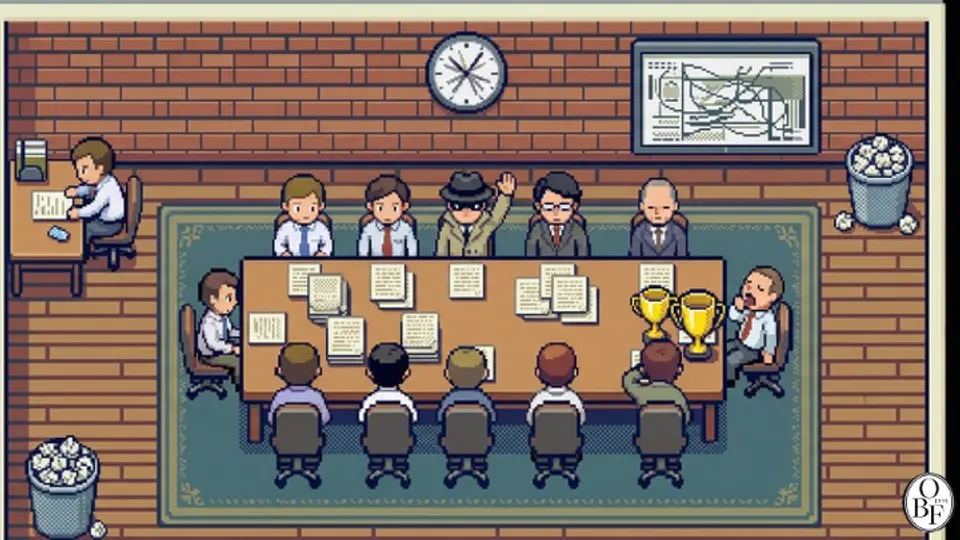
Dear reader, have you ever had this experience? An agenda item that could’ve been wrapped up quickly instead disappears for 2 weeks because someone says, “Let’s have the committee look into it.” A decision made in one meeting gets reopened in the next with, “Let’s discuss this one more time.” Or you watch a scene where the star performer gets the cold shoulder while the underperformer somehow gets rewarded.
Just everyday organizational life, right? Surprisingly, this is straight out of 1944 — a covert-operations manual that the OSS (Office of Strategic Services), the CIA’s wartime predecessor, wrote specifically to wreck enemy organizations. It was called the Simple Sabotage Field Manual1. Distributed in the middle of World War II to Allied sympathizers living inside enemy territory, it was, quite literally, a ‘guidebook for destroying an organization from within.’
Reading this document, declassified in 2008, you start out laughing and end up with chills. Instructions written 80 years ago to destroy an enemy nation are, today, running as the “normal operating process” at countless organizations.
The Spy’s Playbook: 8 Principles for Wrecking an Organization
The manual itself is a short document, just 32 pages long. But personally reviewed by OSS director William “Wild Bill” Donovan, it contains nearly every method for slowly dismantling an organization from the inside.
The manual’s core strategy splits into 3 broad prongs.
First, paralyze decision-making. Force every matter through official channels, and never allow shortcuts. Refer even simple problems to committees of 5 or more, and keep steering people to re-litigate decisions already made in the previous meeting.
Second, destroy motivation. If you’re a manager, praise and reward the underperformers while criticizing and sidelining your best people. Give new hires incomplete instructions and assign them to low-priority work — that’s also in there.
Third, maximize friction. Break work that could be finished in one pass into multiple stages, pile on as much paperwork as possible, and complicate the approval chain. Design things so that even the simplest task requires sign-off from 3 or more people.
What’s fascinating is that the manual doesn’t call for any special tools or training. The original text puts it plainly: just gradually widen the margin of the mistakes and inefficiencies that already occur naturally in everyday work. In other words, the essence of sabotage was never about creating something abnormal — it was about amplifying “normal inefficiency.”
80 Years Later, the Manual Became Reality
This is where the story turns genuinely unsettling. Line up the manual’s directives one by one against modern organizations, and they match with startling precision.
“Hold meetings as often as possible” — According to Asana’s 2024 Work Innovation Lab survey, individual contributors now spend 3.7 hours a week in unproductive meetings, up 118% from 2019. Managers spend 5.8 hours a week, up 87%. 48% of employees said the most recent meeting they attended was unnecessary.
“Route everything through official channels” — Per research by management scholars Gary Hamel and Michele Zanini, excess bureaucracy costs the U.S. economy roughly $3 trillion a year in lost productivity — about 17% of GDP. Among the U.S. workforce, 1 in every 4.7 workers is a manager, supervisor, or administrator.
“Maximize the volume of paperwork” — A Factor.ai report on one tech company found that as organizational inefficiency grew, leadership’s solution was “more memos and more meetings.” The result? Every decision got slower, and leaders found themselves trapped in meetings-to-prepare-for-meetings, as if living inside a permanent essay-writing contest.
Look closely at these numbers and a pattern emerges: much of modern organizational inefficiency isn’t anyone’s intent — it’s the system naturally converging toward the sabotage manual’s direction. Sociologist Robert K. Merton called this the “dysfunction” of bureaucracy2 — the phenomenon where rules made for efficiency instead breed rigidity, and compliance with the rule becomes an end in itself.
In short, the sabotage manual is frightening not because it invented new methods of destruction, but because it precisely captured the trap organizations fall into all on their own.
Flip the Manual and It Becomes the Solution
So what if we read this manual backward? The exact opposite of the principles that ruin an organization turns out to be the principles that save it.
If the manual says “route everything through channels,” the fix is to minimize the decision-making path. If it says “staff every committee with 5 or more people,” the answer is to shrink effective team size. This is where Amazon’s Jeff Bezos and his “two-pizza rule”3 come to mind.
If the manual says “criticize your best performers,” then a fair system of recognition and feedback for performance becomes an organization’s lifeline. If it says “increase paperwork,” then the purpose and scope of documentation must be constantly re-examined.
Spotify’s “Squad and Tribe” model is a great example of this inverted thinking: small, autonomous teams operate like independent startups while staying aligned to a shared mission — an organizational design standing at the exact opposite end from the sabotage manual. Netflix’s “no rules” culture is another great example of reverse-sabotage in action.
Here’s the core point: inefficiency rarely comes from malice — it comes, almost always, from inertia. Phrases like “that’s just how we’ve always done it,” “it’s procedure,” or “it’s safer this way” are where the manual’s shadow hides. Recognizing that inertia is itself the first step toward change.
Oz’s Lens
Honestly, when I first read this manual, I started laughing and then my expression froze. Through years of consulting, I’ve seen countless organizations from the inside and out, and nearly every time I’ve thought, “why is this org so slow?” — the answer traced back to something in this manual. 10 people sitting in a meeting that 3 could’ve handled. A decision already made getting reversed with “let’s double-check one more time.” A structure where a single email can’t go out until it clears 3 layers of approval.
What especially catches my attention is where the manual states outright that “purposeful stupidity is contrary to human nature.” In other words, even sabotage requires training. Yet modern organizations manage to turn their own people into sabotage agents without any training at all — the system does it on its own. No one intends to wreck the organization, and yet, in the end, everyone’s moving exactly according to the manual.
As a data person, I’d add one more thing: this kind of structural inefficiency is hard to measure. You can measure how many hours went into meetings, but the “lost deep-focus time” or the “opportunity cost of delayed decisions” that meetings cause never show up on a dashboard. What isn’t measured doesn’t get managed. And so the sabotage continues — with nobody noticing.
The real question this manual leaves us with is this: “Of all the things in our organization we wave off as just how it is, how many actually belong somewhere in the sabotage manual?”
Closing
To sum up: a 32-page manual written 80 years ago to destroy an enemy nation is now indistinguishable from the “normal operating process” at countless organizations today. This isn’t anyone’s malice — it’s the direction systems naturally converge toward. And flip the manual over, and it becomes, in itself, the set of principles that saves an organization.
Next time a meeting invite lands in your inbox, ask yourself: “Could this meeting be straight out of Article 11 of the CIA’s sabotage manual?” That single question could make your organization a little healthier.
References & Further Reading
- United States Office of Strategic Services, Simple Sabotage Field Manual — Strategic Services (Provisional), 1944. : The CIA’s own page introducing the document, declassified in 2008. It summarizes the manual’s historical context and key content.
- United States Office of Strategic Services, Simple Sabotage Field Manual, Project Gutenberg. : Read the full text of the manual for free. Chapter 11 (Obstructing Organizations and Conferences) and Chapter 12 (Interfering with Production) are the core material behind today’s issue.
- Gary Hamel & Michele Zanini, “Excess Management Is Costing the U.S. $3 Trillion Per Year”, Harvard Business Review, 2016. : The key paper that estimates the economic cost of excess bureaucracy with hard data — the source behind the 17%-of-GDP figure.
- Asana Work Innovation Lab, 2024 State of Work Innovation Report, 2024. : Contains the data on the surge in unproductive meetings — the original source for the 118% increase since 2019.
- Robert K. Merton, Social Theory and Social Structure, Free Press, 1968. : The original source for the concept of bureaucratic “dysfunction,” theorizing how rules end up swallowing their own purpose.
- Gary Hamel & Michele Zanini, Humanocracy: Creating Organizations as Amazing as the People Inside Them, Harvard Business Review Press, 2020. : A book full of concrete examples and principles for organizational design that moves beyond bureaucracy. Recommended if you’re curious about companies putting the “opposite” of the manual into practice.
- Patrick Lencioni, The Five Dysfunctions of a Team, Jossey-Bass, 2002. : A management book laying out a five-stage model of organizational dysfunction. An interesting companion read to the manual’s “destroy motivation” strategy. You Can Do It Too! A Field Manual for Wrecking Your Organization : A blog post I wrote back in 2022, with a more detailed, plain-language translation of the manual.
“There Are No Bad Leaders, Only Bad Systems” : An interview with Professor Olivier Sibony, a leading expert on strategic decision-making, describing how — assuming individuals aren’t acting out of malice — focusing on the system itself can solve most problems.
Actually, today’s issue was written with tomorrow in mind. I hope it gives you a moment to reflect on both individual and organizational productivity. After all, not even a manual for wrecking an organization can wreck itself.

The author, Kwangseob Ahn, is a professor of business administration at Sejong University and lead consultant at OBF (Oswarld Boutique Consulting Firm). He teaches statistics and data analysis — business data management and business analytics — while leading GTM and AI strategy consulting in the field, designing the seam between technology and business. He has published academic research on a memory architecture for AI dialogue systems (HEMA) and runs Daily Arxiv, a daily curation of global AI papers. He holds a master’s from Korea University’s Graduate School of Technology Management and a KMBA. He is the author of Homo Brainless: The People Who Outsource Their Thinking.
Footnotes
-
OSS (Office of Strategic Services): A U.S. intelligence agency active during World War II that became the predecessor of the CIA (Central Intelligence Agency) in 1947. It handled intelligence gathering, covert operations, and recruiting sympathizers within enemy territory. ↩
-
Bureaucratic Dysfunction: A concept introduced by sociologist Robert Merton describing how rules and procedures created for organizational efficiency instead breed rigidity and inefficiency — a situation where compliance with the rule becomes more important than the rule’s original purpose. ↩
-
Two-Pizza Rule: A team-sizing principle proposed by Amazon’s Jeff Bezos, holding that effective decision-making requires a team small enough to be fed by two pizzas — roughly 6 to 8 people. ↩
Related issues
 Issue #28Business
AI and Jobs: What the Data Actually Shows
The real risk isn't mass layoffs — it's the quietly narrowing door into a first job.
 Issue #27Business
Hollywood's Three-Stage Playbook for AI
From courtroom battles to licensing deals to full acquisitions, the entertainment industry is learning to control AI on its own terms.
 Issue #26Business
No 'Strategist' at Your Company? Then Revenue Is Just Luck
GTM is coming: the role that turns one-off sales into recurring revenue
Your take shapes the next issue
What resonated most in this issue, or where has your experience been different?