Hollywood's Three-Stage Playbook for AI
From courtroom battles to licensing deals to full acquisitions, the entertainment industry is learning to control AI on its own terms.
Opening
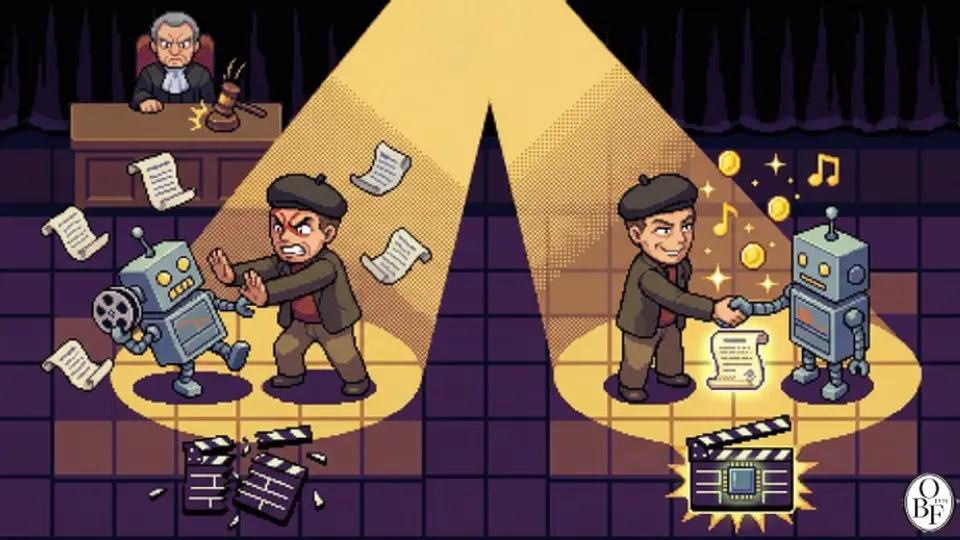
Dear reader, if I had to sum up what’s happening in Hollywood right now in one sentence, it would be this: “Fighting AI and shaking hands with it at the same time.”
On the music side, just a year ago the three major labels — Sony, UMG, and Warner — sued the AI music apps Suno and Udio for copyright infringement, calling it “theft on an unprecedented scale.” Yet by late 2025, those same labels were striking licensing partnerships with those same companies.
On the film side, right after Netflix walked away from a ₩111 trillion (~$83 billion) acquisition of Warner Bros., it turned around and bought InterPositive, a 16-person AI startup founded by actor Ben Affleck. On the surface these look like unrelated stories, but they reveal a single pattern. There’s a common structure to how the entertainment industry is absorbing AI, and today I want to unpack it.
Stage One: Litigation — “This Is Theft”
It always starts with conflict.
In June 2024, the three major labels — Sony, UMG, and Warner — filed a copyright infringement lawsuit against Suno and Udio through the RIAA (Recording Industry Association of America). The core allegation was that both companies had scraped millions of copyrighted songs without permission to train their AI models. So-called “stream-ripping”1 — pulling audio without authorization from platforms like YouTube — was suspected as the main way they gathered training data.
On the film side, it wasn’t a lawsuit but a strike. In 2023, SAG-AFTRA (the Screen Actors Guild – American Federation of Television and Radio Artists) walked out for 118 days, and AI was the central issue: could studios use an actor’s digital likeness without consent, and what would happen to post-production2 jobs if AI replaced them? The strike ended with AI protections written into the contract, but both sides felt it wasn’t enough.
The first stage of this pattern is always the same: a new technology upends the existing order, and the incumbent industry fights back with legal action. When Napster opened the door to P2P music sharing in 1999, a lawsuit shut it down by 2001. But Napster’s death didn’t send people back to buying CDs. Once technology changes behavior, that change doesn’t reverse.
The same held true for Suno. Even as the lawsuit dragged on, Suno was generating 7 million songs a day — roughly the equivalent of Spotify’s entire catalog every two weeks. By November 2025, it had reached $200 million in annual revenue and a $2.45 billion valuation. The lawsuit never slowed its growth.
Stage Two: Reconciliation — “If You Can’t Beat Them, License Them”
That’s when stage two arrives — a strange phase of fighting and reconciling at once.
UMG moved first, in October 2025, settling with Udio and agreeing to co-launch a new, license-based AI music platform in 2026. UMG chairman Lucian Grainge said the goal was to build “a healthy, commercial AI ecosystem where artists and technology companies can thrive together.” A month later, in November, Warner settled with both Suno and Udio. Warner artists can now opt in — giving explicit prior consent — to let their name, voice, and compositions be used by AI.
What matters is the structure of these settlements. They don’t just end litigation — they convert “unauthorized AI” into “licensed AI.” Udio’s new platform will be retrained exclusively on authorized recordings, and generated tracks can’t be downloaded outside the platform — a “walled garden.” In effect, this is about bringing the wild frontier inside a fence.
Not everyone is celebrating, though. Legendary music manager Irving Azoff has warned that “we’ve seen this movie before” — that “everyone talks about ‘partnership,’ but artists end up with the crumbs.” Sony is still suing both Suno and Udio, and a separate class-action lawsuit from independent artists is ongoing. Major labels have leverage at the negotiating table; independent musicians structurally don’t even get a seat.
Stage Three: Internalization — “Make It Our Own”
And now a third, more recent stage has emerged: absorbing AI not as an external threat, but as an internal capability.
Netflix’s March 5, 2026 acquisition of InterPositive is the clearest example. To understand it, you have to back up a week. Netflix had agreed to acquire Warner Bros. Discovery’s (WBD) studio and streaming businesses for roughly $83 billion — an enormous trove of IP including Harry Potter, DC, and HBO. Then Paramount Skydance countered with an offer to buy all of WBD for $111 billion. Rather than get into a bidding war, Netflix cleanly walked away, pocketing a $2.8 billion breakup fee. Its stock actually rose 12%.
A week later, it acquired InterPositive, the 16-person startup founded by Ben Affleck.
What InterPositive does isn’t “generate-something-from-nothing AI” like Sora or Suno. Affleck has been explicit that “you don’t type in text and a movie comes out.” This is an AI tool built specifically for post-production. It trains on a production’s own dailies3 to build a custom model for that project, then handles tasks like color correction, relighting, visual effects, and background replacement. It’s designed to work within the vocabulary that cinematographers and directors already use.
Even more notable is where its training data comes from. Unlike Suno, which stands accused of scraping music off the internet, InterPositive built its own dataset by filming real actors on controlled soundstages — a design that eliminates the seeds of a copyright dispute from the start.
Netflix co-CEO Ted Sarandos summed up the strategy well: “There’s a bigger business opportunity in making content 10% better than in making it 50% cheaper.” Netflix has no plans to sell this technology externally — it says the tool will be reserved for its own creative partners, turning it into a proprietary production capability its rivals can’t touch.
Oz’s Lens
Lay the three stages side by side, and I see an interesting divergence.
The music industry is still stuck at Stage Two (reconciliation/licensing). The logic is: “Your AI stole our music, so from now on you’ll pay to use it.” Essentially, it’s a way of fitting AI inside the existing copyright system. That’s not a bad strategy, but it rests on one assumption — that people will keep valuing music made by professional musicians more highly. With Suno approaching 100 million users and generating 7 million songs a day, it’s an open question how long that assumption holds.
Netflix, by contrast, has moved on to Stage Three (internalization). Rather than licensing AI from an outside vendor, it absorbed the whole team and folded it into its own production pipeline — and put an actor-turned-founder, Ben Affleck, in as senior advisor. That’s not a routine personnel decision.
Because right now, SAG-AFTRA’s 2026 contract negotiations are in full swing. They began on February 9, and the current contract expires June 30. AI is the biggest issue on the table. By this timing, Netflix laying down the narrative that “we’re spreading an AI tool an actor himself built” hands it real leverage in the negotiating room — it reframes the story from “tech companies replacing creators” to “creators leading the technology.”
Of course, there’s reason for caution. InterPositive was a stealth-mode startup with no public product yet, and it’s unproven whether a 16-person team can actually transform Netflix’s production pipeline. And no matter how persuasive the “creator-first” rhetoric is, it may not stop real job losses in post-production.
Still, the direction seems clear to me. The entertainment industry has moved past rejecting AI and into the phase of trying to control it — music through licensing, film through internalization. The methods differ, but the message is the same: “We can’t stop AI. So let’s make it run by our own rules.”
The real question comes after that: who gets to write those “rules”? The major labels? The tech companies? Or the people actually making the music and shooting the films? That answer hasn’t arrived yet.
Closing
It took 15 years to go from Napster to Spotify, from illegal sharing to streaming licenses. The current cycle around AI — “litigation → reconciliation → internalization” — is moving far faster. From the Suno lawsuit to the Warner settlement was 17 months; add the InterPositive acquisition, and it’s 21 months.
What this speed means is that the game is already changing before the rules get written. Whether in music or film, the outcomes of the negotiations and acquisitions happening right now will likely define the relationship between AI and creators for the next decade. If this topic interests you, I’d recommend starting with the U.S. Copyright Office report in the references below.
References & Further Reading
- Netflix official announcement, “Innovation for Filmmaking, By Filmmakers: Why InterPositive Is Joining Netflix”, 2026.03.05.: Contains the full quotes from Affleck and Netflix’s CPTO and CCO.
- Todd Spangler, “Netflix Acquires Ben Affleck’s AI Filmmaker Tools Start-Up InterPositive”, Variety, 2026.03.05.: Useful for how InterPositive’s technology works and a comparison with Disney’s OpenAI strategy.
- Billboard, “UMG and Udio Reach Agreement for ‘New Licensed AI Music Creation Platform’”, 2025.10.29.: A detailed look at the structure of the UMG-Udio settlement and plans for the 2026 platform.
- Rolling Stone, “AI-Music Heavyweight Suno Partners With Warner Music Group After Lawsuit Settlement”, 2025.11.26.: Covers the background of the Warner-Suno settlement, including the Songkick acquisition.
- Julie Bort, “Legally embattled AI music startup Suno raises at $2.45B valuation on $200M revenue”, TechCrunch, 2025.11.19.: Lays out Suno’s financials showing growth continued even amid litigation.
- CNBC, “Netflix ditches deal for Warner Bros. Discovery after Paramount’s offer is deemed superior”, 2026.02.26.: The full timeline of the collapsed Netflix-WBD deal.
- U.S. Copyright Office, “Copyright and Artificial Intelligence, Part 3: Generative AI Training”, 2025.05.: The official interpretation of fair-use principles for AI training, holding that it doesn’t grant a blanket exemption for unauthorized training on expressive works like music.
- SAG-AFTRA, “The Journey Begins Again: Preparing for 2026 TV/Theatrical/Streaming Negotiations”, 2026.01.: Background on the context and AI issues heading into the 2026 labor negotiations.
- IndieWire, “What to Expect from the SAG-AFTRA 2026 Contract Negotiations”, 2026.02.: A rundown of the union’s key demands on AI, residuals, and health coverage.

The author, Kwangseob Ahn, is a professor of business administration at Sejong University and lead consultant at OBF (Oswarld Boutique Consulting Firm). He teaches statistics and data analysis — business data management and business analytics — while leading GTM and AI strategy consulting in the field, designing the seam between technology and business. He has published academic research on a memory architecture for AI dialogue systems (HEMA) and runs Daily Arxiv, a daily curation of global AI papers. He holds a master’s from Korea University’s Graduate School of Technology Management and a KMBA. He is the author of Homo Brainless: The People Who Outsource Their Thinking.
Footnotes
-
Stream-ripping: the practice of extracting or downloading audio from streaming services like YouTube. It’s suspected to be one of the main ways Suno obtained its AI training data. ↩
-
Post-production: the work that happens after a film or show finishes shooting, including editing, color correction, visual effects (VFX), and sound mixing. ↩
-
Dailies: the raw footage shot on a given day, also called “rushes.” Directors and editors review them daily to adjust the shoot. ↩
Related issues
 Issue #26Business
No 'Strategist' at Your Company? Then Revenue Is Just Luck
GTM is coming: the role that turns one-off sales into recurring revenue
 Issue #25Business
Your Customer Is No Longer Human
When a product's real user shifts, the entire way you build it has to change with it
 Issue #11Business
Forget Monetization to Actually Make Money
Monetization isn't a starting point — it follows once you've actually built something of value.
Your take shapes the next issue
What resonated most in this issue, or where has your experience been different?