When a Philosophy PhD Says 'The Humanities Are Dead'
The world isn't a seesaw—one side rising rarely means the other crashes down.

Opening
Hello, dear subscriber. Have you heard, lately, that the humanities matter more than ever in the age of AI? Or, on the flip side, that the humanities education traditionally offered by universities is becoming worthless?
This January, at the World Economic Forum in Davos, a conversation between Palantir CEO Alex Karp and BlackRock CEO Larry Fink made headlines. Asked how AI would affect jobs, Karp answered:
“AI will destroy the jobs that people educated in the humanities [at traditional universities] go looking for.”
Then in March, he went further, saying only two kinds of people have a secure future: those with vocational training, and those with neurodivergence1. Here’s the interesting part—Karp himself majored in philosophy at Haverford College, went to Stanford Law School, and earned a philosophy PhD from Goethe University in Germany. He was essentially using himself as the example, saying “this skillset won’t sell in the market.” That made the claim land even harder.
This wasn’t a one-off remark. In an Axios interview last year, Karp said much the same thing: “If you have the IQ to get into Yale but only generalist knowledge and no specialized expertise, you’re finished.” He’s been consistently pushing skepticism toward traditional elite education. But does this claim actually hold up against the data?
🔍 What Karp Said—and What He Didn’t
Karp’s argument has a clear structure once you lay it out.
As AI replaces much of the knowledge work once done by humans—coding, research, and the like—the economic value of people with a generalist humanities education from elite universities collapses. Meanwhile, people with vocational training—assembling batteries, analyzing drone footage—become more valuable precisely because AI can’t easily replace them.
Employment data does partially back this up. According to the Federal Reserve Bank of New York, the unemployment rate for recent college graduates aged 22-27 climbed to roughly 5.7% in Q4 2025. The overall unemployment rate during the same period was 4.2%—meaning college graduates posted a higher-than-average unemployment rate. The underemployment rate2 hit 42.5%, the highest since 2020.
But there’s something Karp left out.
The thing he says he does every day at Palantir—“find someone’s outlier aptitude, focus them on that, and pull them away from the five other things they mistakenly believe they’re good at”—is, at its core, a humanities skill. Reading people. Grasping context. Making judgment calls in unstructured situations. The philosophy PhD who says a philosophy PhD is useless is, in effect, thinking philosophically every single day.
There’s another thing worth noting. Look at the Meritocracy Fellowship program Karp launched in 2025: it gives high school graduates paid internships and even a shot at a full-time interview at Palantir. It offers a $5,400 monthly stipend, wrapped in messaging like “skip the debt, reclaim your years.” But what do participants actually do in this program? They study philosophy and history while working on live projects. In the end, this isn’t a rejection of humanities education itself—it’s a rejection of the existing university system that delivers that education, with his own company positioned as the alternative.
🔄 Voices From the Other Side
Right after Karp’s comments made the rounds, a chorus of opposing voices rose up.
Anthropic co-founder Daniela Amodei told ABC News that what Anthropic looks for in hiring is strong communication, high emotional intelligence, kindness, and curiosity. Amodei herself majored in literature at UC Santa Cruz. She stated flatly that studying the humanities will matter more than ever going forward.
McKinsey’s Global Managing Partner Bob Sternfels made a similar point on the Harvard Business Review podcast. AI models are excellent at problem-solving, he said, but they can’t make discontinuous leaps in logic—that is, creative judgment. So the firm is actively recruiting liberal arts majors again, a group that had previously fallen down its priority list. McKinsey has in fact built its own AI tool, Lilli, into hiring interviews, using it to assess how much critical judgment candidates can add on top of AI-generated output.
BlackRock COO Robert Goldstein also said the firm is hiring people with majors completely unrelated to finance or technology. Cognizant CEO Ravi Kumar said the company is recruiting from liberal arts colleges and community colleges. Microsoft Chief Scientist Jaime Teevan said what matters for the next generation isn’t “what you do” but disciplines that teach “how to think.” Metacognitive abilities—flexibility, adaptability, the capacity to challenge critically—will be the core, she said.
The data backs this direction too. According to a Deloitte survey of 1,400 professionals, organizations that give equal weight to human skills and technical skills adapt more nimbly to a changing work environment. With the half-life3 of technical skills getting shorter and shorter, technical skill alone is becoming harder to sustain as a durable competitive edge.
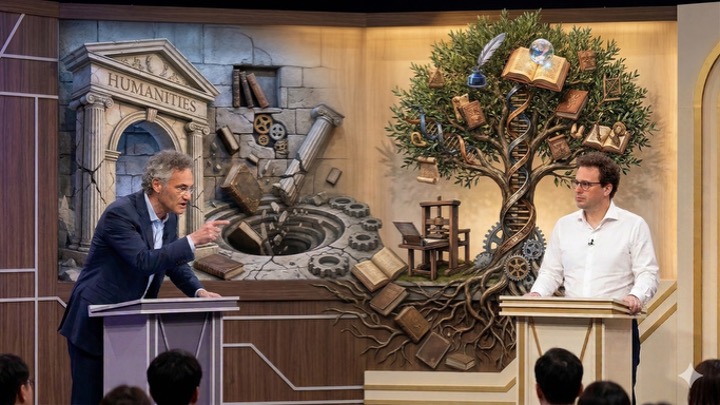
So here’s where things stand right now: the person building AI (Amodei) says the humanities matter more; the person selling AI (Karp) says the humanities are dead; and the people consulting with AI (McKinsey) are hiring humanities majors back.
⚖️ There Is No Seesaw

Let me step back here. Here’s what I think: Karp is wrong, and “the humanities will save us” is an overstatement too. The world isn’t a seesaw. One side rising almost never means the other crashes to the ground.
The actual data paints a far more complicated picture. According to Goldman Sachs Research, much of the rise in college-graduate unemployment isn’t due to AI at all—it stems from an overall decline in labor market churn (a “low-turnover market” where companies are neither hiring nor firing much). Monthly net hiring in industries with high concentrations of college graduates—information services, finance, professional business services—was negative between 2023 and 2025. Meanwhile, industries with fewer college graduates—construction, transportation, retail—added a net of over 12,000 jobs per month over the same period.
So what’s happening isn’t “humanities majors can’t get hired.” It’s that hiring has structurally frozen across knowledge-work industries as a whole. And this trend started back in 2023—before AI was even commercially widespread.
Let’s dig a bit deeper into the numbers. According to LinkedIn data, entry-level hiring is down 17% compared to April 2019. In a 2025 survey by education tech company Cengage Group, only 30% of graduates said they’d found a full-time job in their field of study. In a survey by the National Association of Colleges and Employers (NACE), 51% of employers rated this year’s graduate job market as “poor or fair”—the highest share since 2020-21.
This isn’t a humanities problem—it’s a phenomenon where entry into the labor market itself is getting blocked. Even BlackRock CEO Larry Fink warned that the class of 2026 could face the highest unemployment rate in years, because AI is displacing entry-level roles. Yes, the very same person who shared a stage with Karp.
At the same time, the claim that a humanities education alone is sufficient doesn’t match reality either. According to an analysis by the Federal Reserve Bank of Cleveland, the job-finding rate for young college graduates has fallen to nearly the same level as for young high school graduates. And this trend has been building since the early 2000s. It’s hard to deny that the “safety premium” a college degree once conferred is shrinking. Critical thinking matters, yes—but it’s becoming harder and harder for that alone to secure a competitive edge in the market.
Meanwhile, Karp’s own forecast that “AI will destroy jobs” is itself somewhat overstated. According to Forbes’ 2025 AI survey, 94% of Chief Human Resources Officers (CHROs) predicted that fewer than 5% of jobs at their companies would disappear due to AI over the next two years. 68% said their companies already have a human-AI collaboration strategy in place. The voices on the ground are far more measured than Karp’s apocalyptic framing.
Oz’s Lens
Honestly? I think both Karp and Amodei are saying what’s convenient for their own position.
For Karp, “the humanities are useless” is a narrative that justifies Palantir’s Meritocracy Fellowship (a program that hires high school graduates directly, letting them skip college altogether). For Amodei, “the humanities matter more” dovetails neatly with Anthropic’s “safe AI” branding.
From my experience building GTM strategies, this kind of binary rarely holds up in the market. What’s actually happening is this: the gap is widening between people who combine humanities capability with executable technical skill, and people who have only one or the other.
Take the example Karp himself cites—a former police officer, a community college graduate now running the U.S. Army’s Maven system (an AI tool built by Palantir). What makes this person valuable isn’t vocational training per se. It’s the combination of domain experience and the ability to adapt to new contexts. And that second thing—the ability to adapt to new contexts—is exactly the muscle the humanities train.
The same logic underlies why McKinsey uses its AI tool Lilli in hiring interviews. What they’re looking for isn’t someone who takes AI output at face value, but someone who can add curiosity and judgment to it. That’s not a prompt-engineering skill—it’s a matter of critical thinking.
McKinsey’s own numbers make the case. Eighteen months ago, the firm had 3,000 AI agents. Now it has 20,000. That’s 20,000 agents for 40,000 employees. Sternfels said that within 18 months, there will be more than one agent per employee. In this environment, the people who create value aren’t the ones AI can replace—they’re the ones who can collaborate with AI to make the judgment calls AI can’t make on its own. And the source of that judgment doesn’t come from a coding bootcamp. It comes from training in reading context, asking questions, and interrogating assumptions.
As I see it, the riskiest position over the next five years isn’t held by humanities majors or by vocational-training graduates. It’s held by whoever believes “getting good at just one thing” is enough—whether that one thing is technical or humanistic.
Closing
Here’s why I decided to write this newsletter today, plain and simple. Somewhere online, people are posting that the age of the humanities has arrived, that liberal arts majors are having their moment, that coding is now worthless. Somewhere else, people are cheering AI to the skies, declaring technology supreme and the existing education system doomed. And in the middle of all this, everyone keeps shouting that “critical thinking” and “problem-solving skills” matter more than ever—without actually applying critical thinking to that very claim. 🤷
- Karp’s warning has a point. The data does show that a generalist humanities education alone is becoming increasingly difficult to sustain.
- But calling the humanities “dead” is closer to a promotional narrative for his own company’s hiring program. After all, the work he does every single day requires humanities capability.
- The real question isn’t “humanities or vocational training.” It’s “can you connect your ability to a concrete problem?” Your major is a starting point, not a destination.
The next time someone tells you “the humanities are useless in the age of AI” or “the humanities matter more than ever in the age of AI,” ask them just one question: “So what exactly is this person selling?”
References & Further Reading
Primary sources
- Fortune, “Palantir CEO says AI ‘will destroy’ humanities jobs but there will be ‘more than enough jobs’ for people with vocational training”, 2026.4. : A comprehensive rundown of Alex Karp’s Davos remarks and follow-up interviews.
- Fortune, “Anthropic cofounder says studying the humanities will be ‘more important than ever’”, 2026.2. : An interview with Daniela Amodei, whose position is the polar opposite of Karp’s. Also covers Anthropic’s hiring criteria.
- Goldman Sachs Research, “Why Is the College Graduate Unemployment Rate Higher Than Usual?”, 2026.2.
Background
- Federal Reserve Bank of New York, “The Labor Market for Recent College Graduates”, 2026. : A dataset tracking the unemployment and underemployment rates of college graduates aged 22-27 since 1990. Useful for checking the long-term trend directly.
- Federal Reserve Bank of Cleveland, “Are Young College Graduates Losing Their Edge in the Job Market?”, 2025.11. : An analysis showing that the gap in job-finding rates between college and high school graduates is narrowing—a trend that, notably, has been running since the early 2000s.
- Fortune, “McKinsey challenges graduates to master AI tools as it shifts hiring hunt toward liberal arts majors”, 2026.1. : Covers McKinsey’s adoption of AI in interviews and its expanded hiring of liberal arts majors.

The author, Kwangseob Ahn, is a professor of business administration at Sejong University and lead consultant at OBF (Oswarld Boutique Consulting Firm). He teaches statistics and data analysis — business data management and business analytics — while leading GTM and AI strategy consulting in the field, designing the seam between technology and business. He has published academic research on a memory architecture for AI dialogue systems (HEMA) and runs Daily Arxiv, a daily curation of global AI papers. He holds a master’s from Korea University’s Graduate School of Technology Management and a KMBA. He is the author of Homo Brainless: The People Who Outsource Their Thinking.
Footnotes
-
Neurodivergence: A term for neurological differences from the majority in how people think—ADHD, autism spectrum, dyslexia, and the like. Karp himself has dyslexia and has cited it as a factor in Palantir’s success. ↩
-
Underemployment: The share of college graduates working in jobs that don’t require a college degree. They’re employed, but in work that doesn’t match their level of education. ↩
-
Half-life of Technical Skills: The length of time a given technical skill retains its value in the market—for instance, how long it takes for demand for a particular programming language or tool to fall by half. In the age of AI, this half-life is shrinking fast. ↩
Related issues
 Issue #71Society
The Cornfield Theory That Still Explains Tech Adoption
Technology moves faster than ever, but the psychology behind how people accept change hasn't changed at all.
 Issue #70Society
How Child Safety Laws Are Building an Internet ID System
Child protection is real, but should the fix mean embedding everyone's identity into the operating system?
 Issue #69Society
US Cyber Strategy Shrinks from 39 Pages to 7
Why a strategy that hits harder but defends less isn't just America's problem
Your take shapes the next issue
What resonated most in this issue, or where has your experience been different?