The Cornfield Theory That Still Explains Tech Adoption
Technology moves faster than ever, but the psychology behind how people accept change hasn't changed at all.

Opening
Dear reader, let me pose an interesting question. What do 1940s corn farmers in Iowa, USA, have in common with corporate executives trying to adopt AI in 2026?
Both said, “I can see this is good, but I’ll wait and watch a bit longer.”
According to Deloitte’s 2026 State of AI in the Enterprise report, released last week, 88% of companies say they’re using AI for at least one task. But the same report found that fewer than 40% have actually scaled beyond the pilot stage to the entire organization. PwC’s 2026 Global CEO Survey offers an even more candid number: 56% of CEOs said their AI investments have “yielded no measurable results” whatsoever.
Technology is everywhere, yet diffusion has stalled. A book published in 1991 explains this phenomenon precisely. Today, let’s talk about it.
The Diffusion Theory Born in a Cornfield
The word chasm originally comes from geology—a deep crack formed when land or ice splits apart. Before it became a core concept in management and marketing, the term had an unexpected starting point: a cornfield.
In 1941, sociologist Bryce Ryan of Iowa State University and his graduate student Neal C. Gross began a fascinating study. At the time, Iowa was seeing the spread of an improved corn variety—hybrid seed corn—that yielded about 20% more than existing varieties and was more resistant to drought. Developed in 1928, the seed was objectively superior, but farmers were adopting it far more slowly than expected.
Ryan and Gross personally interviewed 257 farmers across two rural Iowa communities. What they found was a striking pattern. The timing of when farmers first heard about the new seed varied little among them. But the time it actually took to adopt it varied by as much as 7 years. Early on, the main information channel was the seed company’s sales representatives, but over time, the testimony of neighboring farmers became the decisive factor.
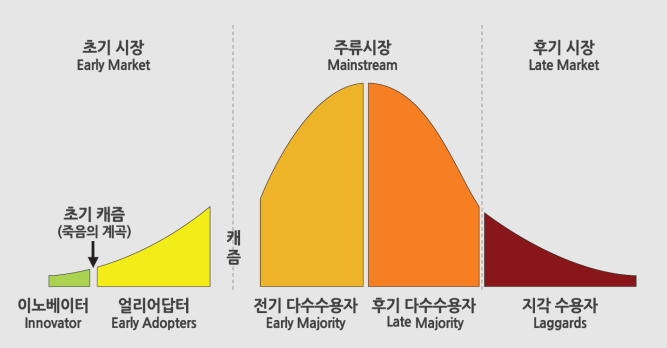
This 1943 paper1 went on to reshape sociology. In 1962, Ohio State University sociologist Everett Rogers, inspired by this research, published Diffusion of Innovations. Rogers divided the process by which new ideas or technologies spread through society into five groups.
- Innovators: 2.5% of the population. People fascinated by the technology itself
- Early Adopters: 13.5%. Visionaries who recognize the technology’s strategic value
- Early Majority: 34%. Pragmatists who want a proven product
- Late Majority: 34%. Conservative users who move only after something becomes mainstream
- Laggards: 16%. The group that resists change until the very end This model explained the diffusion of major 20th-century technologies like radio, television, and the telephone remarkably well. As adopter groups passed the baton to one another in sequence, the market traced an S-curve toward saturation. For decades, this model held up almost like a formula.
But in the 1980s, something strange started happening. Information technology products—computers, software—kept showing the same pattern: demand would suddenly collapse right at the transition from early adopters to the early majority.
The Crack Discovered by an English Literature PhD
This is where Geoffrey A. Moore enters the picture. His background is somewhat unexpected—he majored in American literature at Stanford and earned a PhD in English literature from the University of Washington. After teaching English literature at the university level for 4 years, he moved to Silicon Valley and threw himself into sales and marketing at tech companies. He later became a partner at Regis McKenna Inc., the legendary Silicon Valley marketing consultancy, where he crafted go-to-market strategies for countless high-tech firms.
There was a scene Moore witnessed over and over in the field: the development team behind a new product was firmly convinced of its technical superiority, while most other employees didn’t even know what the product was. Even more interesting, what customers perceived as the product’s strengths was completely different from what the development team believed those strengths to be.
Drawing on this experience, Moore published Crossing the Chasm in 1991. The publisher initially expected sales of around 5,000 copies, but cumulative sales surpassed 1 million, making it the bible of high-tech marketing.
Moore’s core discovery was this: within Rogers’ smooth bell curve, there are actually several cracks, and the crack between early adopters and the early majority is overwhelmingly larger than the rest. He called this the chasm.
Why does the crack appear at exactly this point? Because the purchasing psychology of early adopters and the early majority is fundamentally different.
Early adopters are visionaries. Even if the technology is still imperfect, they’re willing to bet on its potential and work through the rough edges themselves. The early majority, by contrast, are pragmatists. They ask: “Is there already a proven case?” “Is it being used in an industry similar to mine?” “Is it a finished product?” And crucially, pragmatists don’t take early adopters’ recommendations seriously. To a pragmatist, a visionary’s success story reads as “that’s a special case, not my case.”

Four Ways to Cross the Chasm
Moore laid out four strategies for crossing this deep divide. Even 33 years later, they remain remarkably concrete.
First, the Bowling Alley Strategy. Instead of attacking the entire mainstream market all at once, you pick a single narrow niche and dominate it by building a whole product2 there. Just as knocking down the head pin precisely in bowling sends the rest of the pins tumbling in a chain reaction, this strategy lets one success story spread to adjacent markets. Tesla’s path—starting with the luxury sedan market (the Model S) in 2012, then expanding to the mass market (the Model 3 and Y)—is a textbook example.
Second, building out infrastructure and complementary products. An innovative product often doesn’t function on its own. Pragmatists want a complete ecosystem. This is why Tesla built its own Supercharger network alongside selling electric vehicles. When Tesla entered Korea in 2016, there were only dozens of charging stations; today there are hundreds.
Third, securing a de facto standard. Pragmatists prefer products with high market share—they need the reassurance that future upgrades are guaranteed. When Tesla opened up all its electric vehicle patents in 2014, it wasn’t technological altruism; it was a strategy to grow the EV ecosystem itself and thereby extend the reach of Tesla’s own standard.
Fourth, using bridge products. This means building a middle bridge between the existing product and the innovative one, reducing consumer resistance and offering a learning curve. A lower-spec, lower-priced model can serve this role. Tesla’s Model 3, launched at less than half the price of the Model S, lowered the barrier to EV entry—a clear example of this strategy.
Oz’s Lens
The real value of chasm theory isn’t the discovery that “a crack exists”—it’s the structural explanation of why success with early adopters doesn’t guarantee success in the mainstream market.
I believe the AI market is standing exactly at this point right now. Global enterprise spending on generative AI reached $37 billion in 2025—a 3.2x increase year-over-year (Menlo Ventures, 2025). Yet according to MIT’s GenAI Divide report, 95% of generative AI pilot projects never make it past the experimental stage. Money is pouring in, but for most organizations, it isn’t converting into tangible results.
This is a textbook chasm. The innovators and early adopters excited about AI—the dev teams, CTOs, and dedicated AI units—are already in motion, but the early majority—business units, middle managers, operational teams—are standing by, demanding a “proven case” and a “complete product.”
Mapping Moore’s framework onto AI produces a picture like this.
- Bowling Alley Strategy: Instead of rolling AI out across the entire organization, deliver complete results in one specific task (e.g., code review, customer inquiry classification), then expand from there
- Complementary infrastructure: Not just deploying an AI model, but building out the surrounding ecosystem—data pipelines, governance, training programs
- De facto standard: First establishing a common language and evaluation criteria for how AI is used internally
- Bridge products: Lowering the barrier to entry with AI assistant tools (copilot-style) that blend naturally into existing workflows, rather than jumping straight to agentic AI Just as those 1943 Iowa farmers only switched seeds after seeing with their own eyes that hybrid corn actually thrived in their neighbor’s field, what’s needed to cross the AI chasm isn’t a more brilliant model—it’s a verified reference case proving “this actually worked in an environment similar to mine.”
The reason a 33-year-old theory still holds true is simple. The pace of technology has accelerated dramatically, but the psychological structure by which people accept change is the same in 1943 as it is in 2026.
Closing
The chasm isn’t a technology problem—it’s a problem of psychology and trust. Early adopters bet on possibility; pragmatists demand evidence. What bridges that gap isn’t better technology, but a single, perfect success story.
Whether you’re an organization adopting AI or a team launching a new product into the market, the goal is to resist the temptation to build “a product that’s good for everyone” and instead knock down exactly one pin. That advice, published in 1991, is still the single most practical strategy in 2026.
References & Further Reading
- Geoffrey A. Moore, Crossing the Chasm: Marketing and Selling Disruptive Products to Mainstream Customers, 3rd Edition, Harper Business, 2014. : This is the original source of chasm theory. The 3rd edition has been updated with recent case studies, so it still feels current today.
- Bryce Ryan & Neal C. Gross, “The Diffusion of Hybrid Seed Corn in Two Iowa Communities,” Rural Sociology, 8(1), 15-24, 1943. : This is the paper that started diffusion theory. Though the research is 80 years old, it remains a valid starting point for understanding the social dynamics of innovation adoption.
- Everett M. Rogers, Diffusion of Innovations, 5th Edition, Free Press, 2003. : This is the culmination of 40 years of Rogers’ diffusion research—a landmark textbook synthesizing more than 5,000 diffusion studies.
- Deloitte, The State of AI in the Enterprise 2026, 2026. : A survey of 3,235 business leaders that reveals the current state of AI adoption and the chasm phenomenon at work.
- Menlo Ventures, 2025: The State of Generative AI in the Enterprise, 2025. : Covers how enterprise generative AI spending reached $37 billion and how coding became AI’s first killer use case.

The author, Kwangseob Ahn, is a professor of business administration at Sejong University and lead consultant at OBF (Oswarld Boutique Consulting Firm). He teaches statistics and data analysis — business data management and business analytics — while leading GTM and AI strategy consulting in the field, designing the seam between technology and business. He has published academic research on a memory architecture for AI dialogue systems (HEMA) and runs Daily Arxiv, a daily curation of global AI papers. He holds a master’s from Korea University’s Graduate School of Technology Management and a KMBA. He is the author of Homo Brainless: The People Who Outsource Their Thinking.
Footnotes
-
The Ryan & Gross (1943) paper: a study of 257 farmers in Iowa examining how they adopted hybrid corn seed. It’s considered the origin of innovation diffusion research. Everett Rogers drew inspiration from this paper to systematize the theory of diffusion of innovations. ↩
-
Whole Product: this refers to a state that includes everything a customer needs in order to achieve the purpose for which they bought the product. For an electric vehicle, for example, this means not just the car itself but the entire package—charging infrastructure, service networks, and insurance products. Geoffrey Moore emphasized that this whole product is essential to crossing the chasm. ↩
Related issues
 Issue #70Society
How Child Safety Laws Are Building an Internet ID System
Child protection is real, but should the fix mean embedding everyone's identity into the operating system?
 Issue #69Society
US Cyber Strategy Shrinks from 39 Pages to 7
Why a strategy that hits harder but defends less isn't just America's problem
 Issue #63Society
When Silicon Valley Talks 'Taste,' What's It Really Hiding?
Is 'knowing what to build' really the same thing as taste, or something else entirely?
Your take shapes the next issue
What resonated most in this issue, or where has your experience been different?