Italy's New Law: Paid Leave When Your Pet Is Sick
Italy just made pet sick leave a legal right — and Korea's numbers suggest it might not be far behind.

Hello, dear reader. Do you have a pet? Or maybe someone close to you does? If so, I think you should share today’s newsletter with them. I have a feeling you’ll both enjoy this one.
Imagine your dog needs surgery, and you tell your boss, “I’d like to take leave because of my pet.” How do you think that would go over? At most workplaces, you’d either burn a vacation day or never even bring it up. But in Italy, this is now a legally guaranteed right.
Today, let’s talk about why this policy emerged now, and whether the same trend could reach Korea.
Opening
In March 2026, Italy became the first country in the world to formally institute paid leave for pet care. Employees can now take up to 3 paid days off per year to care for a sick pet, provided they submit a veterinary certificate. The pet must be registered via microchip, and a digital certificate from a veterinarian is required.
When I first heard this news, my reaction was something like, “Paid leave for a pet? Isn’t that a bit much?” But once you dig into the background of this policy, you realize it’s not simply an animal-welfare issue. It’s a signal that the legal concept of “family” is expanding.
🐾 Why Did Italy Create This Policy?
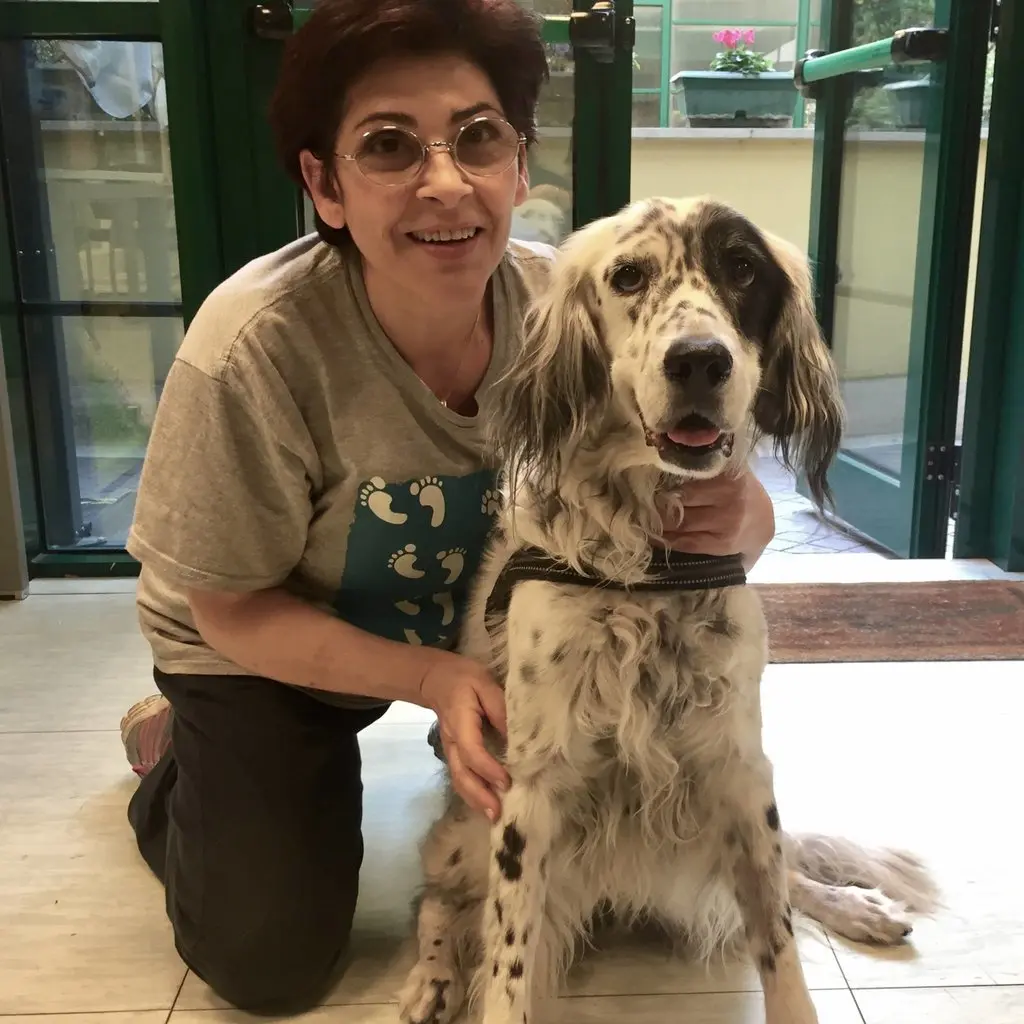
This policy didn’t come out of nowhere. It traces back to a 2017 case. A librarian working at Sapienza University of Rome (La Sapienza) requested paid leave to take her elderly English setter, Cucciola, to the hospital. Cucciola needed tumor-removal surgery, followed by treatment for laryngeal paralysis. For an owner living alone, there was no other option. The university, her employer, refused the request, but the Italian Anti-Vivisection League (LAV) represented her in court, and the court ruled in her favor.
The legal basis was Article 727 of the Italian Penal Code, which allows for up to 1 year in prison and a €10,000 (~₩15,000,000, ~$10,800) fine for leaving an animal in serious distress. The court’s logic was clear: if the law defines animal neglect as a crime, then an employer who prevents an employee from providing care is forcing that employee into an impossible choice between their legal obligation and their employment obligation. Italy’s public-sector labor law recognizes “serious personal and family reasons” as valid grounds for paid leave, and the court ruled that emergency pet care qualifies.
This ruling became known as the “Cucciola ruling” and set a precedent. Animal-welfare groups then pushed hard for legislation, and after roughly 9 years of debate, it was formally written into labor law in March 2026.
Here’s what’s worth noting: more than half of Italian households have a pet. This isn’t a niche hobby — it’s part of the everyday fabric of Italian society. The law is closer to catching up to a reality that already existed. Put another way, the law could only move because reality had already matured enough to demand it.
📊 Korea and Japan Already Have the Same Conditions
Is this unique to Italy? Looking at the data, Korea and Japan are structurally in a very similar position.
Let’s look at Korea first. According to KB Financial Group Research Institute’s “2025 Korea Pet Report,” as of end-2024, Korea had 5.91 million pet-owning households, or 26.7% of all households. The pet-owning population reached 15.46 million people — about 30% of the total population. The pet count breaks down to 5.46 million dogs and 2.17 million cats, totaling 7.63 million animals.
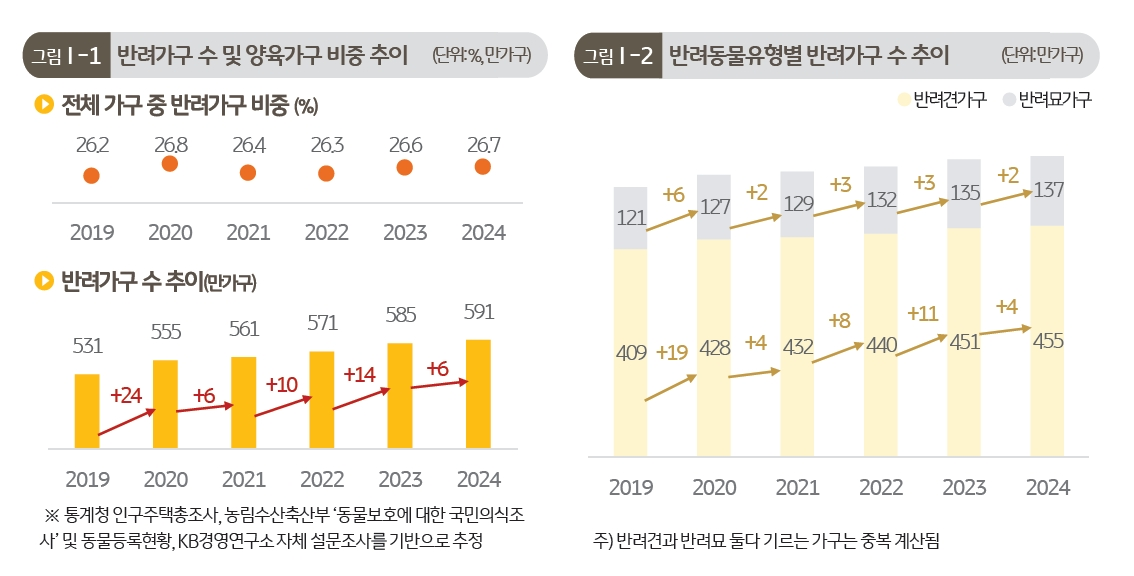
What’s interesting isn’t just the quantitative growth — there’s a clear qualitative shift too. The share of non-pet-owning households1 who agree that “a pet is a member of the family” has climbed steadily, from 50.6% in 2018 to 68.2% in 2025. That means even people who don’t own pets are increasingly coming to recognize pets as “family.” Another notable shift: the number of pet dogs declined for the first time (from 5.56 million to 5.46 million), while the number of pet cats kept rising. The “fewer dogs, more cats” pattern that Japan has experienced for over a decade has now begun in Korea too.
The market itself is growing fast too. According to the Ministry of Agriculture, Food and Rural Affairs, Korea’s pet-related industry was worth about ₩8.5 trillion (~$6.1 billion) in 2022, and is projected to grow to ₩21 trillion (~$15.1 billion) by 2032. Average monthly pet-care spending per household jumped from ₩154,000 (~$111) in 2023 to ₩194,000 (~$140) in 2024. Average medical spending over the past two years reached ₩1,027,000 (~$739), nearly double the 2023 figure.
Japan is already a step ahead. There, the pet population has outnumbered children under 15 for more than 20 years. As of 2022, the number of pet dogs and cats stood at about 15.89 million, compared to roughly 14.65 million children under 15. Japanese companies have already begun responding on their own. The IT company Eureka introduced half-day leave for veterinary visits (up to 3 times a year), and Mars Japan allows employees to bring their pets to work twice a month. The internet company Paray created a food-subsidy program called the “cat allowance,” and reportedly saw a sharp rise in job applicants as a result.
Here’s what the three countries have in common:
- Traditional family structures are shifting amid low birth rates and an aging population
- As single-person households increase, pets are becoming the primary object of emotional attachment
- The pet market is growing rapidly, expanding its economic influence
- Social perceptions of “family” are expanding beyond blood ties toward multispecies families2
🔍 Why the System Hasn’t Caught Up
So could Korea adopt a system like Italy’s right away? Honestly, it’s not that simple. There are a few structural hurdles.
First, there’s the question of legal status. Under Korean civil law, animals are still classified as “objects.” Korea’s Animal Protection Act does have provisions that criminalize neglect, similar to Italy, but no one has yet built the legal logic connecting that to a leave provision in labor law. There’s ongoing discussion about amending the Civil Act to redefine animals as “beings, not objects,” but progress has been slow.
Second, there’s corporate culture. Korea has a low utilization rate even for statutory paid annual leave. In a workplace culture where “people already feel guilty taking leave to care for a sick family member,” the reaction to “pet leave” is predictably skeptical. Japan’s approach of moving through corporate benefits rather than legislation is, in part, a strategy for working around this exact barrier.
Third, there’s a perception gap between pet-owning and non-pet-owning households. 81.6% of pet-owning households agree that “a pet is family,” compared to 68.2% of non-pet-owning households. The gap looks like it’s narrowing on the surface, but on the question of whether pet owners “follow pet etiquette well,” only 17.1% of non-pet-owning households agreed, versus 63.7% of pet-owning households. “Empathy” toward pets is growing, but trust in pet owners’ “follow-through on responsibility” remains low. Without closing this trust gap, it will be hard to build institutional consensus.
Oz’s Lens

I see this less as an “animal welfare” issue and more through the frame of “lagging institutional design.” There’s a question I always ask when building a go-to-market strategy: “The market is already moving — is the product (or the policy) keeping up?” Korea’s pet market is already worth trillions of won, and 15.46 million people live with pets. Yet when one of those 15.46 million people faces a pet emergency, they effectively have only two institutional options: use a vacation day, or grin and bear it.
What’s really worth noting about Italy’s case isn’t the “3 paid days off” itself. It’s that Italy resolved, at the institutional level, the contradiction between a law that criminalizes animal neglect and a workplace reality that prevents people from providing care. If a law imposes an obligation but gives no time to fulfill it, that’s a design flaw in the system.
Korea, too, criminalizes animal abuse and neglect under its Animal Protection Act. Pet registration is mandatory, and the government has announced its Third Comprehensive Animal Welfare Plan (2025-2029). But the reality that fulfilling all these “obligations” takes time hasn’t yet been reflected in the labor system. That’s the exact gap Italy has closed — and the gap Korea has not.
Of course, legislation isn’t likely to happen anytime soon. But there’s also a path where companies move first, as in Japan. If IT firms or startups competing fiercely for talent introduced “pet care leave” as an employee benefit, that alone could be a meaningful signal. In the end, institutions are just formal ratifications of reality.
Closing
What did you think after reading today’s story? I’d love to hear your thoughts in the comments. Here’s a summary of today’s newsletter:
- Italy’s pet sick leave is the result of 9 years of legal debate, and it’s a system that resolved the contradiction between “penalizing animal neglect” and “labor rights.”
- Korea (5.91 million households, 26.7%) and Japan already have demographic and social structures similar to Italy’s, but this reality hasn’t been reflected in their labor systems.
- The definition of “family” is already changing faster than the law. Whether institutions can catch up with this shift is what’s worth watching going forward.
If you live with a pet right now, take a moment to think: when your pet gets sick, what options do you actually have? And are they enough?
References & Further Reading
Primary sources
- KB Financial Group Research Institute, “2025 Korea Pet Report”, June 2025. A comprehensive report covering the care patterns, spending structure, and shifting perceptions of Korea’s 5.91 million pet-owning households.
- Animals Around the Globe, “Italy Advances Pet-Friendly Workplace Policies With Paid Leave to Care for Sick Pets”, 2026.
Background Knowledge
- Samjong KPMG Economic Research Institute, “The Coming Pet-conomy 2.0 Era: Pet Business Trends and New Opportunities”, 2024. A report comparing and analyzing the scale and growth outlook of the domestic and global pet markets.
- Ministry of Agriculture, Food and Rural Affairs, “Third Comprehensive Animal Welfare Plan (2025-2029)”, 2025. Essential material for understanding the direction of the Korean government’s animal welfare policy.
- Nikkei, “Leave for a Pet’s Birthday, Bringing Pets to Work… Japan’s ‘Pet-Friendly’ Companies Expand”, translated by The Kyunghyang Shinmun, July 2017. An article covering the current state of pet welfare programs at Japanese companies. While researching this, I also came across a domestic case — a pet-related startup here has done something similar.

The author, Kwangseob Ahn, is a professor of business administration at Sejong University and lead consultant at OBF (Oswarld Boutique Consulting Firm). He teaches statistics and data analysis — business data management and business analytics — while leading GTM and AI strategy consulting in the field, designing the seam between technology and business. He has published academic research on a memory architecture for AI dialogue systems (HEMA) and runs Daily Arxiv, a daily curation of global AI papers. He holds a master’s from Korea University’s Graduate School of Technology Management and a KMBA. He is the author of Homo Brainless: The People Who Outsource Their Thinking.
Footnotes
-
Non-pet-owning households: households that currently do not keep a pet. When measuring social perception of pets, shifts in this group’s attitudes serve as an important indicator of the likelihood of institutional consensus. ↩
-
Multispecies family: a concept referring to a family form composed of both humans and pets. It’s also the official term Italy used when explaining this legislation. ↩
Related issues
 Issue #73AI & Tech
Tokens Are the Product: Inside Alibaba's Token Hub
In China, the idealism of AI research is colliding head-on with the realities of monetizing a business.
 Issue #68AI & Tech
The Price of One Token Changes Everything
A 125x gap — $25 vs $0.20 per million tokens — is quietly redrawing who can afford to run AI
 Issue #67AI & Tech
The End of MAU—And Now MRR Can't Be Trusted Either
AI firms' 'annual revenue' is just monthly revenue × 12 — a fiction that breaks once inference costs hit margins directly.
Your take shapes the next issue
What resonated most in this issue, or where has your experience been different?