Tokens Are the Product: Inside Alibaba's Token Hub
In China, the idealism of AI research is colliding head-on with the realities of monetizing a business.
Opening
Hello, dear reader. In the early hours of March 3rd, China’s AI community was set abuzz by a short message in English.
“me stepping down. bye my beloved qwen.”
It was the farewell message that Lin Junyang (林俊旸), head of Alibaba’s Qwen1 models, posted on social media. He was Alibaba’s youngest-ever P102 executive, and effectively the person who built Qwen into the open-source AI ecosystem the whole world now watches. Just 13 days after he said his goodbyes, Alibaba officially announced the founding of a new business unit: Alibaba Token Hub (ATH).
The timing is too pointed to read as a mere reorg. In today’s issue, I want to unpack why ATH isn’t just a shift in the org chart but a declaration of Alibaba’s AI monetization strategy, and look at the structural tensions underneath it.
What Exactly Is Alibaba Token Hub?
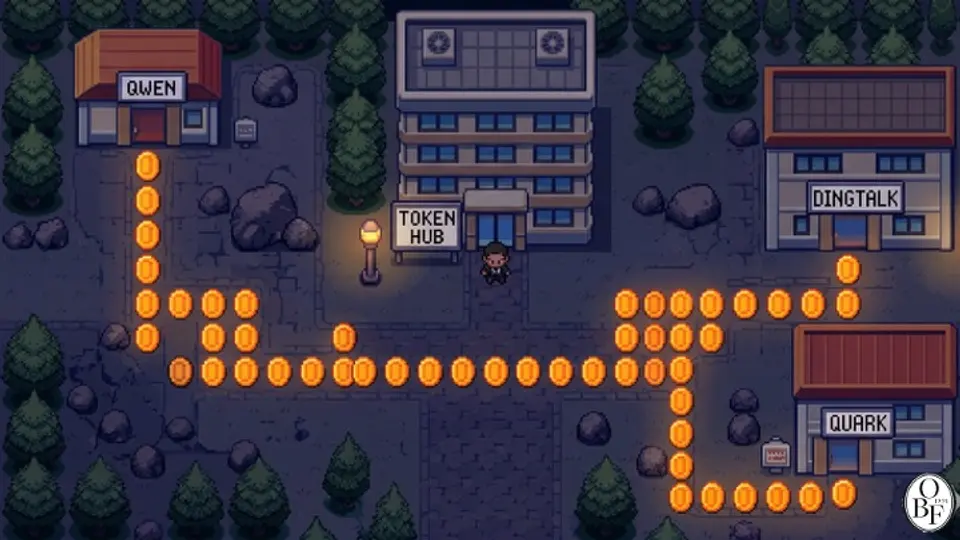
ATH consolidates Alibaba’s previously scattered AI-related organizations into a single business unit. It officially launched today (March 16, 2026), with CEO Eddie Wu personally at the helm. The scale of what’s been folded in gives you a sense of its ambition:
- Tongyi Lab: Alibaba’s foundation model3 research organization
- MaaS (Model-as-a-Service) division: cloud-based AI model services
- Qwen division: the consumer-facing Qwen app and open-source models
- Wukong division: the image and multimodal AI brand
- AI Innovation division: the unit incubating new AI products
On top of that, the enterprise collaboration platform DingTalk and the device brand Quark (which includes smart glasses) were also brought under ATH. Research, product, design, and sales now all sit under a single chain of command.
In a memo to staff, CEO Eddie Wu defined the founding principle of ATH this way:
“ATH is built around a single organizing principle: create tokens, deliver tokens, and apply tokens.”
Those three short phrases are the crux of today’s entire issue.
A Strategic Declaration Named “Token”
Baking the word “token”4 into the business unit’s name is no accident. In AI services, the token is the basic unit of billing. When OpenAI, Anthropic, and Google price their AI services, “price per token” is the exact metric they use.
Naming the new division “Token Hub” is an explicit message aimed outward: “We are no longer an AI research organization — we are a business that sells tokens.” What makes this declaration interesting is that China’s AI market is currently moving in exactly the opposite direction.
Since the price war that DeepSeek ignited, Alibaba has cut Qwen API pricing by 93%, from $1.1 to $0.07 per million tokens. Chinese AI companies are deliberately steering token prices toward zero — and it’s precisely in that environment that Alibaba is standing up a token hub. It looks like a contradiction. It isn’t.
The real revenue model for Chinese AI companies was never selling tokens themselves. It’s giving tokens away for nearly free in order to make money on cloud infrastructure, e-commerce, and enterprise software. In Alibaba’s case, internal figures reportedly show that Taobao sellers using the Qwen copilot saw conversion rates rise 16-22%. Tokens are the tool; the money comes from somewhere else.
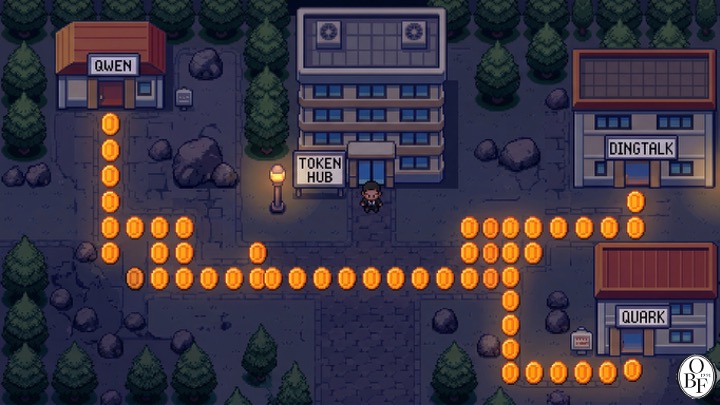
Read this way, ATH’s real purpose becomes clear: unifying everything from token production to ecosystem monetization into a single pipeline. That’s also the lens through which to view bundling DingTalk (enterprise collaboration) and Quark (devices) under the same roof. It’s building a full-stack ecosystem — build the model (Tongyi Lab) → sell it via API (MaaS) → hook consumers through the app (Qwen App) → embed it in enterprise workflows (DingTalk) → and lock it in through devices (Quark).
China’s AI Monetization Dilemma — A Market Where Tokens Are Hard to Sell
To understand the context behind ATH, you need to understand the structural peculiarities of China’s AI market.
Western AI companies can generate revenue directly through subscriptions or API billing. ChatGPT Plus runs $20 a month, and Anthropic’s Claude Pro follows a similar structure. Chinese consumers, by contrast, are notably reluctant to pay for software subscriptions. Most Chinese AI apps are free or ad-supported. As a result, the revenue models of Chinese AI companies are considerably more indirect.
ByteDance, for instance, uses Doubao to extend session times on Douyin by roughly 11%, maximizing ad revenue. It also leans on local government computing subsidies — 20-40% in Shanghai and Shenzhen — to cut infrastructure costs.
Against this backdrop, Alibaba’s 93% cut to Qwen API pricing is a rational choice — attracting developers and expanding the ecosystem matters more than direct billing. And it’s working: the Qwen model family has surpassed 1 billion cumulative downloads on Hugging Face, with more than 2 million developers using it. Over 180,000 derivative models have been fine-tuned5 on top of open-source Qwen models. Global enterprise adoption is rising too — Airbnb’s CEO has publicly said, “We use Qwen — it’s fast and cheap.”
The problem is that these impressive numbers don’t translate directly into revenue. Open-source models are free, and anyone can download and use them. Alibaba has built the world’s largest open-source AI ecosystem under the Qwen brand, but it still hasn’t built the mechanism to directly harvest the fruit of that. The founding of ATH is Alibaba’s answer to that problem.
The Conflict the Qwen Exodus Exposed — Researchers vs. Management
There’s another key to understanding ATH: the string of resignations from the Qwen team.
In January 2026, Hui Binyuan, head of Qwen Code, left for Meta. On March 3rd, technical lead Lin Junyang resigned, and on the same day, Yu Bowen, head of post-training6, also left the team. That’s three senior Qwen leaders gone this year alone.
Multiple insiders familiar with the situation point to the same underlying cause: a clash between changing organizational structure and shifting strategic direction. The Qwen that Lin Junyang led operated like a startup, with a single team vertically integrating language, image, code, and video modalities7. But Alibaba’s management wanted to split this into a horizontal division of labor — separate functions for pre-training, post-training, multimodal, and so on. The philosophy Lin Junyang championed collided head-on with the direction management wanted.
This kind of conflict isn’t unfamiliar, actually. OpenAI, Google, and Meta have all seen similar fault lines. Researchers value technical completeness and the open-source ecosystem; management focuses on DAU (daily active users) and cloud revenue. What made this rupture especially visible at Alibaba is that the Qwen team was disproportionately small. While ByteDance’s Seed team runs roughly 1,000 people just for foundation model training, the Qwen team has handled comparable work with around 100. In that environment, frustration over resource allocation and organizational direction building up was a structurally foreseeable outcome.
The founding of ATH is both a product of this conflict and an attempted fix. The CEO personally taking the helm of the AI organization, with a message about “strengthening strategic coordination across the AI business while staying agile enough to move fast,” also functions as a stabilizing signal aimed inward.
Oz’s Lens
Honestly, when I read the news about ATH, what I saw wasn’t a tech story — it was a declaration of a management strategy shift.
If you unpack Eddie Wu’s phrase “create tokens, deliver tokens, apply tokens,” it reads like this: build (product) → deliver (distribution/platform) → apply (customer success/embedding). This is a classic full-stack GTM pipeline. Alibaba has finally decided to treat AI not as a “research project” but as a “product sold in the market.”
There’s one interesting tension here. Qwen’s global influence came from its open-source strategy. Airbnb was able to use Qwen for customer service agents precisely because the model could be freely downloaded. But the more ATH focuses on monetization, the more its open-source commitment could weaken. Some analysts note that, much as Meta recalibrated its open-source strategy after Llama 4, Qwen’s flagship models could eventually end up locked behind paid APIs.
To my mind, the core risk here is developer trust. Qwen was able to spawn 180,000 derivative models because developers believed “this model will stay open.” Lin Junyang was the face of that trust. Whether that trust can survive under the ATH regime is something I’m still withholding judgment on.
The structural dilemma of Chinese AI ultimately comes down to this: consumers won’t pay, open source doesn’t generate revenue, and cloud monetization is fiercely competitive. I hope the name “Token Hub” carries the answer — but a name can’t substitute for a strategy.
Closing
Summed up in three sentences, today’s issue comes down to this:
First, ATH is Alibaba’s public declaration that it’s shifting AI from a research asset to a revenue-generating business. Second, behind it lies a collision between “researcher logic” and “management logic,” exposed by the Qwen talent exodus. Third, the real test is whether Alibaba can pursue monetization while preserving trust in its open-source ecosystem.
Here’s something to chew on. What if you mapped the “create, deliver, apply” pipeline onto your own business or organization? I’d encourage you to check where the bottlenecks form, and whether the point where you’re pouring your energy right now is actually where the real value gets created.
References & Further Reading
- Reuters, “Alibaba CEO takes helm of new AI-focused business group,” Reuters, March 16, 2026. : The primary report covering ATH’s official launch and the full text of CEO Eddie Wu’s memo.
- Bloomberg, “Alibaba Plans Major Revamp to Heighten Focus on AI Profits,” Bloomberg, March 16, 2026. : The report that goes deepest into the context of ATH’s monetization strategy.
- TechCrunch, “Alibaba’s Qwen tech lead steps down after major AI push,” TechCrunch, March 3, 2026. : Coverage of the community reaction and internal situation right after Lin Junyang’s resignation.
- Recode China AI, “Alibaba’s Qwen Lead Just Stepped Down. Is China’s Open-Source Moment at Risk?”, March 2026. : The most detailed account tracing the internal circumstances behind Lin Junyang’s resignation and the chain of departures from the Qwen team. If you want to dig deeper into this topic, start here.
- VentureBeat, “Did Alibaba just kneecap its powerful Qwen AI team?”, March 2026. : Industry analysts’ concerns about the future of the open-source strategy are well summarized here.
- ABHS, “China AI Model War 2026: Doubao, Qwen, DeepSeek,” March 2026. : A rundown that gives an at-a-glance view of the competitive landscape and price war in China’s AI market.
- Hello China Tech, “Qwen 3.5-Plus: Open Source, Aggressive Pricing, and a Vertical Lock,” February 2026. : An in-depth analysis of Qwen’s pricing strategy and MoE architecture. Recommended if you want to understand the token pricing structure.

The author, Kwangseob Ahn, is a professor of business administration at Sejong University and lead consultant at OBF (Oswarld Boutique Consulting Firm). He teaches statistics and data analysis — business data management and business analytics — while leading GTM and AI strategy consulting in the field, designing the seam between technology and business. He has published academic research on a memory architecture for AI dialogue systems (HEMA) and runs Daily Arxiv, a daily curation of global AI papers. He holds a master’s from Korea University’s Graduate School of Technology Management and a KMBA. He is the author of Homo Brainless: The People Who Outsource Their Thinking.
Footnotes
-
Qwen (Qianwen/千问): A large language model family developed by Alibaba Cloud. Its open-source models have become especially popular within the global developer community, surpassing 1 billion cumulative downloads. ↩
-
P10: The top-tier senior technical expert grade within Alibaba’s internal job-level system. It’s equivalent to an executive rank, granted to only a small number of people recognized for their technical expertise. ↩
-
Foundation Model: A general-purpose AI model pretrained on massive datasets, like GPT or Qwen. Think of it as the prototype model before additional training for a specific task. ↩
-
Token: The basic unit AI language models use to process text. One English word is roughly 1-1.5 tokens, and one Korean character is roughly 1-2 tokens. AI APIs typically price services at “X dollars per million tokens.” A single page of A4 paper is roughly 500-700 tokens. ↩
-
Fine-tuning: Additional training of an already-trained foundation AI model on data from a specific domain. It’s the process of turning a general-purpose model into a specialized model optimized for a particular use, such as medicine, law, or coding. ↩
-
Post-training: Additional training conducted after foundation model training. This includes work to refine responses to match human preferences, or to adjust the model to follow specific formats and safety standards. ↩
-
Modality: A type of data that AI can process. Text, images, audio, and video are each a modality. AI that can process multiple types together is called “multimodal AI.” ↩
Related issues
 Issue #68AI & Tech
The Price of One Token Changes Everything
A 125x gap — $25 vs $0.20 per million tokens — is quietly redrawing who can afford to run AI
 Issue #67AI & Tech
The End of MAU—And Now MRR Can't Be Trusted Either
AI firms' 'annual revenue' is just monthly revenue × 12 — a fiction that breaks once inference costs hit margins directly.
 Issue #62AI & Tech
We Asked 81,000 People What They Want From AI
What people truly wanted from AI wasn't faster work — it was the life beyond that work
Your take shapes the next issue
What resonated most in this issue, or where has your experience been different?