Does Mouth Taping Actually Help You Sleep?
200 million views vs. 213 test subjects — tracking the science behind the mouth-taping trend

Opening
Dear reader, have you seen those videos on Instagram or YouTube lately of people sleeping with tape over their mouths? This trend, called “mouth taping,” has spread quite widely here in Korea too. It shows up in nearly every influencer’s “daily routine” video, and you can even find dedicated products at Olive Young, Korea’s popular beauty retailer.
The claim is simple. If you put medical tape over your lips before bed, you’re forced to breathe through your nose, which supposedly reduces snoring, improves sleep quality, eliminates bad breath, and even sharpens your jawline. The #mouthtaping hashtag has racked up over 200 million views on social media. Celebrities like Gwyneth Paltrow and Erling Haaland have publicly endorsed it. Is any of this true?
I decided to trace the scientific evidence behind this trend, and honestly, I was floored by what I found. Let me walk you through it.
What the Science Actually Says: 25 Years of Research, 213 Subjects

In May 2025, the journal PLOS ONE published the first systematic review1 of mouth taping. A research team from the London School of Hygiene & Tropical Medicine and the University of Saskatchewan College of Medicine synthesized 25 years of research, from 1999 to 2024, following the PRISMA guidelines2.
Let me give you the bottom line first. Of 120 papers screened, only 10 met the inclusion criteria. Total number of subjects across all studies: 213. Of the 6 studies that measured the Apnea-Hypopnea Index (AHI)3, only 2 showed statistically significant improvement.
Let’s unpack this a bit. A 2022 study from Chang Gung Memorial Hospital in Taiwan applied mouth taping to 20 patients with mild sleep apnea and found their snoring index and AHI roughly cut in half. Sounds promising so far, right? But there’s an important caveat: the subjects were limited to people with a BMI under 30 and mild sleep apnea, and the sample size was just 20. The research team itself warned that “this could be dangerous for patients with moderate to severe sleep apnea.”
What about the rest of the studies? A 2023 study published in Sleep and Breathing observed something interesting. Even with tape applied, many people were still breathing through their mouths. The researchers called this phenomenon “mouth puffing” — air leaking out through the cheeks even when the mouth itself is sealed by tape. In other words, taping the mouth often didn’t result in complete nasal breathing at all.
And critically, a randomized controlled trial on asthma patients found no significant effect from mouth taping whatsoever.
Between 200 Million Views and 10 Papers
The cumulative view count for mouth-taping content on social media exceeds 200 million. The total number of subjects across 25 years of clinical research backing this trend is 213. And the systematic review’s authors noted that all 10 of those studies had methodological limitations — issues like lack of follow-up, unrepresentative samples, and uncontrolled confounding variables.
A 2024 scoping review in the American Journal of Otolaryngology went a step further. The research team analyzed the top 50 mouth-taping videos on TikTok and found that most claims weren’t backed by the existing literature. The two most frequently cited benefits — “improved sleep” and “better oral health” — both lack scientific support.
This isn’t just a mouth-taping problem. A 2024 study by researchers at the University of Chicago’s Pritzker School of Medicine analyzed the quality of health information on TikTok and found that 44% of all videos contained factually incorrect information. Videos made by non-medical influencers accounted for nearly half of all content, and these were the most likely to contain misinformation. Ironically, they were also the most widely shared.
A 2024 survey found that a third of Gen Z uses social media as their primary source of health information — turning to short-form video instead of search engines. This represents a structural problem: information has become more accessible, but the credibility filter simply isn’t functioning.
Warning Signs: What the Tape Might Be Hiding
The bigger issue with mouth taping isn’t that “it doesn’t work.” It’s that it might mask a real underlying problem.
Four of the 10 studies included in the systematic review explicitly warned of choking risk. If you apply tape while your nose is congested, breathing can become difficult — and if vomiting occurs during sleep, you may not be able to safely expel it.
But here’s what concerns me more. Someone who snores heavily or stops breathing during sleep might choose tape over a doctor’s visit. Obstructive sleep apnea is closely linked to heart disease, stroke, diabetes, and high blood pressure. These symptoms call for a polysomnography4 test, not tape — yet an influencer’s “daily routine” video may be blocking that path entirely.
A 2024 commentary in the Journal of Physiology put it precisely — mouth taping “has no evidence base to support its widespread application as a panacea for self-diagnosed sleep apnea.” In fact, for some people, it may make sleep apnea worse.
Oz’s Lens
Honestly, when I first came across this topic, part of me thought, “maybe I should try it too.” Even someone who works with data all the time can have their judgment swayed by a well-packaged personal testimonial.
But once I started tracing the data point by point, a pattern emerged. A structure where 200 million views’ worth of conviction rests on evidence from just N=213. This isn’t just a mouth-taping problem — it’s a symptom of how health information works in the social media era more broadly.
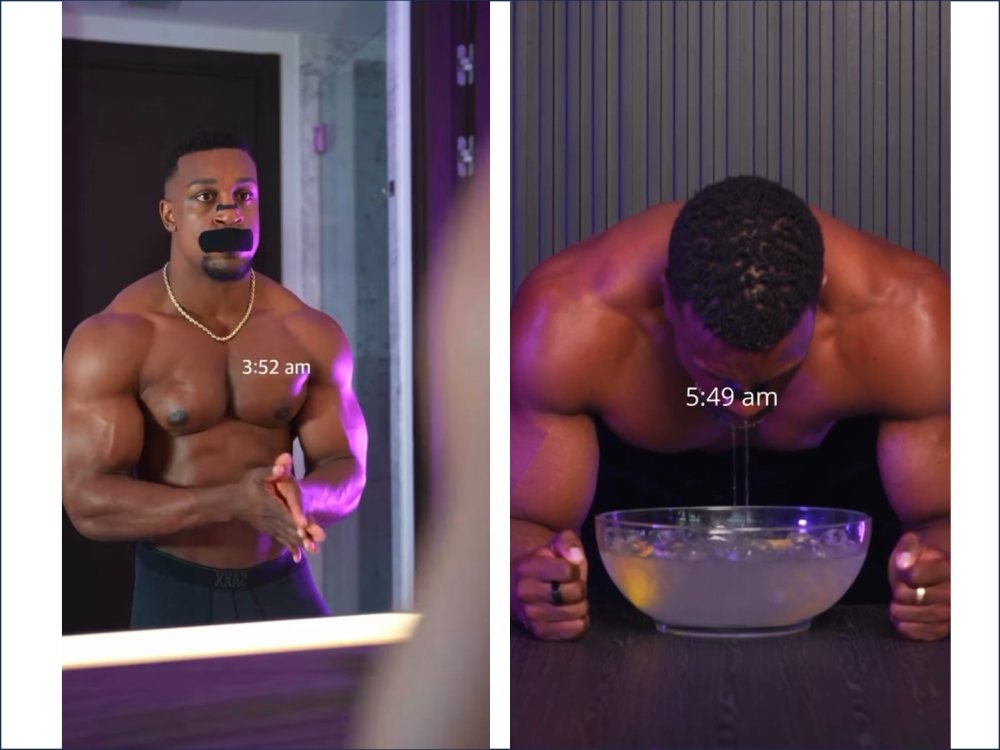
This is a classic case of the illusion of product-market fit. The demand is real — people genuinely want to sleep better. But the solution to that demand is being filled not by scientifically validated methods, but by personal anecdotes curated by an algorithm. TikTok’s recommendation algorithm gives high exposure to testimonials saying “this worked for me,” while giving relatively little reach to messages saying “this didn’t work” or “this is dangerous.” Dramatic transformation narratives generate views, views generate trust, and trust drives product purchases — a self-reinforcing loop.
Breathing through your nose is, in itself, a good thing. It’s well-established science that nasal breathing filters air, humidifies it, and aids oxygen exchange. But “nasal breathing is good” and “taping your mouth makes you healthy” are not the same statement. The former is physiology; the latter is an unvalidated intervention. It’s worth pausing to ask whether we’ve been too willing to accept the logical leap between the two.
Closing
There is limited evidence that mouth taping may somewhat reduce snoring in mild sleep apnea. But most of the other claims — “improved sleep quality,” “eliminating bad breath,” “changing your jawline” — currently have no scientific backing. And under certain conditions, it can actually be dangerous.
If you’re dealing with snoring or sleep issues, there are things worth trying before tape — sleeping on your side, treating allergies, using a nasal dilator, and above all, consulting a sleep specialist. The most reliable first step toward better sleep isn’t tape. It’s a diagnosis.
Next time you see someone taping their mouth in a “morning routine” video, take a moment to consider just how much scientific evidence is actually behind it.
References & Further Reading
- Rhee, J. S. et al., “Breaking social media fads and uncovering the safety and efficacy of mouth taping in patients with mouth breathing, sleep disordered breathing, or obstructive sleep apnea: A systematic review”, PLOS ONE, 2025. : The core source behind today’s newsletter — the first comprehensive systematic review of 25 years of mouth-taping research.
- Lee, Y.-C. et al., “The Impact of Mouth-Taping in Mouth-Breathers with Mild Obstructive Sleep Apnea: A Preliminary Study”, Healthcare, 2022. : A Taiwanese study reporting positive results for mouth taping. Should be read alongside its limitations — a sample of just 20 patients, all with mild cases.
- Fangmeyer, S. K. et al., “Nocturnal mouth-taping and social media: A scoping review of the evidence”, American Journal of Otolaryngology, 2025. : A study comparing the top 50 mouth-taping videos on TikTok against the academic literature.
- O’Halloran, K., “Mouth taping: a little less conversation, a little more action, please!”, The Journal of Physiology, 2024. : A balanced physiological commentary on the mouth-taping trend.
- Dimitroyannis, R. et al., “A Social Media Quality Review of Popular Sinusitis Videos on TikTok”, Otolaryngology–Head and Neck Surgery, 2024. : A University of Chicago study finding that 44% of TikTok health content contains factually incorrect information — useful for understanding the structural problems in social media health information.
- Huang, T.-W. & Young, T.-H., “Novel porous oral patches for patients with mild obstructive sleep apnea and mouth breathing: A pilot study”, Otolaryngology Head and Neck Surgery, 2015. : An early pilot study on mouth taping — 30 subjects, over a brief 3-day experiment.

The author, Kwangseob Ahn, is a professor of business administration at Sejong University and lead consultant at OBF (Oswarld Boutique Consulting Firm). He teaches statistics and data analysis — business data management and business analytics — while leading GTM and AI strategy consulting in the field, designing the seam between technology and business. He has published academic research on a memory architecture for AI dialogue systems (HEMA) and runs Daily Arxiv, a daily curation of global AI papers. He holds a master’s from Korea University’s Graduate School of Technology Management and a KMBA. He is the author of Homo Brainless: The People Who Outsource Their Thinking.
Footnotes
-
Systematic Review: A research method that collects and synthesizes existing studies on a specific topic according to predefined criteria. It offers a fuller picture than any single study alone, and is recognized in medicine as one of the highest tiers of evidence. ↩
-
PRISMA Guidelines: An international standard for improving the reporting quality of systematic reviews and meta-analyses. It requires researchers to transparently disclose which papers were included and excluded, and why. ↩
-
AHI (Apnea-Hypopnea Index): A measure counting the number of times breathing stops or becomes shallow per hour of sleep. Below 5 is normal; 5–15 is mild; 15–30 is moderate; 30 or above is classified as severe sleep apnea. ↩
-
Polysomnography: A comprehensive sleep test that measures brain waves, breathing, heart rate, muscle activity, and more during sleep. It is the standard diagnostic test for sleep apnea and other sleep disorders. ↩
Related issues
 Issue #29AI & Tech
AI Agents Are Ready — We're the Ones Who Aren't
The real bottleneck in agent adoption isn't capability. It's trust.
 Issue #24AI & Tech
Why Almost Every Brand Community Fails
A community's essence isn't a platform—it's showing up, again and again.
 Issue #23AI & Tech
The SaaS Stock Crash Isn't Really About AI
Software is shifting from a divergence phase to convergence—survival favors those who deliver action, not summaries.
Your take shapes the next issue
What resonated most in this issue, or where has your experience been different?