Companies Want to Hire, Korea's Youth Don't Want to Go
The government and corporations shook hands perfectly—the only thing missing is the young workers' consent.

Opening
Dear reader, after the conglomerate CEO meeting held at Cheongwadae (the Blue House, Korea’s presidential office) on February 4, the news headlines all led with the same number: 51,600 new hires. Samsung, SK, Hyundai Motor, LG, POSCO, Hanwha — Korea’s top 10 conglomerates all announced large-scale hiring plans for this year. Of that total, 66%, about 34,200 people, are slated to be entry-level hires.
Looking at the numbers alone, this is remarkable news. But when I read it, one question came to mind first: companies abroad are cutting people — why is Korea alone hiring more? And is this hiring really the kind of job young people want?
Today, I want to unpack the structural mismatch hidden behind these numbers, centered on these two questions.
Global Layoffs, Korean Hiring — What Explains the Gap?
Right now, global companies are moving in the opposite direction from Korea. According to analysis by RationalFX and various employment-tracking organizations, roughly 245,000 layoffs were announced across global tech companies in 2025 alone. US companies accounted for about 70% of that total. Intel cut about 34,000 jobs, Amazon about 20,000, and Microsoft about 17,000.
More recently, Jack Dorsey’s Block cut 4,000 employees — 40% of its entire workforce — in one stroke, and named the reason explicitly as AI. The logic: “a much smaller team can accomplish more with AI tools.”
Against this backdrop, Korean conglomerates hiring more than 50,000 new employees? Honestly, my first reaction was pure curiosity — why? Sure, it’s a positive signal. But look a little closer at the substance of this hiring, and you’ll see the gap with the global trend isn’t just a difference in direction — it’s a difference in the very nature of the hiring itself.
Here’s the core point: a significant portion of this large-scale hiring is tied to regional, physical construction projects — building semiconductor fabs, breaking ground on battery mass-production facilities, building out data center infrastructure. These aren’t white-collar office jobs; many are on-site positions running equipment and managing production processes.
Look at the Investment Map — It’s All Regional
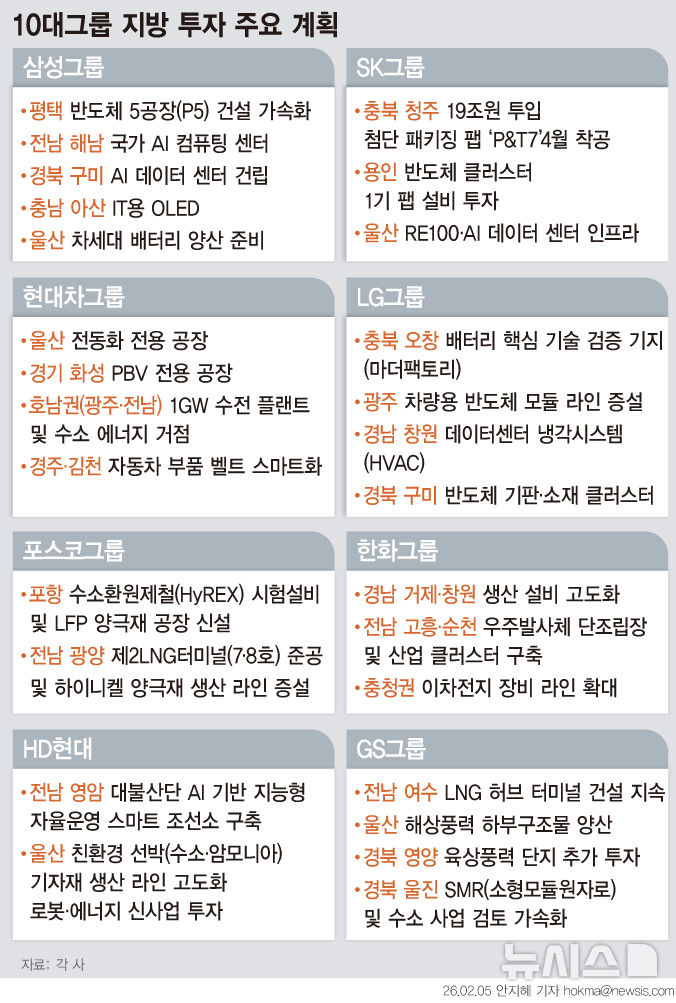
Line up the regions where each conglomerate has officially announced its investment plans, and a clear pattern emerges.
Samsung is concentrating on Pyeongtaek (semiconductor fab), Haenam in South Jeolla Province (national computing center), Gumi in North Gyeongsang Province (AI data center), Asan in South Chungcheong Province (additional foundry construction), and Ulsan (next-generation batteries). SK is focused on Cheongju in North Chungcheong Province (advanced packaging fab), Yongin (semiconductor cluster), and Ulsan (data center). Hyundai Motor’s projects are spread across Ulsan (dedicated electrification plant), Hwaseong in Gyeonggi Province (dedicated EV plant), Gwangju and South Jeolla (hydrogen energy hub), Gimcheon in North Gyeongsang (smart parts manufacturing), Ochang in North Chungcheong (battery testing), and Changwon in South Gyeongsang (data center cooling).
See the pattern? These aren’t headquarters in the Seoul metropolitan area — they’re industrial complexes and factory sites scattered across the country. This lines up precisely with the government’s “regional-led growth” policy direction. Deputy Minister Kwon Chang-jun of the Ministry of Trade, Industry and Energy said as much directly, stating that “business model transformation will accelerate in earnest, and employment expansion must proceed alongside structural change.”
Government and business are perfectly in step. Semiconductors, bio, energy transition — these are the future industries the government is pushing, and companies are responding with regional investment. The problem is that one axis is missing from this structure: the actual people who will fill those jobs.
”The Yangjae Twin Towers” — The Workplace Young People Picture

When I meet students at universities and talk with them at job fairs, almost every single one draws the same picture in their head.
“Hyundai Motor? I want to work at the Yangjae Twin Towers [the company’s Seoul headquarters].” “Samsung? Samsung Tower in Gangnam, or the Seocho office.” “SK? The SK Building in Jongno. I’ve never even considered Bundang [SK’s suburban tech campus].”
Honestly, I’ve almost never met a student who ranks a regional factory or hub facility as their first choice. They simply assume headquarters — and specifically, a tower in central Seoul.
This isn’t simply a matter of “young people these days just want comfort.” There are structural reasons behind it.
First, Korea’s higher education attainment rate is among the highest in the world. According to the OECD’s Education at a Glance 2025, the higher education attainment rate among Korean young adults (ages 25–34) is 70.6% — first among the OECD’s 49 member countries. It’s the only country to break 70%, ahead of second-place Canada at 68.86%. The university enrollment rate has also climbed to 76.3% as of 2025 — meaning three out of every four young people are in college.
Tell someone who’s gone through college to “go take a hands-on job in the provinces,” and it’s natural for both that person and their parents to feel resistance. The mindset — “my child went to college, why should they have to do that kind of work?” — isn’t an individual problem. It’s a structural mismatch of expectations created by a society where 70% go to college.
Second, options have widened for a smarter, more capable generation. Today’s late-20-somethings are markedly different from the generations before them. English fluency has risen sharply, and working abroad or starting a company overseas is now a realistic option they weigh seriously. According to the Human Resources Development Service of Korea, the number of young people employed overseas rose from 5,024 in 2022 to 5,720 in 2024 — a third straight year of increase. In 2025, agency-brokered overseas placements alone reached 5,008.
The startup world is even more dramatic. According to Startup Alliance data, an increasing share of young founders with promising business ideas are incorporating and raising funding abroad from the very start. The same idea can command a valuation1 several times higher when funded overseas. Domestic investors tend to weight “pedigree” — school background, previous employer — much more heavily, while overseas investors put far more weight on the idea itself and its market potential.
The Handshake Between Government and Business — and the Empty Space Where Youth Should Be
Here’s how the current situation breaks down.
The government has set a broad direction: balanced regional development and cultivating future industries. Companies have responded, executing large-scale regional investment and announcing hiring plans in line with that direction. So far, the logic holds — the direction is right, and the scale is meaningful.
But the problem is that young people — the ultimate consumers of this policy — aren’t part of the picture. Deputy Minister Kwon Chang-jun of the Ministry of Employment and Labor stated directly that “youth employment has been set as the top priority for closing the labor market gap,” but there’s still no concrete design showing under what conditions young people would actually accept regional postings.
A survey of Korea’s top 500 companies by revenue, conducted by the Federation of Korean Industries (FKI), found that companies themselves cite “resolving the mismatch between job seekers’ capabilities and employers’ needs” as a key challenge (10.7%). A Korea Employers Federation survey similarly found that the most important evaluation factor in hiring is “job-related work experience” (81.6%), and the most urgently needed roles are in “manufacturing, technical, and skilled trades” (26.0%) and “production management” (25.8%).
In other words, the people companies most urgently want to hire are on-site technical and production workers — but young people, 70% of whom hold a college degree, don’t put those jobs at the top of their list. What happens if this gap gets ignored? I’ve seen the pattern play out clearly. It either fades into the vague conclusion that “there aren’t enough good jobs,” or gets chalked up to generational narratives like “young people these days lack perseverance.” Neither actually solves the problem.
Oz’s Lens
Honestly, I think this announcement of 50,000-plus hires has the right direction but is missing the design.
From my experience building go-to-market strategies, even the best product fails in the market if you deliver it in a form the end user doesn’t want. The same logic applies to the hiring market. You’ve created a supply — “50,000 new hires” — but if you don’t build the demand side’s (young people’s) needs into the design, all you’re doing is widening the mismatch.
What worries me most is the drift toward generational narratives. If this policy underdelivers, it’s far too easy to slide into framing like “young people avoid the regions” or “they’re too spoiled.” But that’s not a fair diagnosis. A society where 70% go to college, a generation for whom working abroad is a realistic option, a structure of family-wide expectations that includes parents — ignoring all of this context and reducing it to a question of individual willpower is a way of concealing policy failure.
Government and business being in sync is genuinely a good sign. But without the third axis — young people’s consent — even the best-laid plan can end up an empty vessel.
Closing
To sum up: First, the plan to hire 51,600 people is real, but a significant share of those jobs are concentrated in regional, on-site positions. Second, for a generation with the OECD’s highest college enrollment rate and a much wider set of overseas options, these jobs aren’t attractive in their current form. Third, generational narratives that blame this mismatch on individual willpower are not the solution.
If you’re the one designing this policy, why not actually talk to ten people in their late 20s? Ask them directly: “There’s a good position in Ulsan — would you be willing to go?” I think their answers will reveal exactly where the policy falls short.
📎 References & Further Reading
- Federation of Korean Industries, “Survey on Large Enterprises’ New Hiring Plans for H2 2025,” 2025. : Quantitative data on hiring plans and the mismatch among Korea’s top 500 companies by revenue.
- Korea Employers Federation, “2025 Survey on New Hiring Practices,” 2025. : Shows the kind of talent companies want and how hiring trends are shifting.
- OECD, “Education at a Glance 2025”, OECD Publishing, 2025. : The source data behind Korea’s #1 OECD ranking (70.6%) in higher education attainment among young adults.
- RationalFX, “2025 Global Tech Sector Layoffs Report”, 2026. : Provides the full picture of the 245,000 layoffs across global tech companies in 2025.
- News2Day, “[On the Job Front] Youth Overseas Employment Rises for a Third Straight Year,” 2025. : An article summarizing the rising trend in overseas employment and related government support programs.
- TechCrunch, “A comprehensive list of 2025 tech layoffs”, 2025. : A month-by-month tracker of layoffs at global tech companies.

The author, Kwangseob Ahn, is a professor of business administration at Sejong University and lead consultant at OBF (Oswarld Boutique Consulting Firm). He teaches statistics and data analysis — business data management and business analytics — while leading GTM and AI strategy consulting in the field, designing the seam between technology and business. He has published academic research on a memory architecture for AI dialogue systems (HEMA) and runs Daily Arxiv, a daily curation of global AI papers. He holds a master’s from Korea University’s Graduate School of Technology Management and a KMBA. He is the author of Homo Brainless: The People Who Outsource Their Thinking.
Footnotes
-
Valuation: An assessment of a company’s worth in monetary terms. When a startup raises funding, the same business can be valued very differently depending on the evaluation criteria used. Overseas investors tend to assess based on global market potential, which often results in higher valuations than those seen domestically. ↩
Related issues
 Issue #14Society
Why the Pentagon Pizza Theory Didn't Hold Up
The more seductive a hypothesis feels, the sharper your scrutiny needs to be.
 Issue #13Society
Orwell's 1946 Warning on Language and Thought
Clear language isn't the result of clear thinking — it's the precondition for it
 Issue #5Society
Jensen Huang Never Did 'Self-Development.' He Just Worked.
Ask any successful person for their secret, and you'll always get the same answer: "I just did it."
Your take shapes the next issue
What resonated most in this issue, or where has your experience been different?