Adobe Paid $75M Over Dark Pattern Subscription Traps
If signing up takes one click but canceling takes six, that's not UX — that's a trap.
Opening
Dear reader, how long has it taken you to cancel a piece of software?
On March 13, Adobe agreed to pay the U.S. Department of Justice (DOJ) $75 million (~₩105 billion) and provide $75 million worth of free services to affected customers to settle a lawsuit. The total package comes to $150 million. Adobe — the company behind Creative Cloud, the de facto industry standard bundling Photoshop, Illustrator, and Premiere Pro — was fined for making subscription cancellation deliberately difficult.
But what caught my eye wasn’t the case itself — it was one detail. A statement from an Adobe executive, surfaced during litigation. Talking about the early-termination penalty, he reportedly called it “heroin for Adobe.” This isn’t a UI mistake. It’s designed intent. Today, let’s use this case to look at a structure we all encounter daily but rarely notice: the “dark pattern.”
What Happened — Adobe’s “Annual, Paid Monthly” Trap
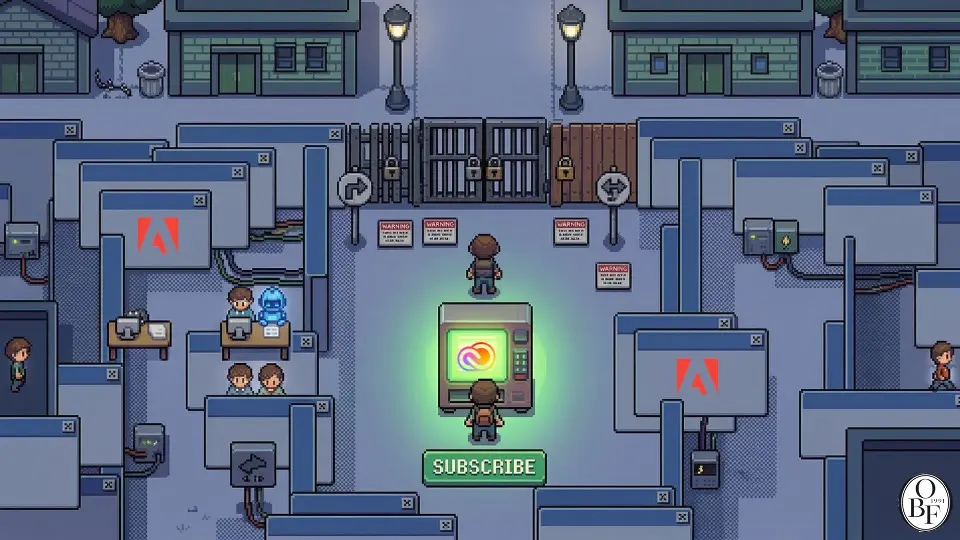
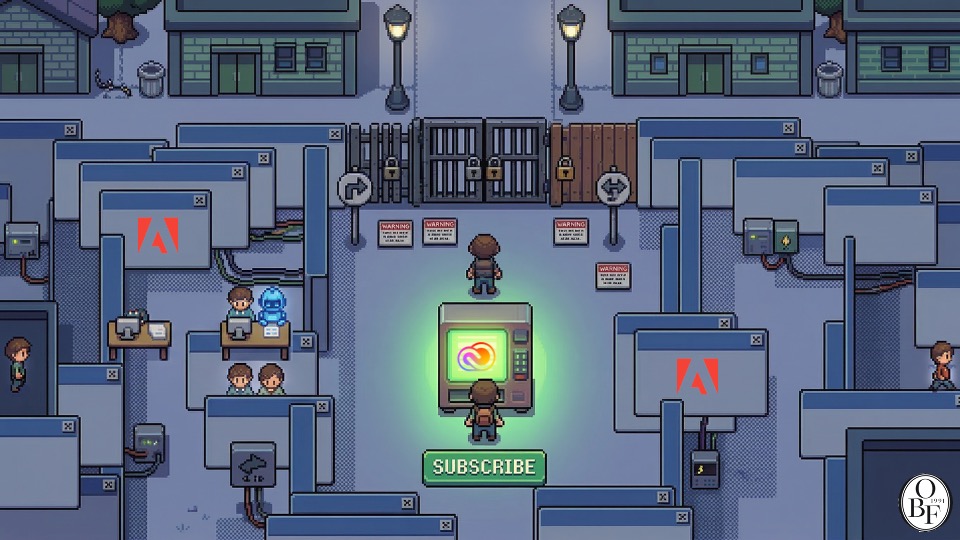
Among Adobe’s Creative Cloud plans is one called “Annual, Paid Monthly.” Judging by the name alone, it sounds like a plan you pay for month to month. In reality, it’s a one-year commitment. Cancel early, and you owe a penalty equal to 50% of the remaining contract value — a sum that can run into the hundreds of dollars. In June 2024, the DOJ and the Federal Trade Commission (FTC) sued Adobe. The core allegations came in three parts.
First, Adobe concealed key terms at sign-up. The one-year commitment and the early-cancellation penalty were buried in small print or behind hyperlinks. Second, Adobe deliberately complicated the cancellation process. Canceling online required navigating multiple pages; canceling by phone meant repeating the same request to multiple representatives. Third, customers only learned a penalty existed the moment they tried to cancel. The DOJ described this as customers being “ambushed.”
Adobe’s fiscal 2025 revenue was $21.5 billion. The $75 million settlement amounts to roughly 0.35% of annual revenue — proportionally, about the equivalent of a single speeding ticket relative to an average Korean office worker’s salary. But this case matters not because of the dollar amount, but because of the precedent it sets.
What Is a Dark Pattern — A Taxonomy of Designed Friction
The term “dark pattern” was coined in 2010 by Harry Brignull, a UX designer based in London. It refers to interfaces deliberately designed to deceive or manipulate users. This is fundamentally different from merely “inconvenient design.” The key is intent — a design calculated to exploit user error or inertia. Breaking down the specific dark patterns used in the Adobe case:
- Roach Motel1: A structure that’s easy to enter but hard to exit. Adobe’s cancellation process fit this pattern exactly. Signing up took a few clicks; canceling required navigating multiple pages or calling in.
- Hidden Cost: Additional charges that surface only right before payment or at the moment of cancellation. Adobe’s early-termination penalty falls into this category.
- Misdirection: Deliberately steering the user’s attention elsewhere — making the “Keep Subscription” button large and colorful while the “Cancel” button stays small and gray.
- Confirmshaming2: Displaying guilt-inducing copy to users trying to cancel. Phrases like “Are you sure you want to give up these benefits?” are a classic example.
These patterns aren’t isolated incidents. According to a 2024 global survey by the International Consumer Protection and Enforcement Network (ICPEN), which the FTC participated in, researchers examined 642 websites and apps worldwide and found that 76% used at least one dark pattern, while 67% used two or more simultaneously.
The Global Regulatory Wave — U.S., EU, and Korea Respond
The Adobe case isn’t an isolated incident. It’s one scene in a broader, simultaneous global tightening of dark pattern regulation.
In September 2025, the FTC reached a $2.5 billion (~₩3.5 trillion) settlement with Amazon over allegations that dark patterns in the Prime sign-up process enrolled 35 million consumers in unwanted subscriptions. Internally, Amazon reportedly called its Prime cancellation flow the “Iliad Flow” — canceling required 4 pages, 6 clicks, and 15 choices.
Meanwhile, the FTC’s “Click-to-Cancel” rule, finalized in late 2024 — which required cancellation to be as easy as sign-up — was struck down by the U.S. Eighth Circuit Court of Appeals in July 2025 on procedural grounds, ruling that the FTC hadn’t adequately conducted a cost-benefit analysis during rulemaking. Under the current administration, the odds of the rule being revived look slim.
The EU’s Digital Services Act (DSA), effective since 2022, explicitly bans dark patterns on online platforms. Aggressive pop-ups and misleading consent buttons are among the targeted practices. Going further, the European Commission has been preparing a “Digital Fairness Act” since 2025 — a horizontal regulatory framework covering not just dark patterns but addictive design, personalized pricing, and influencer marketing.
Korea is moving too. On February 14, 2025, an amended e-commerce law took effect, legally banning six categories of dark patterns: hidden auto-renewal, drip pricing, pre-selected options, misleading hierarchy, obstruction of cancellation/withdrawal, and repeated interference. After a six-month grace period, Korea’s Fair Trade Commission (FTC-KR) began active enforcement in August 2025, and in October issued its first corrective orders and fines against four operators in the OTT, music streaming, and e-commerce sectors — the first actual sanctions since the amended law took effect.
The three regions take different approaches, but the direction is the same: the “easy sign-up, hard cancellation” business practice is no longer being tolerated.
Oz’s Lens
Honestly, what stays with me longer than the settlement figure is that executive’s remark. Comparing the cancellation penalty to “heroin” reveals that Adobe’s own people recognized this was an addictive revenue structure. And yet they couldn’t let it go — because removing it would mean “a major hit to the business.”
From my experience building go-to-market strategy, this is a classic retention-metric trap. Once a company sets “churn rate” as a KPI, the organization instinctively moves to “prevent” churn. The question is how. Do you increase product value so customers stay voluntarily, or do you make cancellation difficult so they’re stuck against their will? The former is hard and slow. The latter is easy and fast. And quarterly earnings don’t distinguish between the two.
From a data perspective, there’s one more thing worth noting: the most insidious thing about dark patterns is that they create harm that goes unmeasured. Customers who give up trying to cancel never show up in churn statistics. Customers who keep paying while resentful get classified as “loyal customers” in retention metrics. This is exactly why it’s so hard for companies to recognize, internally, that this structure is a problem.
So I don’t think the real question raised by the Adobe case is “where should the cancel button go.” It’s “Does our retention come from value, or from friction?” This isn’t a UX team problem — it’s a problem with executive incentive structures.
Closing
Adobe’s $150 million settlement signals that regulation of “subscription traps” has entered the enforcement phase. From the U.S. ($2.5 billion from Amazon), to the EU (the Digital Fairness Act underway), to Korea (the first application of dark pattern clauses under the e-commerce law) — this is a simultaneous global trend. And the essence of dark patterns isn’t UI design — it’s a structural problem with business models that manage churn through friction rather than value.
Next time you cancel a service, try counting: how many clicks did sign-up take, and how many does cancellation require? That difference will tell you how much that company actually respects you.
References & Further Reading
- Reuters, “Adobe to pay $75 million to resolve U.S. lawsuit over fees, subscription cancellations”, CNBC, 2026. — The most concise article summarizing the full context of the settlement.
- FTC, “Bringing Dark Patterns to Light”, FTC Staff Report, 2022. — An FTC report systematically cataloging dark pattern types and cases. Essential reading for understanding the classification framework.
- Lalsinghani, “Left in the Dark: Evaluating the FTC’s Limitations in Combatting Dark Patterns”, Berkeley Technology Law Journal, Vol. 39, No. 4, 2025. — An academic paper analyzing the legal limits of U.S. dark pattern regulation and where it’s headed.
- Korea Fair Trade Commission, “Q&A on Regulation of Six Types of Online Dark Patterns”, 2025. — The official Korea FTC document outlining Korea’s six dark-pattern categories and interpretive standards.
- European Parliament, “Regulating dark patterns in the EU: Towards digital fairness”, EPRS, 2025. — A European Parliament briefing summarizing the EU’s dark pattern regulations and the background of the Digital Fairness Act (DFA).
- Longblack, “Dark Patterns: UX Design That Deceives Consumers — Hearing from the Original Whistleblower’s Solutions”, June 14, 2024. — I once contributed as a speaker on Longblack (EP.9) writing about dark patterns, covering common tactics seen both in Korea and abroad, so I’m sharing it here.
- Kwangseob Ahn, 101 Psychological Effects You’ll Eventually Use, https://haebom.dev/psychology101 — My own writeup on psychological effects and dark patterns.

The author, Kwangseob Ahn, is a professor of business administration at Sejong University and lead consultant at OBF (Oswarld Boutique Consulting Firm). He teaches statistics and data analysis — business data management and business analytics — while leading GTM and AI strategy consulting in the field, designing the seam between technology and business. He has published academic research on a memory architecture for AI dialogue systems (HEMA) and runs Daily Arxiv, a daily curation of global AI papers. He holds a master’s from Korea University’s Graduate School of Technology Management and a KMBA. He is the author of Homo Brainless: The People Who Outsource Their Thinking.
Footnotes
-
Roach Motel: A dark pattern type named after the sticky trap used to catch cockroaches. It refers to designs that make signing up or consenting easy, while requiring a complicated process to cancel or withdraw. Adobe’s cancellation process is a textbook example. ↩
-
Confirmshaming: A dark pattern that uses copy designed to make users feel ashamed or disadvantaged when they choose to decline or cancel. For example, a newsletter’s unsubscribe button might read, “No thanks, I don’t mind missing out on important updates.” ↩
Related issues
 Issue #51AI & Tech
How a Memory-Saving Algorithm Tanked Memory Stocks
Google's TurboQuant compression algorithm rattled memory stocks Wednesday — but what actually got shaken?
 Issue #49AI & Tech
OpenAI's Five-Punch Day Reveals Its Real Strategy Shift
Sora didn't fail — OpenAI abandoned it on purpose.
 Issue #43AI & Tech
NVIDIA GTC 2026: The Blueprint, Not the Chips
One trillion dollars in order visibility, a $20 billion acquisition paying off, and the 'token factory' business model
Your take shapes the next issue
What resonated most in this issue, or where has your experience been different?