OpenAI's Five-Punch Day Reveals Its Real Strategy Shift
Sora didn't fail — OpenAI abandoned it on purpose.
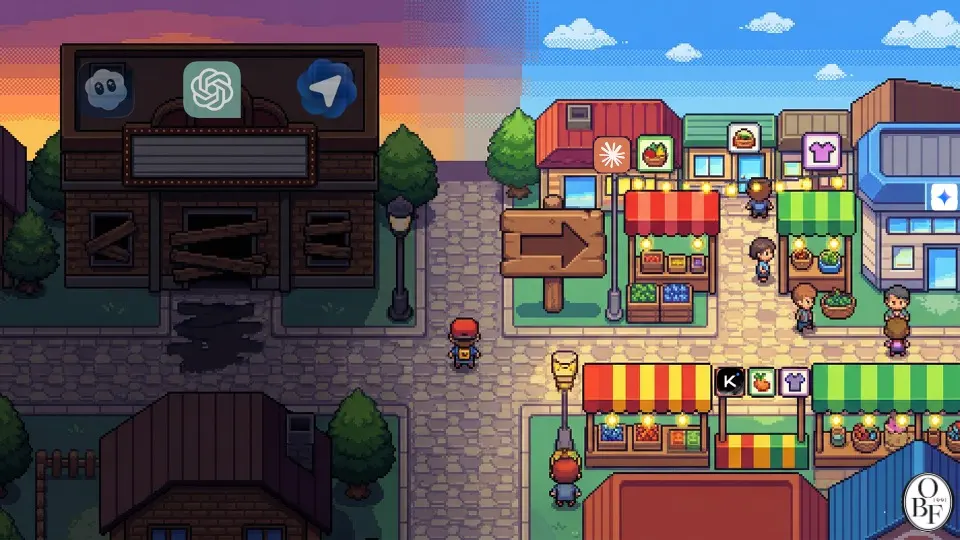
Opening
Reader, there was a product Disney bet $1 billion on. It hit 1 million downloads in 5 days and topped the App Store charts. That product disappeared yesterday. After just 6 months.
This is the story of OpenAI’s Sora.
But that’s not all. On the same day, Sam Altman announced a reorganization via internal memo, and stepped back from overseeing the safety team himself, declaring he’d focus on “building data centers” instead. Then, ChatGPT transformed into a shopping platform hosting Walmart, Target, and Sephora. And on top of that, reports surfaced that OpenAI is courting private equity firms with a guaranteed 17.5% return to win over the enterprise market.
Five headline-worthy pieces of news, in a single day. Coincidence?
I don’t think so. This is a single strategy — the pivot from “AI that impresses” to “AI that earns.” In today’s issue, I want to unpack why these 5 announcements belong to the same story, why Sora’s death was a choice rather than a failure, and what the direction OpenAI is heading toward means for the entire AI industry.
Sora’s Exit After 6 Months — What Happened
The Sora app launched in September 2025. It surpassed 1 million downloads within 5 days and topped the iOS App Store’s Photo & Video category. Technically, the Sora 2 model could generate native audio and realistic physics simulations, earning it the label “the most impressive video generation model in existence” at the time.
In December, Disney signed a 3-year deal licensing Mickey Mouse, Marvel, and Pixar characters to Sora, alongside a $1 billion equity investment. It was the largest IP deal in the AI video industry.
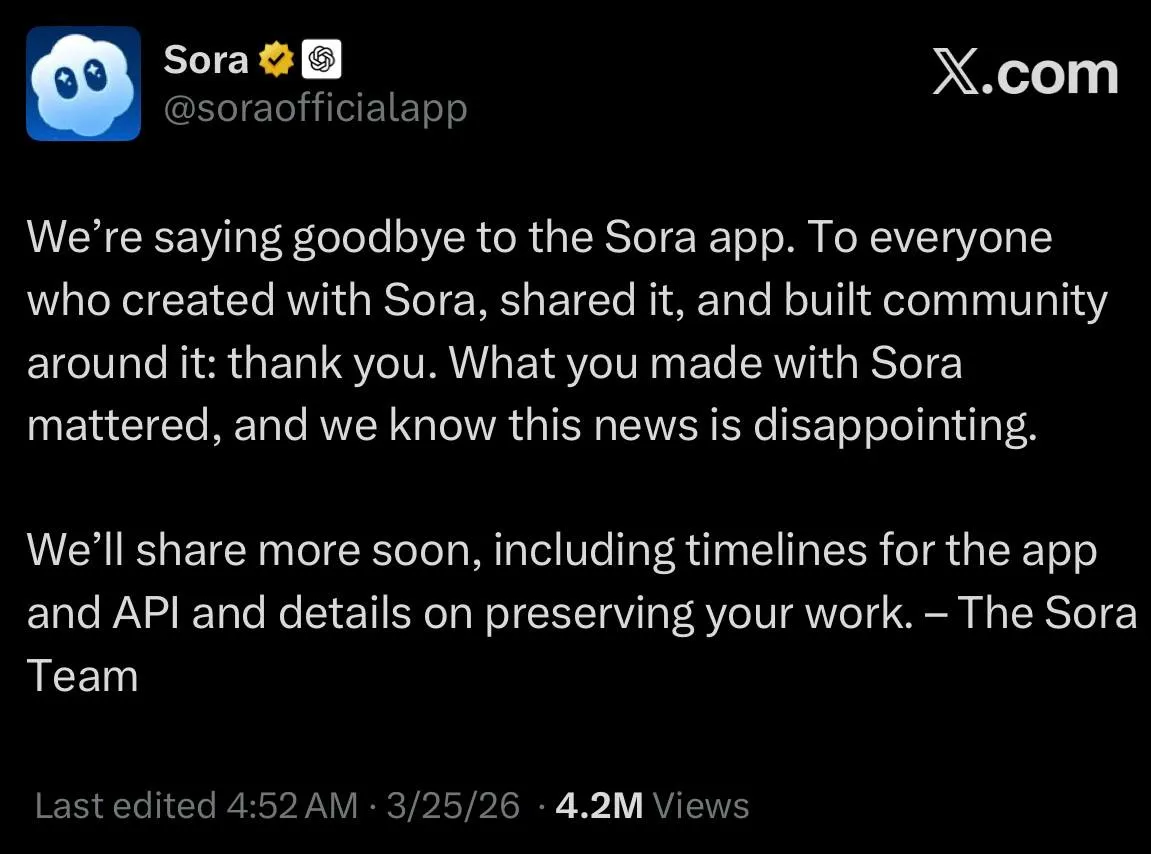
Then, on March 24th, it suddenly ended. The Sora team posted a brief farewell on X (formerly Twitter), with no official explanation for the shutdown. Disney withdrew both the investment and the licensing agreement.
Why kill it? There’s no official reason, but the puzzle pieces exist.
CNN quoted an OpenAI spokesperson saying that “as demand for computing1 grew, tradeoffs became necessary for products with high compute costs.” NBC framed it as part of a cost-cutting push ahead of an IPO2. And Altman’s internal memo, released the same day, fills in the rest of the picture.
Altman’s Internal Memo — “I Will Build Data Centers”
Altman’s memo to employees boiled down to 3 points.
First, a redefinition of his own role. Altman relinquished direct oversight of the safety and security teams. The safety team moved under CRO Mark Chen’s research organization, and the security team moved under Greg Brockman’s scaling organization. Altman himself stated he would focus on capital raising, supply chain management, and “building data centers at an unprecedented scale.”
Second, an organizational name change. The product organization led by Fidji Simo was renamed “AGI3 Deployment.” It’s a declaration of the shift from research-focus to actual deployment.
Third, the next-generation model, “Spud.” Pre-training4 is complete, and release is expected within weeks. And while the Sora research team wasn’t disbanded, it pivoted away from video generation toward world model5 research. The new goal is robotics-centered physical simulation — “automating the physical economy.”
To sum up: OpenAI’s top priorities are now the next-generation model (Spud) → data center infrastructure → enterprise market deployment. There was no room for Sora within this priority list. Sora didn’t fail technically. It was strategically abandoned.
And there’s another number that shows just how aggressive this “enterprise market deployment” push is. According to Seeking Alpha, OpenAI is competing to set up joint ventures with private equity (PE)6 firms by offering a guaranteed minimum return of 17.5% — far higher than a typical preferred stock7 yield. The purpose is clear: to distribute AI tools en masse across the hundreds of private portfolio companies PE firms hold. The competitor in this space is Anthropic. It’s a strategy to secure both capital and distribution channels at once, by offering better terms than Anthropic, which has traditionally held the edge in the enterprise market.
The Day ChatGPT Became a Shopping Mall
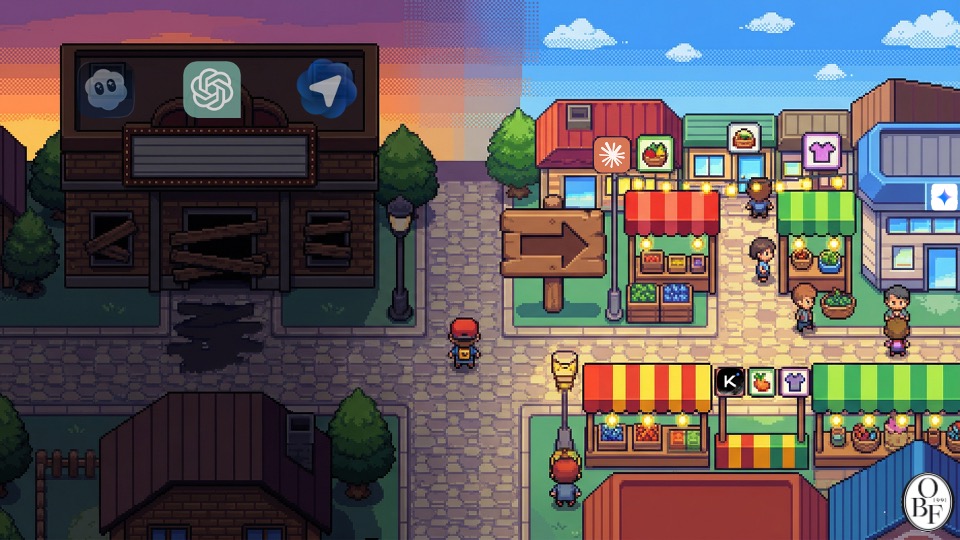
On the same day, OpenAI significantly expanded ChatGPT’s shopping features. What’s interesting here is the change in direction.
Last year, OpenAI’s ambitious “Instant Checkout” feature let users complete purchases directly within ChatGPT. The Agentic Commerce Protocol (ACP)8, built with Stripe, was the foundation of this structure. But in practice, only about 12 merchants out of Shopify’s millions were ever onboarded. Transaction infrastructure — inventory syncing, shipping cost calculation, state-by-state tax handling — simply couldn’t keep up.
So OpenAI revised its strategy. Instead of direct payment, it shifted focus to the discovery and comparison stage that shapes purchase decisions. Upload an image, and it recommends similar products, letting you compare prices, reviews, and features on a single screen. Walmart began embedding its own app inside ChatGPT, offering an integrated experience with account linking and checkout, while major retailers like Target, Sephora, Nordstrom, Lowe’s, Best Buy, Home Depot, and Wayfair connected their product data through ACP.
It shifted from “we’ll handle checkout ourselves” to “we’ll control the entry point to purchase decisions.” This is a more realistic — and arguably more powerful — strategy. As Google proved in the search ad market, dominating the starting point of a purchase decision is a bigger business than processing the payment itself.
Oz’s Lens
I read these 3 announcements as a single sentence: “OpenAI is no longer trying to be a company that demos technology — it’s trying to become an infrastructure company.”
From a GTM strategy standpoint, Sora’s shutdown is a textbook case of Portfolio Rationalization9. What’s the first thing a company preparing for an IPO does? It trims product lines with unclear profitability and concentrates resources on core revenue sources. Sora was technically impressive, but its path to direct revenue was murky. ChatGPT Shopping, by contrast, has a clear revenue model — per-transaction fees — and a user base of 700 million weekly active users that no retailer can afford to ignore.
Offering PE firms a guaranteed 17.5% return is even more telling. In GTM terms, this is the classic tradeoff of ceding margin to a channel partner in exchange for buying distribution speed. The hundreds of portfolio companies held by PE firms represent enterprise customers that would take years to acquire one by one — now packaged into a single deal. 17.5% may look extravagant, but there’s an underlying calculation: in a structure where the marginal cost10 of AI tools approaches zero, securing a massive user base can recoup far more than that. The number also reveals just how fierce the enterprise-market competition with Anthropic has become.
As someone who works with data, I’d add one more thing: it’s quite unusual for a CEO to declare he’s personally focusing on building data centers. When a CEO goes all-in on infrastructure, it signals a belief that future competition will be less about model performance and more about a fight for compute resources. In fact, OpenAI has stated it plans to invest over $1.4 trillion in 30 gigawatts of infrastructure. That scale rivals the total electricity consumption of a mid-sized country.
And recall the structural collapse in AI video generation costs I covered in last week’s issue. In a market where costs have fallen to $0.01 per second, sustaining Sora’s differentiation would require pouring in enormous computing infrastructure continuously. With Chinese competitors like ByteDance’s Seedance 2.0 and Kuaishou’s Kling 3.0 churning out cheaper, more flexible models, this is a fight with poor odds. Redirecting that compute toward the Spud model and commerce infrastructure is the more rational choice.
That said, this strategic pivot comes at a cost. It’s still unclear how Sora users’ content will be preserved, and the collapse of the $1 billion Disney deal has cracked trust across the AI-entertainment industry. The more OpenAI repeats its pattern of “launch fast, kill fast,” the more long-term trust costs accumulate with partners and users.
Closing
One. Sora’s shutdown isn’t a technical failure — it’s a resource reallocation toward the IPO and the next-generation model. Compute is a finite resource, and OpenAI chose to spend it “earning money” instead of “putting on a show.”
Two. ChatGPT’s push to control the shopping-discovery gateway is a signal that an AI company is evolving from a media company into a commerce infrastructure company.
Three. The AI video generation market will keep growing without OpenAI. If anything, Google’s Veo, ByteDance’s Seedance, and Kuaishou’s Kling are likely to fill the gap quickly.
Watching Sora’s shutdown, there’s one more thing worth reflecting on. When you invest time creating content, building a community, around an AI tool — there’s no guarantee that platform will still exist tomorrow. Tools disappear, but perspective remains. In the end, what matters isn’t which tool you use, but what you know how to build with it.
References & Further Reading
- Variety, “OpenAI Will Shut Down Sora Video App; Disney Drops Plans for $1 Billion Investment”, 2026.03.24. : The most detailed account of Disney’s investment withdrawal and the termination of the character licensing deal.
- CNN, “OpenAI is shutting down its Sora video app just months after launch”, 2026.03.24. : The original source of the OpenAI spokesperson’s “computing cost tradeoff” comment.
- The Information, “OpenAI CEO Shifts Responsibilities, Preps ‘Spud’ AI Model”, 2026.03.24. : The most detailed reporting on Altman’s internal memo and the reorganization.
- CNBC, “OpenAI revamps shopping experience in ChatGPT after struggling with Instant Checkout”, 2026.03.24. : Covers the background behind Instant Checkout’s scale-back and the shopping strategy pivot.
- OpenAI official blog, “Powering product discovery in ChatGPT”, 2026.03.24. : The official announcement of the ACP-based commerce expansion.
- Seeking Alpha, “OpenAI Offering Attractive Deals to Private Equity Firms”, 2026.03.25 : Details the competition among PE joint ventures and the specific terms of the enterprise-market push.
- Digital Commerce 360, “OpenAI Scales Back ChatGPT Checkout: Why Agentic Commerce Needs Universal Checkout Infrastructure”, 2026.03.06. : A structural analysis of why Instant Checkout failed to scale.
- TechCrunch, “OpenAI’s Sora was the creepiest app on your phone — now it’s shutting down”, 2026.03.24. : A recap of Sora’s six-month trajectory and the deepfake controversy surrounding it.

The author, Kwangseob Ahn, is a professor of business administration at Sejong University and lead consultant at OBF (Oswarld Boutique Consulting Firm). He teaches statistics and data analysis — business data management and business analytics — while leading GTM and AI strategy consulting in the field, designing the seam between technology and business. He has published academic research on a memory architecture for AI dialogue systems (HEMA) and runs Daily Arxiv, a daily curation of global AI papers. He holds a master’s from Korea University’s Graduate School of Technology Management and a KMBA. He is the author of Homo Brainless: The People Who Outsource Their Thinking.
Footnotes
-
Computing: A blanket term for the computational resources (GPUs, servers, power, etc.) needed to train or run AI models. In the AI industry, it’s arguably the second most important resource after money — whoever secures more compute holds the competitive edge. ↩
-
IPO (Initial Public Offering): The process by which a private company lists its shares on a stock exchange and sells them to the general public for the first time. Simply put, it’s “the moment ownership of the company expands to the public.” Companies preparing for an IPO tend to clean up unprofitable business lines to present clear profitability and growth. ↩
-
AGI (Artificial General Intelligence): Unlike today’s AI, which excels at narrow tasks, AGI refers to a level of AI that can think and reason flexibly across diverse domains, much like a human. It hasn’t been achieved yet, but it’s the stated official goal of OpenAI and other major AI companies. ↩
-
Pre-training: The stage in which an AI model learns basic language and knowledge structures from massive datasets before being put to practical use. Think of it as roughly equivalent to “having completed general education in college.” Afterward, the model undergoes additional fine-tuning for specific purposes before deployment. ↩
-
World Model: A model in which AI simulates the laws of the physical world — gravity, collision, friction, and so on. It goes a step beyond “making videos look pretty,” moving toward research that “understands and predicts” the real world. This kind of physical understanding is essential for a robot to pick up an object or take a step. ↩
-
Private Equity (PE): A fund that pools capital from a small number of large investors to invest in private (non-public) companies. Firms like KKR and Blackstone are well-known examples. They typically generate returns by acquiring a company, restructuring it, and selling it within a few years — which is why they often hold hundreds of companies in their portfolios simultaneously. ↩
-
Preferred Stock: A class of stock that gets priority over common stock in receiving dividends or proceeds during liquidation, but usually comes with limited or no voting rights. It’s a structure often used in startup investing — and a guaranteed 17.5% return is far higher than a typical preferred stock dividend rate (5–10%). ↩
-
Agentic Commerce Protocol (ACP): An open protocol built jointly by OpenAI and Stripe that allows AI agents to browse for and even purchase products on a user’s behalf. In simple terms, it’s “the shared language an AI uses to communicate with merchants when acting as a shopping assistant.” ↩
-
Portfolio Rationalization: A management strategy in which a company trims business lines or products that are underperforming or that fall low on its strategic priority list. Think of it as “letting go of the rest in order to focus on what you do best.” It often appears ahead of an IPO or during restructuring periods. ↩
-
Marginal Cost: The additional cost incurred by producing one more unit of a product or service. For AI tools, once the model is built, the cost of serving one more user barely increases. It’s similar to how Netflix’s server costs don’t rise much just because one more subscriber signs up. ↩
Related issues
 Issue #43AI & Tech
NVIDIA GTC 2026: The Blueprint, Not the Chips
One trillion dollars in order visibility, a $20 billion acquisition paying off, and the 'token factory' business model
 Issue #42AI & Tech
AI Is Getting Smarter. Is It Also Getting More Alike?
A NeurIPS award-winning study finds that leading AI models converge on nearly identical answers to open-ended questions.
 Issue #41AI & Tech
Could a One-Won Stamp on Every Email Kill Spam?
In a world where sending a message costs nothing, your attention became a free resource up for grabs.
Your take shapes the next issue
What resonated most in this issue, or where has your experience been different?