Amazon's Globalstar Deal: From Cables to Satellites
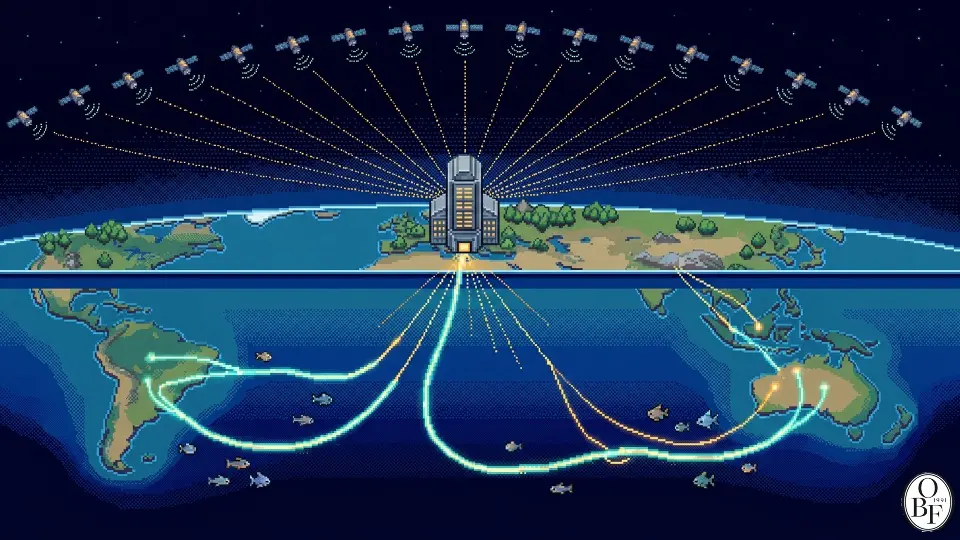
Control over global telecom infrastructure is shifting from carriers to Big Tech.
Opening
Hello, dear reader. On April 14, Amazon announced it would acquire satellite communications company Globalstar for about $11.6 billion — $90 a share, a 23.5% premium over the previous closing price. But the acquisition price isn’t what caught my attention.
One line in the press release jumped out at me: “Amazon and Apple have agreed that Amazon LEO1 will handle satellite communication services for the iPhone and Apple Watch.”
This isn’t a simple satellite company acquisition. To understand what’s really going on here, we first need to dive under the ocean.
🌊 The Path for 99% of the World’s Data: Subsea Cables
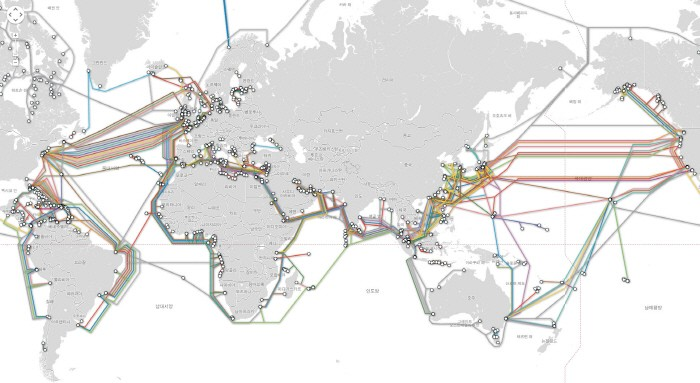
About 99% of the emails, video calls, and financial transactions we exchange every day travel through undersea fiber-optic cables — not satellites. Roughly 570 fiber-optic cables laid beneath the world’s oceans connect continent to continent, carrying an estimated $10 trillion in financial transactions every single day.
The problem is that ownership of these cables is changing hands.
As recently as 2012, Google, Meta, Amazon, and Microsoft together used less than 10% of total subsea cable capacity. Today that figure is about 66%. These four companies now own or hold stakes in more than 60 subsea cables. Google alone has invested in 33 cables, and this year Meta is spending $10 billion to build a 50,000km cable called “Project Waterworth.”
Subsea cables used to be built through consortia — national telecom carriers pooling investment and sharing capacity, a kind of “public highway.” Now, Big Tech companies are building their own private roads instead. The companies that make the content now also own the pipes that carry it.
If I had to sum up what this shift means in one line: the physical foundation of the internet is moving from public infrastructure to private corporate assets.
🛰️ And Now, the Same Thing Is Happening in the Sky
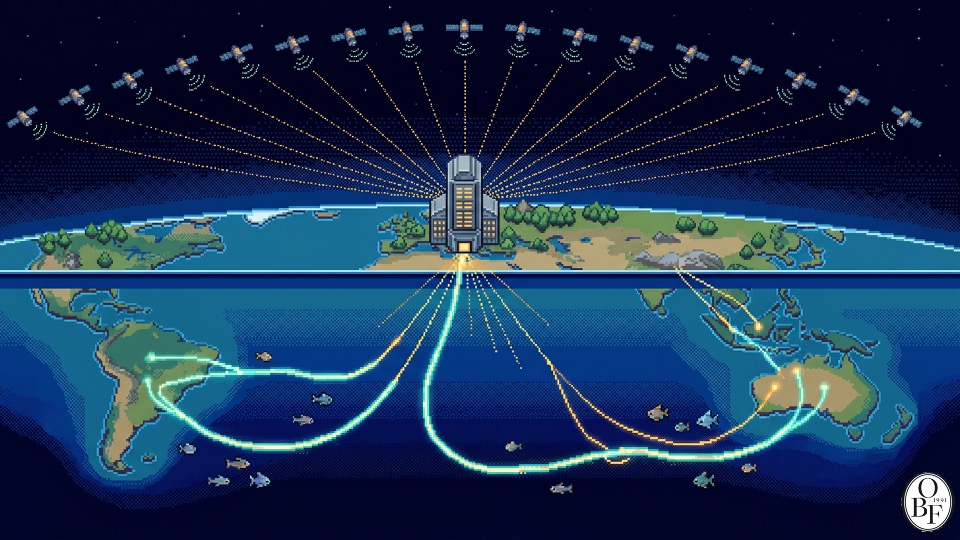
If subsea cables are the “internet under the sea,” Low Earth Orbit (LEO) satellites are the “internet above the sky.” Thousands of small satellites, orbiting roughly 500km above Earth, beam internet connectivity down to the entire planet.
There are three major players in this market right now.
Starlink (SpaceX): The overwhelming leader. As of April 2026, it has roughly 10,200 satellites in orbit and more than 10 million subscribers worldwide. It’s live in more than 150 countries, and it’s adding over 20,000 new subscribers a day, on average. Starlink satellites account for 65% of all active satellites currently in orbit. It’s also locking down the B2B market, signing deals with airlines (Air France, Air Canada, Southwest) and shipping companies (Maersk, Hapag-Lloyd, Hyundai Glovis).
Amazon LEO (formerly Project Kuiper): Today’s protagonist. It currently has about 211 satellites in orbit — still early-stage compared to Starlink. But the Globalstar acquisition changes the game. In one move, Amazon secures Globalstar’s MSS spectrum2, 24 second-generation satellites, more than 20 ground stations worldwide, and — most importantly — its existing partnership with Apple. On top of that, Amazon plans to add Direct-to-Device (D2D)3 service, rolling out a next-generation D2D satellite system starting in 2028.
AST SpaceMobile: A coalition of carriers. It’s partnered with more than 50 telecom operators, including Vodafone, AT&T, Verizon, and Rakuten. What sets it apart from Starlink and Amazon LEO is that it connects directly to ordinary smartphones — no dedicated terminal required. Each satellite carries an antenna array of about 223㎡ (2,400 sq ft), the largest of any commercial communications satellite, and the company has targeted putting 45–60 satellites into orbit by the end of 2026. In practice, though, repeated schedule slips have led some analysts to estimate the real number will land closer to 30.
🤝 Why the Amazon-Globalstar-Apple Triangle Matters
The key to this acquisition is that it secures both spectrum and relationships at once. In the LEO satellite business, the scarcest resource isn’t the satellites themselves — it’s radio spectrum. Globalstar’s MSS spectrum is a licensed frequency asset usable around the world. You can build new satellites, but spectrum has to be coordinated through the International Telecommunication Union (ITU)4, which means it isn’t an asset you can simply buy with money.
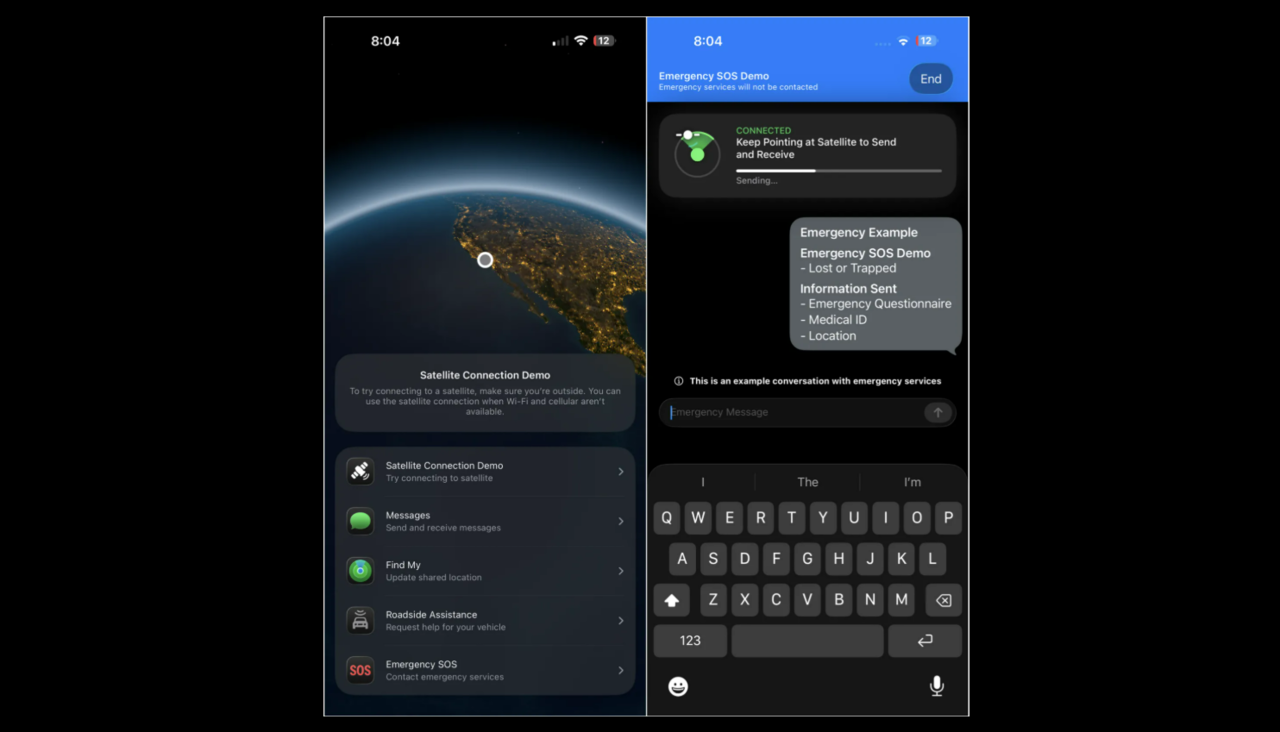
Then there’s Apple. In 2024, Apple invested about $1.5 billion in Globalstar for roughly a 20% stake. The satellite Emergency SOS feature available since the iPhone 14 has been running on Globalstar’s satellite network. Now that Amazon is acquiring Globalstar outright, the iPhone’s satellite communications infrastructure effectively moves onto Amazon LEO.
Here’s how it all fits together:
- Amazon: Spectrum + satellite infrastructure + ground stations5 → LEO business accelerates
- Apple: Stable satellite service for the iPhone/Apple Watch + a strategic alliance with Amazon
- Starlink: Its fiercest rival just got real teeth The fun part is that Globalstar had previously discussed a sale to SpaceX as well. In other words, this was an asset coveted by all three — Elon Musk, Jeff Bezos, and Tim Cook.
🔑 The Real Question: Who Owns the Backbone[6] of Global Connectivity
Step back for a moment, and a clear pattern emerges in what’s happening right now.
Under the sea: Google, Meta, Amazon, and Microsoft have emerged as the biggest investors in and owners of subsea cables. Together, they account for about 66% of the world’s undersea bandwidth.
Above the sky: Starlink (SpaceX), Amazon LEO, and AST SpaceMobile — all three major players in LEO satellite communications are American companies.
Whether under the ocean or in low orbit, physical ownership of the world’s internet infrastructure is concentrating in the hands of a handful of American Big Tech companies. National carriers used to maintain at least nominal, distributed ownership through consortia — and that structure is collapsing fast.
This isn’t just a business story. Communications infrastructure is national security.
The EU has already recognized this. Through the “IRIS2 project,” it’s building its own LEO satellite network of roughly 170 satellites, and Vodafone has formed a joint venture called SatCo with AST SpaceMobile for a Europe-only satellite service. China, for its part, plans to independently deploy roughly 13,000 communications satellites under a government-led effort called the “Guowang (国网, “national network”) project.”
Oz’s Lens
Honestly, when I saw the Amazon-Globalstar news, my first thought was: “of course it comes down to this.” In the infrastructure business, the most powerful strategy has always been the same: own the pipes. No matter how fierce the competition over content gets, whoever owns the pipes that content flows through ends up setting the rules of the game.
Google started this game with subsea cables, and now Amazon is running the same playbook with LEO satellites. And by pulling Apple into the mix this time, it’s built out a vertical integration6 play — device (iPhone) plus infrastructure (Amazon LEO) — all in one.
Korea’s reality is, frankly, a bit frustrating. Starting in 2025, the Ministry of Science and ICT (MSIT) launched a ₩320 billion LEO satellite communications R&D program, with ETRI (Electronics and Telecommunications Research Institute) and KAI (Korea Aerospace Industries) selected as lead agencies. The plan is to launch two 6G-standard-based communications satellites by 2030. This past March, a dedicated “LEO Satellite Communications Task Force” was also formed.
The direction is right. But the gap in scale and speed is enormous. Starlink has already put more than 10,000 satellites into orbit, and Amazon is executing an $11.6 billion acquisition — while our plan is to launch two satellites over six years. This isn’t “catching up.” It’s closer to a survival strategy. We need to build independent technical capability while also making the strategic call on which camp to align with.
Closing
Before I close, a disclosure: I’ve made significant gains on $ASTS and I’m quite bullish on this space — which means I may well be looking at it through a biased lens. (For reference, my average cost basis is $18.35.) Here’s today’s story in three lines:
- Physical ownership of global internet infrastructure is consolidating in the hands of Big Tech. It started with subsea cables, and now it’s spreading to LEO satellites.
- Amazon’s Globalstar acquisition isn’t just a “satellite company purchase” — it’s a communications infrastructure platform play that secures spectrum, infrastructure, and the Apple ecosystem all at once.
- This goes beyond business competition to a question of communications sovereignty. The EU and China are building their own satellite networks, and Korea took its first step this year — but the gap remains wide. Next time you connect to Wi-Fi on a plane, or send a message from the middle of the ocean, take a moment to think about whose infrastructure that data is riding on. That question is only going to matter more from here.
References & Further Reading
Primary sources
- Amazon, “Amazon to Acquire Globalstar and Expand Amazon Leo Satellite Network”, Amazon Press Center, 2026.4.14. : Today’s official press release. It covers the acquisition terms, the agreement with Apple, and the D2D strategy.
- Bloomberg, “Amazon to Acquire Globalstar for $90 a Share”, 2026.4.14. : Details on the acquisition price and deal structure.
Background
- Internet Society, “Enhancing the Resilience of Submarine Internet Infrastructure”, 2025.12. : A policy brief on the vulnerabilities and resilience of subsea cable infrastructure. Useful context for understanding why cables matter.
- The Register, “Hyperscalers tying up the world in submarine cables”, 2024.9. : An article laying out Big Tech’s subsea cable holdings, with concrete figures like Google’s 33 cables and Meta’s 15.
- Ministry of Science and ICT (MSIT), “Korea Moves Decisively to Prepare for the LEO Satellite Communications Era”, 2025.4. : An overview of Korea’s progress on its LEO satellite communications R&D program.
Related video
- Starlink vs. Amazon vs. AST SpaceMobile — Who Will Control the Future of Communications? : A video deep dive into the competitive dynamics among Starlink, Amazon LEO, and AST SpaceMobile.

The author, Kwangseob Ahn, is a professor of business administration at Sejong University and lead consultant at OBF (Oswarld Boutique Consulting Firm). He teaches statistics and data analysis — business data management and business analytics — while leading GTM and AI strategy consulting in the field, designing the seam between technology and business. He has published academic research on a memory architecture for AI dialogue systems (HEMA) and runs Daily Arxiv, a daily curation of global AI papers. He holds a master’s from Korea University’s Graduate School of Technology Management and a KMBA. He is the author of Homo Brainless: The People Who Outsource Their Thinking.
Footnotes
-
LEO (Low Earth Orbit): refers to orbits roughly 200–2,000km above Earth’s surface. The TV relay satellites we’re familiar with (geostationary satellites) sit around 36,000km up. LEO satellites are much closer, which means less signal latency and faster internet connections — but because they orbit so quickly, thousands of them are needed to provide stable coverage. ↩
-
MSS Spectrum (Mobile Satellite Service Spectrum): internationally allocated radio frequency bands used to provide mobile connectivity via satellite. Think of it as a “radio license for satellite communications.” Because it requires ITU6 coordination, it’s a scarce asset that can’t simply be created with money. ↩
-
D2D (Direct-to-Device): technology that lets ordinary smartphones connect directly to satellites without a dedicated antenna, dish, or extra hardware. Traditional satellite internet required receiver equipment installed at a home or building, but D2D works with just a phone. The iPhone’s satellite Emergency SOS feature can be seen as an early form of D2D. ↩
-
ITU (International Telecommunication Union): a UN agency responsible for allocating radio frequencies and coordinating satellite orbits. Since wireless spectrum is a finite resource, any company or country that wants to use a specific frequency band must go through international coordination via the ITU — which is why it can take new satellite operators years to secure spectrum. ↩
-
Ground Station/Gateway: a terrestrial facility that exchanges signals between satellites and Earth. It acts as a relay, connecting data received from satellites in space to terrestrial internet networks. Globalstar owns more than 20 such ground stations worldwide, an infrastructure footprint that carries substantial value on its own. ↩
-
Vertical Integration: a strategy in which a single company directly owns and operates multiple stages of a product or service’s supply chain. Apple’s control over chip design, software, and retail stores is a classic example. Here, it refers to Amazon assembling cloud (AWS), satellite infrastructure (LEO), and a device ecosystem (via its Apple partnership) all under one roof. ↩
Related issues
 Issue #95AI & Tech
Smell, the Last Sense AI Still Lacks
Intelligence isn't just in the head — truly embodied AI still doesn't have a nose.
 Issue #92AI & Tech
An AI Ran a Store—and Paid Women Less
When you hand a decision over to a machine, who ends up owning the bias inside it?
 Issue #90AI & Tech
Hancom's PDF Tool Hits #1 on GitHub Trending
35 years of document know-how just got cashed into global currency for the first time.
Your take shapes the next issue
What resonated most in this issue, or where has your experience been different?