The Coal Problem: Why AI Never Actually Saves You Time
The paradox where greater efficiency makes you busier is playing out on your own desk right now.

Opening
Let me ask you something. Since you started using AI at work, has it actually gotten you out the door earlier?
I use AI pretty aggressively myself — for writing, research, organizing all kinds of things. Individual tasks are undeniably faster now. Something that used to take an hour now takes 15 minutes. And yet, strangely, my leaving time hasn’t budged. If anything, it feels like I’m getting out later.
I wondered if it was just me, when a study published in the Harvard Business Review (HBR) this past February landed a direct hit on the question. Associate Professor Aruna Ranganathan of UC Berkeley’s Haas School of Business and doctoral researcher Xinqi Maggie Ye spent eight months closely tracking a US tech company. Their conclusion gave me chills: the people using AI most enthusiastically are the very ones burning out first.
Today, I want to cross this study with a 160-year-old piece of economic theory to explain why AI is making us busier — and how we might actually escape the trap.
What 160-Year-Old Coal Can Teach Us
To understand this, we first need to travel back to England in 1865.
The economist William Stanley Jevons discovered something strange at the time. James Watt’s steam engine had dramatically improved coal efficiency — and common sense says coal consumption should have dropped, since the same amount of coal now did more work. But the result was the exact opposite. As efficiency rose, the cost of using coal fell; as costs fell, people built more factories, ran more trains, and found new uses for coal. Consumption exploded instead.
This is the ‘Jevons Paradox’1. Put simply, it’s the same logic as widening a highway expecting less traffic, only to have even more cars pour in and clog it right back up. The same thing happened when LED lighting spread and lighting usage actually rose, or when the internet made communication more efficient and total communication volume exploded.
And this 160-year-old paradox is at work again today. When the DeepSeek incident hit in January 2025, Microsoft CEO Satya Nadella posted on social media: “Jevons Paradox strikes again! As AI gets more efficient and accessible, usage will skyrocket.” Coal has simply been swapped for AI — the structure is identical.
But what caught my attention is that the ‘usage’ Nadella is talking about isn’t just API call counts. A surge in AI usage means a surge in the volume and density of the work we’re actually doing. And the UC Berkeley study captured exactly this.
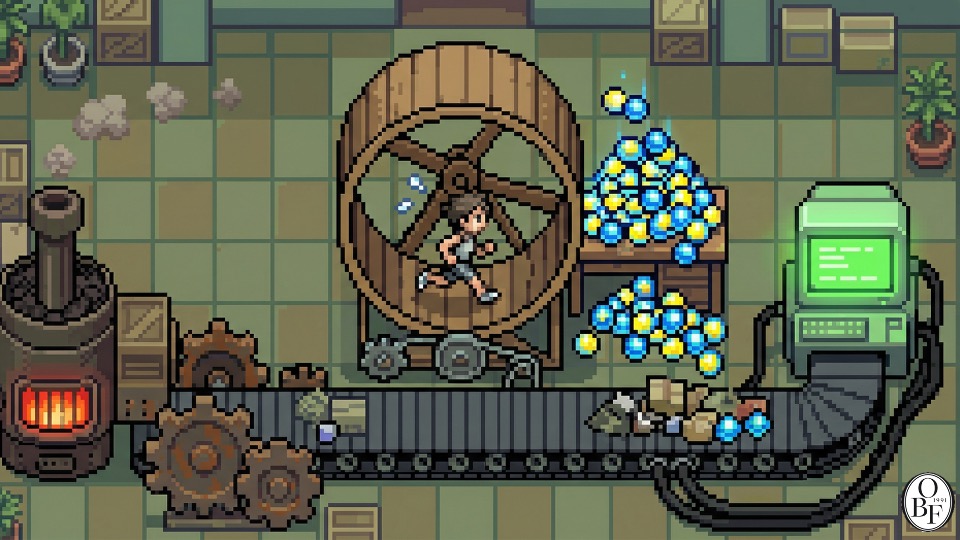
Eight Months Inside the Life of an ‘AI Power User’
Let’s start with the study design. From April to December 2025, researchers embedded themselves two days a week inside a roughly 200-person US tech company. They tracked internal communications like Slack and conducted more than 40 in-depth interviews across engineering, product, design, research, and operations.
Crucially, the company never mandated AI use — it just provided enterprise subscriptions and let people use them if they wanted. And yet the pattern the researchers found was unmistakable: employees were working faster, across a wider range of tasks, and at higher density — and nobody had told them to.
The researchers called this phenomenon Work Intensification2. It’s not that working hours increase — it’s that work density rises. You’re still putting in the same 8 hours, but it feels like 12 hours’ worth of exhaustion. And this intensification showed up in three concrete forms.
Three Patterns of Intensification: Because You Can, Because You Can’t Stop, Because Someone Has to Manage It
First, the scope of work voluntarily expands.
A PM starts writing code with AI’s help. A designer does data analysis. A researcher takes on engineering tasks. Work that would once have gone to another team or been outsourced now gets done in-house, with AI assistance. The researchers attribute this to the “cognitive boost” AI provides: it fills in knowledge gaps people couldn’t previously cross, creating a sense of “wait, I could actually do this myself.”
The problem is this ripples outward. Who reviews the code a PM wrote with AI? An engineer, of course. But not through a formal work request — through a Slack thread, or someone walking up to their desk asking for an informal favor. The output of so-called ‘Vibe Coding’3 — giving AI a rough direction and fixing things by feel — ends up landing on the actual engineer’s plate. It’s a paradox: when one person’s capability expands, the total workload of the whole team goes up, not down.
Second, the boundary between work and life collapses.
AI’s conversational interface has all but erased the friction of starting a task. In the past, doing work meant opening a program, setting up your environment, hunting down files — all that preparation actually functioned as a natural brake.
But with AI, all it takes is a single prompt. “Let me just ask this” during lunch, “let me just check this” mid-meeting, “just one last thing” right before leaving. The study frequently observed this habit of a “last prompt” right before clocking out. Because sending a prompt to AI feels like chatting rather than working, people’s sense of the boundary dulls. One participant put it this way: looking back, prompting during breaks had become such a habit that breaks stopped feeling restorative at all.
If the smartphone created a state of “always connected,” AI is creating a state of”always working”. With smartphones, the most you’d do was check email and fire off a reply; in the AI era, a single prompt can actually move real work forward.
Third, a backlog of “open tasks” to manage piles up.
As people start treating AI as a “partner,” they begin running multiple tasks at once: coding manually while having AI generate an alternative version, running another AI agent in the background, even reviving tasks they’d long shelved. The result is constant context switching4.
One engineer in the study nailed it: they’d expected that becoming more productive with AI would save time and mean less work, but in practice they ended up doing the same amount or more. They felt more productive — but never felt less busy. AI hasn’t become your “assistant”; it’s become a new hire who never stops producing output, and you’ve become that new hire’s manager.
The Self-Reinforcing Loop: The Trap Six Months Later
These three patterns don’t operate independently. Together, they form a single loop.
AI speeds up a given task → expectations about speed rise → reliance on AI grows → the scope of work expands → density and volume of work both increase → and to handle that increased load, you turn to AI even more. The researchers called this the “self-reinforcing loop.”
At first, it’s exciting — “Look how much I can do now, thanks to AI!” But six months later, that becomes the new normal. This is ‘Workload Creep’5 — workload quietly ratcheting up bit by bit until, without you noticing, it becomes the default. And what makes this scarier is that it happens voluntarily. No company mandated it. So neither the organization nor the individual recognizes it as overload.
This isn’t a finding unique to the UC Berkeley study. Other large-scale surveys point in the same direction.
In a 2024 Upwork Research Institute survey of 2,500 workers across the US, UK, Australia, and Canada, 77% of employees using AI said their workload had actually increased. In DHR Global’s 2026 Workforce Trends Report, 83% of workers reported experiencing burnout, and 48% of them cited excessive workload as the cause. And in METR’s 2025 experimental study, experienced developers using AI tools actually took 19% longer to complete tasks — yet perceived themselves as 20% faster. The “productivity illusion” was confirmed through measurement.
One caveat worth flagging: the UC Berkeley study observed a single 200-person tech company, so generalizing it to every industry calls for caution. The researchers themselves note this is still ongoing work, published as an HBR piece rather than in a peer-reviewed journal. That said, given that independent large-scale surveys from Upwork, DHR Global, and METR all point in the same direction, this pattern is quite likely to be widespread.
And as for Korea — honestly, this could be even worse here. Korea ranks among the longest-working-hours countries in the OECD, with an organizational culture that strongly prizes “working hard” as a virtue. AI gives people the sense that they “can do more,” and when that sense collides with Korea’s work culture, it’s easy to see how a structure of voluntary over-work would emerge.
Oz’s Lens
Honestly, I wasn’t surprised by these findings. If anything, my reaction was, “finally, someone measured this.” There’s a pattern I’ve seen over and over while building GTM strategy: whenever a new tool arrives, the first question is always “what more can I do with this?” The question “what can I stop doing because of this?” comes much later, if it comes at all. AI is no different.
What worries me most is this “productivity illusion.” In the METR study, developers who were actually 19% slower felt 20% faster. This isn’t just an individual-level misperception — it’s a structural problem that can distort decision-making across an entire organization. If leaders measure the impact of AI adoption by “gut feel,” they can easily conclude “this is going great” even while the team is actually overloaded.
So far, most discussion of AI adoption has centered on “how do we use it better” — prompt engineering, tool selection, workflow design. All of that matters. But what this study is telling us is that there’s one missing question: “when do we stop?”
Closing
Today’s argument comes down to three points. AI doesn’t reduce work — it intensifies it: speed, scope, and density all rise together. Because this intensification happens voluntarily, neither organizations nor individuals easily recognize it as overload. Which is why the answer can’t rely on individual willpower — organizations need to design an AI Practice6 at the organizational level.
The researchers propose an AI Practice built on three pillars: Intentional Pauses, deliberately stopping before important decisions; Sequencing, batching AI notifications and protecting focus time; and Human Grounding, making sure human-to-human conversation happens between stretches of solo AI work. This isn’t about an individual’s personal routine — it’s something an organization has to build into its systems.
Why not try just one experiment this week? Pick one stretch of the day when you won’t send a single prompt — whether that’s lunchtime or the 30 minutes before you leave. Whatever you feel during that time — anxiety, or relief — is itself a diagnosis.
📎 References & Further Reading
- Ranganathan, A. & Ye, X.M. (2026), “AI Doesn’t Reduce Work—It Intensifies It”, Harvard Business Review. : This is the core basis for today’s newsletter. The three intensification patterns and the AI Practice concept both come from here.
- METR (2025), “Measuring the Impact of Early-2025 AI on Experienced Open-Source Developer Productivity” : A study that experimentally proved experienced developers’ “productivity illusion.” The finding that they felt 20% faster while actually being 19% slower is striking.
- Upwork Research Institute (2024), “AI-Enhanced Work Models: From Burnout to Balance” : This is where the data on 77% of AI-using employees reporting increased workload comes from.
- DHR Global (2025), “Workforce Trends Report 2026” : Large-scale survey data, including 83% of workers experiencing burnout and a 52% drop in engagement.
- Jevons, W.S. (1865), The Coal Question: An Inquiry Concerning the Progress of the Nation. — The original source of the Jevons Paradox. Recommended if you want to see how a 160-year-old coal story connects to today.
- NPR Planet Money (Feb 2025), “Why the AI world is suddenly obsessed with Jevons paradox”.: The most accessible explanation of the Jevons Paradox’s history and its connection to AI.

The author, Kwangseob Ahn, is a professor of business administration at Sejong University and lead consultant at OBF (Oswarld Boutique Consulting Firm). He teaches statistics and data analysis — business data management and business analytics — while leading GTM and AI strategy consulting in the field, designing the seam between technology and business. He has published academic research on a memory architecture for AI dialogue systems (HEMA) and runs Daily Arxiv, a daily curation of global AI papers. He holds a master’s from Korea University’s Graduate School of Technology Management and a KMBA. He is the author of Homo Brainless: The People Who Outsource Their Thinking.
Footnotes
-
Jevons Paradox: A phenomenon where rising efficiency in resource use doesn’t reduce consumption but actually increases it. It’s the same logic as widening a highway expecting less traffic, only to have even more cars pour in. ↩
-
Work Intensification: A phenomenon where it’s not work hours but work “density” that rises. The same 8 hours end up feeling like 12 hours’ worth of exhaustion. ↩
-
Vibe Coding: A coding approach where you give AI only a rough direction, let it generate the code, then judge and revise the output by feel — relying on AI’s output without fully understanding it. ↩
-
Context Switching: Shifting attention back and forth between different tasks. Cognitive psychology research shows that each switch takes an average of 23 minutes to fully regain focus. ↩
-
Workload Creep: A phenomenon where workload quietly increases bit by bit until, without you noticing, it becomes the default. ↩
-
AI Practice: A concept proposed by the UC Berkeley researchers — organizational norms and routines for when and how to use AI, and when to stop. The key is that it’s designed as a system, not left to individual self-regulation. ↩

Your take shapes the next issue
What resonated most in this issue, or where has your experience been different?