Brainwave-Trained Robots: Why China and the U.S. Are All In
AI's next textbook isn't a book—it's the human brain itself.
Opening
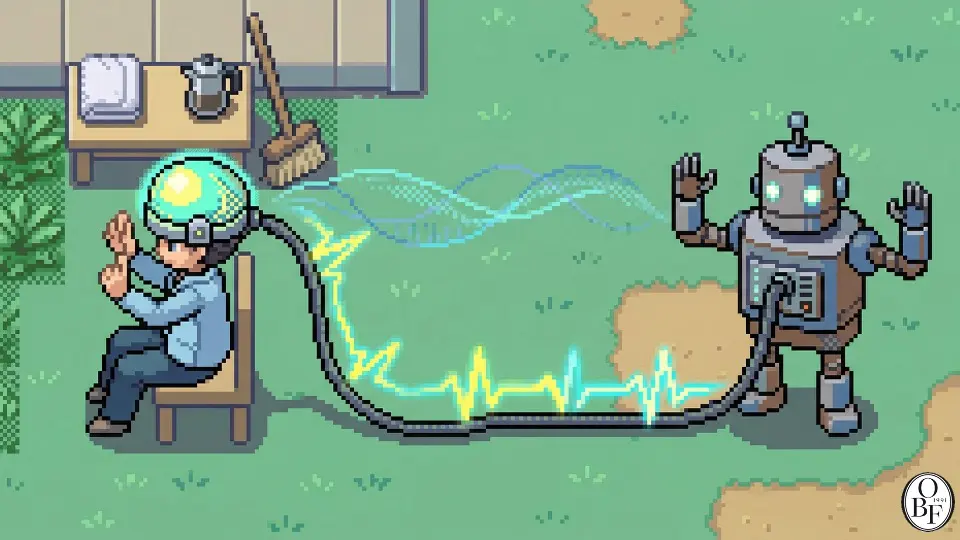
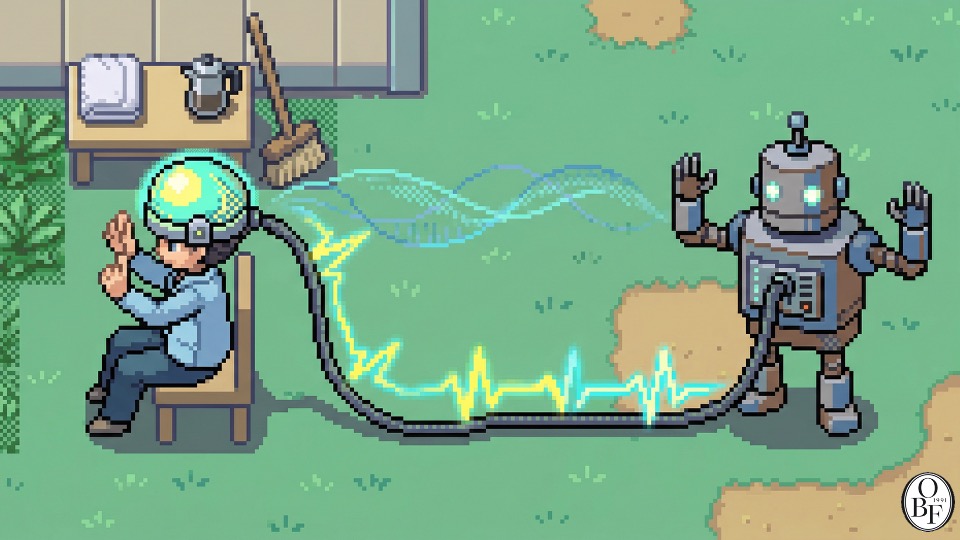
Dear reader, a fascinating scene recently came out of a research lab in China. Researchers fitted a brainwave-measuring helmet on people’s heads and recorded, in real time, the electrical signals coming from their brains as they folded laundry, picked up a coffee pot, and organized objects. Then they fed that data to a robot.
This is a completely different approach from the conventional method of “teaching robots the laws of physics.” Instead, it extracts a human veteran’s know-how itself as electrical signals and transplants it into a robot. Academically, this is called BCI (Brain-Computer Interface)1-based robot training.
But this raises a question. If this technology really works, what should we give the person who lent their brain? Today, let’s talk about the substance of this technology—and the uncomfortable questions it raises.
How Brainwaves Teach Robots
Let’s start with the scientific background. The core principle is more intuitive than you’d think.
When a person watches a robot’s actions and the robot makes a mistake, a specific electrical signal fires unconsciously in the brain. This is called ErrP (Error-Related Potential)2, a distinctive waveform that appears in the frontocentral region (near the forehead) about 200–400 milliseconds after the mistake is perceived. Put simply, it’s the brain unconsciously reacting, “ah, that’s wrong.”
Researchers discovered that this “brain wince” can be used as a reward signal for robot reinforcement learning3. Instead of a person manually inputting “correct/incorrect” for every action, the brain automatically provides feedback just by watching.
The foundational study in this field is a 2017 paper from Germany’s DFKI research institute, published in Scientific Reports. Using only error signals measured via EEG4, this team succeeded in getting a robot to learn gesture-action mapping, achieving 91% single-trial error detection accuracy.
In 2020, Akinola and colleagues at Columbia University took it a step further. They showed that as long as BCI feedback accuracy exceeds 60%, brain-signal-based learning performs comparably to a reward function manually designed by humans. In other words, a robot can learn just by being watched, without a person coding complex rules.
In 2023, Germany’s Fraunhofer Institute achieved an important practical breakthrough. They confirmed that meaningful learning effects still occur with dry EEG headsets, instead of the cumbersome wet electrodes that require gel. This opened up the possibility of moving beyond the lab and onto the factory floor.
Why China Is Racing Ahead
If this technology were confined to academic papers, it wouldn’t be newsletter material. What deserves attention is that China is going all-in on this field at the national level.
In August 2025, seven Chinese government ministries jointly released “Implementation Opinions on Promoting Innovative Development of the Brain-Computer Interface Industry.” The goal is core technology breakthroughs by 2027 and a globally competitive ecosystem by 2030. At the Shenzhen BCI Expo in December 2025, a brain science fund worth 11.6 billion yuan (~₩220 billion) was even launched.
China’s BCI market was worth roughly 3.2 billion yuan (~₩600 billion) as of 2024, with about 170 core companies. Of these, 82% focus on non-invasive methods (that don’t require opening the skull)—a different direction from Elon Musk’s Neuralink.
Actual demos keep emerging. Hangzhou-based Deep Robotics demonstrated on CCTV a scene of controlling a robot dog with an EEG helmet, and Shanghai-based Fourier Intelligence released footage of BCI control of its humanoid robot, GR-1. In October 2024, a joint research team from Australia, Hong Kong, and Beijing published the E2H (EEG-to-Humanoid) framework, collecting 23.6 hours of EEG data from 10 subjects and successfully controlling a humanoid robot’s full-body movements.
What catches my attention isn’t just the technical demos—it’s that China is trying to get ahead on standardization, too. China’s first BCI medical device standard (YY/T 1987-2025) takes effect on January 1, 2026, and Hubei province became the first local government to include BCI procedures in public health insurance reimbursement. They’re systematically laying down a pipeline from technology to standards to industrialization.
What If We Transplanted a Hyundai Veteran’s Skill into Atlas?
Now, let’s imagine something. Suppose there’s an assembly veteran with 30 years of experience at Hyundai Motor’s Ulsan plant. We put a brainwave-measuring helmet on this person and have them do their usual assembly work. What would happen if we trained Boston Dynamics’ Atlas on that brainwave data?
This isn’t pure fantasy. Hyundai Motor Group acquired an 80% stake in Boston Dynamics in 2021 for $1.1 billion (~₩1.5 trillion), and unveiled a mass-production electric Atlas at CES 2026. It’s a robot standing 189cm tall, with 56 degrees of freedom, IP67 dust/water resistance, 4 hours of continuous operation, and the ability to lift 50kg objects. At mass-production scale, the price comes to roughly ₩200 million—lower than two years of wages for a Korean manufacturing worker. And this robot can work 16 hours a day.
In August 2025, Boston Dynamics and the Toyota Research Institute demonstrated the LBM (Large Behavior Model). In this structure, once a single robot learns a skill—whether through teleoperation5 or autonomous practice—that skill gets replicated across the entire robot fleet. The know-how extracted from one veteran gets transplanted into thousands of robots simultaneously.
Hyundai is targeting mass production of 30,000 units by 2028. Boston Dynamics deployed over 500 units in 2025 alone, generating roughly $130 million in revenue, and its entire 2026 supply is already sold out.
Retire with ₩1 Billion vs. Guard Your Skill: The Compensation Equation
Here’s where an uncomfortable question emerges: what should we give that veteran?
In reality, in most cases, there’s no concrete compensation. But a few models are starting to emerge.
The most direct form is teleoperation wages. Companies like Weave Robotics in the US pay workers $25/hour (~₩35,000) to remotely operate robots and generate training data. But this is closer to compensation for simple labor than for the IP value of a skill.
At the platform level, much larger sums are changing hands. Reddit receives roughly $130 million a year (~₩180 billion) from Google and OpenAI for providing AI training data. But the individual users who actually wrote that content get ₩0. Stack Overflow struck a similar deal, and users who edited their own answers in protest were suspended instead.
The case where the compensation problem for AI training data has become most acute is Anthropic’s copyright lawsuit. Between 2021 and 2022, Anthropic downloaded over 7 million books from pirate sites to use for AI training. Books it purchased separately were unbound, scanned, and discarded. In June 2025, Judge William Alsup ruled that training AI on legally acquired works constitutes fair use, but that downloading pirated copies was clear infringement. The result: a $1.5 billion (~₩2.1 trillion) settlement—the largest copyright settlement in US history.
The only place to have built a systematic compensation framework is Hollywood. SAG-AFTRA (the US actors’ union) secured consent rights, pricing power, and residual payments for AI digital replicas in its 2025 agreement. For AI to train on an actor’s face and voice, the actor’s own consent is required, and the actor sets the price.
But there’s still no such framework for a factory worker’s brainwaves. If an offer came saying, “We’ll buy your 30 years of know-how for ₩1 billion,” would that be a win-win, or a betrayal?
Oz’s Lens
Honestly, I think the institutional vacuum here is more dangerous than the scientific feasibility of this technology.
BCI-based robot training clearly works. The papers prove it, and both China and the US are investing seriously. That said, the “2x improvement in learning efficiency” cited in some reports needs a more precise look. UC Berkeley’s HIL-SERL study showed a 2x improvement in success rate, but that was based on feedback from a physical joystick (SpaceMouse), not brain signals. Pure BCI studies report improvements in the 15–91% range. That’s a wide gap.
What I’m really focused on is Korea’s situation.
Korea’s total fertility rate is 0.75 (as of 2024)—the lowest in the world. Seoul’s is 0.58. The working-age population (ages 15–64) will fall from 37.38 million in 2020 to 24.19 million in 2050—a decline of 13 million. Bank of Korea Governor Rhee Chang-yong has called this a “national emergency.”
Faced with these numbers, “blocking robot adoption” isn’t realistic. The Korean government knows this too—in its 2024 “4th Basic Plan for Intelligent Robots,” it announced a goal of deploying 1 million advanced robots by 2030, with public-private investment exceeding ₩3 trillion.
But it’s a signal that can’t be ignored that Hyundai Motor’s union declared, right after CES 2026, “Not a single robot comes in without labor-management agreement.” In February 2026, the Korean Confederation of Trade Unions (KCTU) launched a monthly joint council with the Ministry of Employment and Labor—the first official channel through which Korea’s largest labor federation and the government regularly discuss AI/automation policy.
From my experience building go-to-market strategies, the success or failure of technology adoption is decided not by the technology itself but by stakeholder management. No matter how technically brilliant Boston Dynamics’ Atlas is, deploying it on the floor without workers’ consent can lead to resistance and sabotage. I think applying the “consent + compensation” framework SAG-AFTRA built to manufacturing may ultimately be the fastest path forward.
One more thing. This technology isn’t simply replacing jobs—it’s the first large-scale attempt to digitize human tacit knowledge. If the “feel” a 30-year veteran has can really be extracted via brainwaves, that’s not simple labor—it’s intellectual property. And intellectual property requires compensation.
Closing
To sum up:
First, training robots with human brainwaves isn’t science fiction. There’s academic evidence accumulated since 2017, and China is pushing this as a national strategy.
Second, the bigger bottleneck than the technology is the absence of a compensation system for “whose brainwaves are these.” Hollywood actors have a framework; factory workers don’t.
Third, for Korea, this isn’t a choice—it’s a matter of survival. An alternative is needed to fill a 13-million-person labor gap, but there’s still no answer for how to treat existing workers in the process.
If you’re curious about this topic, I recommend starting with the Akinola et al. (2020) paper in the references below. It’s the clearest explanation of the technical mechanism—how brain signals can substitute for a robot’s reward function.
📎 References & Further Reading
- Kim et al., “Intrinsic Interactive Reinforcement Learning – Using Error-Related Potentials for Real World Human-Robot Interaction”, Scientific Reports (Nature), 2017. : This paper laid the foundation for brainwave-based robot reinforcement learning. The key finding is 91% accuracy in online error detection.
- Akinola et al., “Accelerated Robot Learning via Human Brain Signals”, IEEE ICRA, 2020. : The key study showing that BCI feedback accuracy above 60% yields performance equivalent to manual reward functions.
- Vukelić et al., “Combining Brain-Computer Interfaces with Deep Reinforcement Learning for Robot Training”, Frontiers in Neuroergonomics, 2023. : A practicality validation showing meaningful results even with dry EEG.
- E2H Framework, “A Two-Stage Non-Invasive Neural Signal Driven Humanoid Robotic Whole-Body Control Framework”, arXiv, 2024. : A joint China-Australia-Hong Kong study. The latest framework connecting EEG to full-body humanoid robot movement.
- “Mind Meets Robots: A Review of EEG-Based Brain-Robot Interaction Systems”, International Journal of Human-Computer Interaction, 2025. : A comprehensive review analyzing 87 studies from 2018–2023.
- “Not a Single Robot Without Agreement: Hyundai Motor Union Gripped by Atlas Fear”, Seoul Economic Daily, 2026.1.22. : Essential for understanding the context of the conflict between Hyundai Motor’s union and Atlas’s introduction.

The author, Kwangseob Ahn, is a professor of business administration at Sejong University and lead consultant at OBF (Oswarld Boutique Consulting Firm). He teaches statistics and data analysis — business data management and business analytics — while leading GTM and AI strategy consulting in the field, designing the seam between technology and business. He has published academic research on a memory architecture for AI dialogue systems (HEMA) and runs Daily Arxiv, a daily curation of global AI papers. He holds a master’s from Korea University’s Graduate School of Technology Management and a KMBA. He is the author of Homo Brainless: The People Who Outsource Their Thinking.
Footnotes
-
BCI (Brain-Computer Interface): a technology that reads electrical signals from the brain to send commands to a computer or robot. There are non-invasive methods (attaching sensors to the head) and invasive methods (implanting a chip in the brain). ↩
-
ErrP (Error-Related Potential): an electrical signal that automatically arises in the brain when a person perceives a mistake. It can be detected with brainwave-measuring devices even if the person isn’t consciously aware of it. ↩
-
Reinforcement Learning: a method by which AI learns on its own through trial and error. It repeats a cycle of “reward for success, penalty for failure” to find the optimal action. AlphaGo is a representative example. ↩
-
EEG (Electroencephalography): a method of measuring the brain’s electrical activity by attaching electrodes to the scalp surface. It’s non-invasive—no need to open the skull—so it can be used both in labs and in the field. ↩
-
Teleoperation: a person remotely controlling a robot. Using a VR controller or joystick, they directly move the robot’s arms and legs to demonstrate a task, and that motion data is used for training. ↩
Related issues
 Issue #3AI & Tech
Robots at $5 an Hour: What Will Humans Do?
The question is shifting from how well robots perform to what humans do.
 Issue #11Business
Forget Monetization to Actually Make Money
Monetization isn't a starting point — it follows once you've actually built something of value.
 Issue #10Business
Your Strategy Document: Have You Tried Inverting It?
Real strategy isn't discarding the bad option—it's giving up one good option for another.
Your take shapes the next issue
What resonated most in this issue, or where has your experience been different?